Global AI workforce to create 133m new jobs by 2030, says minister

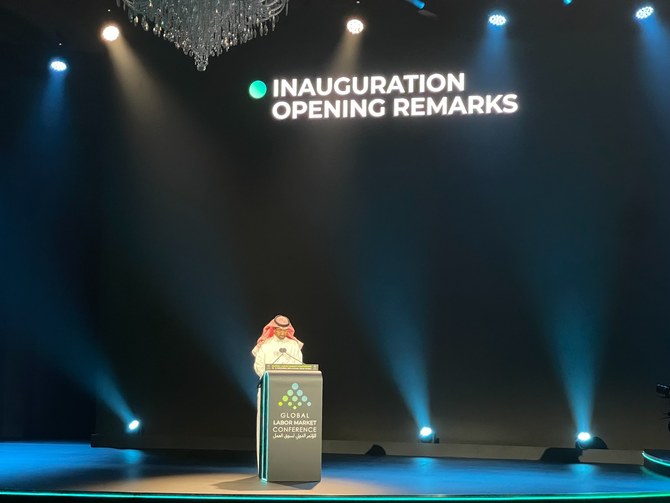
Speaking at the opening ceremony of the first Global Labor Market Conference, Saudi Human Resources and Social Development Minister Ahmed Al-Rajhi stressed the transformation the labor market is currently seeing is unlike anything that has ever happened before. AN Photo
Short Url
Updated 17 April 2024
Follow

Global AI workforce to create 133m new jobs by 2030, says minister

RIYADH: Global artificial intelligence labor market is expected to create new jobs by 2030, said Saudi Human Resources and Social Development Minister Ahmed Al-Rajhi.   

Speaking at the opening ceremony of the first Global Labor Market Conference held in Riyadh from Dec. 13-14, Al-Rajhi stressed the transformation the labor market is currently seeing is unlike anything that has ever happened before.    

“The growth of the global AI job market is expected to create 133 million new jobs from now until 2030,” said Al-Rajhi while pointing out the growing demand for new professions, skills and jobs in the future.    

He highlighted Saudi Arabia’s role in supporting international efforts to keep pace with changes in the global labor market, emphasizing the Kingdom’s diverse workforce and its aim to be a preferred destination for top talents globally.  

The minister affirmed Saudi Arabia’s commitment to creating private sector-led work environments to meet the needs of Saudis. 

Al-Rajhi advocated for creating work conditions free from exploitation or technological disruptions leading to abrupt job losses, while ensuring that new technologies are used to maximize value for the global economy.   

“Saudi Arabia is emerging not just as an international center of commerce but also as a leader in global sectors such as aviation, mining, tourism, and healthcare,” he said.  

Al-Rajhi added: “We are blessed with a young and highly educated population, and we want to ensure that everyone who works in Saudi Arabia has access to everything they need to realize their ambitions, whatever their individual talents and abilities. To achieve this goal, we want to work with friends throughout the world.”   

Additionally, he addressed the challenges from a supply chain perspective, emphasizing the necessity for greater adaptation to cope with increased geopolitical volatility, economic uncertainty, and rising inflation.  

“The factors that we consider today are not only incredibly complex but also dynamic,” Al-Rajhi said. 

Furthermore, the minister underscored the importance of the current phase in the global labor market, emphasizing the necessity of international cooperation, knowledge exchange, and experience sharing to address the rapid and unprecedented changes imposed by new work patterns, modern technologies, and geopolitical shifts.   

The conference, organized by the Ministry of Human Resources and Social Development, is being attended by over 6,000 participants from 40 countries.  

This diverse gathering includes ministers, government officials, and leaders. Additionally, heads of international and professional organizations and representatives from academic circles are also in attendance. 


Saudi Arabia set to attract $500bn in private investment, Al-Falih tells conference

Updated 09 December 2025
Follow

Saudi Arabia set to attract $500bn in private investment, Al-Falih tells conference

RIYADH: Sustainability, technology, and financial models were among the core topics discussed by financial leaders during the first day of the Momentum 2025 Development Finance Conference in Riyadh.

The three-day event features more than 100 speakers and over 20 exhibitors, with the central theme revolving around how development financial institutions can propel economic growth.

Speaking during a panel titled “The Sustainable Investment Opportunity,” Saudi Investment Minister Khalid Al-Falih elaborated on the significant investment progress made in the Kingdom.

“We estimate in the midterm of 2030 or maybe a couple of years more or so, about $1 trillion of infrastructure investment,” he said, adding: “We estimate, as a minimum, 40 percent of this infrastructure is going to be financed by the private sector, so we’re talking in the next few years $400 (billion) to $500 billion.”

The minister drew a correlation between the scale of investment needs and rising global energy demand, especially as artificial intelligence continues to evolve within data processing and digital infrastructure in global spheres.

“The world demand of energy is continuing to grow and is going to grow faster with the advent of the AI processing requirements (…) so our target of the electricity sector is 50 percent from renewables, and 50 percent from gas,” he added.

Al-Falih underscored the importance of AI as a key sector within Saudi Arabia’s development and investment strategy. He made note of the scale of capital expected to go into the sector in coming years, saying: “We have set a very aggressive, but we believe an achievable target, for AI, and we estimate in the short term about $30 billion immediately of investments.”

This emphasis on long-term investment and sustainability targets was echoed across panels at Momentum 2025, during which discussions on essential partnerships between public and private sectors were highlighted.

The shared ambition of translating the Kingdom’s goals into tangible outcomes was particularly essential within the banking sector, as it plays a central role in facilitating both projects and partnerships.

During the “Champions of Sectoral Transformation: Development Funds and Their Ecosystems” panel, Saudi National Bank CEO Tareq Al-Sadhan shed light on the importance of partnerships facilitated via financial institutions.

He explained how they help manage risk while supporting the Kingdom’s ambitions.

“We have different models that we are working on with development funds. We co-financed in certain projects where we see the risk is higher in terms of going alone as a bank to support a certain project,” the CEO said.

Al-Sadhan referred to the role of development funds as an enabler for banks to expand their participation and support for projects without assuming major risk.

“The role of the development fund definitely is to give more comfort to the banking sector to also extend the support … we don’t compete with each other; we always complement each other” he added.