

China’s Xi looks to strengthen Vietnam ties after Biden visit

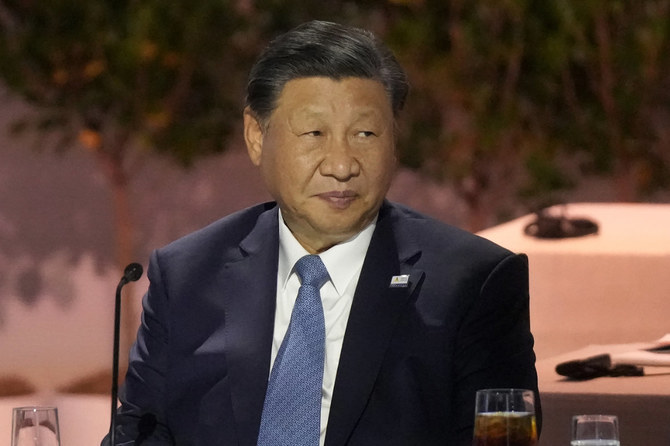
Chinese President Xi Jinping's visit comes hot on the heels of US President Joe Biden’s stopover in Hanoi in September, when he sought to shore up support against Beijing’s growing influence in the region. (AP)
Short Url
Updated 10 December 2023
Follow

China’s Xi looks to strengthen Vietnam ties after Biden visit

  • China and Vietnam have a border in common, as well as close economic ties and ruling communist parties, but Xi’s two-day trip will be his first visit to the country in six years
  • Like the United States, Vietnam has concerns about its neighbor’s growing assertiveness in the contested South China Se

HANOI: China’s President Xi Jinping will arrive in Vietnam on Tuesday on a mission to strengthen relations, just months after Washington and Hanoi upgraded their diplomatic ties.
China and Vietnam have a border in common, as well as close economic ties and ruling communist parties, but Xi’s two-day trip will be his first visit to the country in six years.
It comes hot on the heels of US President Joe Biden’s stopover in Hanoi in September, when he sought to shore up support against Beijing’s growing influence in the region.
“From China’s perspective, the visit is to emphasize that it has not lost Vietnam to the rival camp,” said Huong Le Thu, Deputy Director of the Asia Program at the International Crisis Group.
“For Vietnam, it represents its successful ‘bamboo diplomacy’, in which it is able to maneuver between the competing great powers without being forced to take one side over another,” she told AFP.
After an official welcome at the presidential palace on Tuesday, Xi will hold talks with Nguyen Phu Trong, the leader of Vietnam’s ruling communist party.
On Wednesday, there will be a wreath-laying ceremony at the mausoleum of revolutionary leader Ho Chi Minh, before Xi meets Vietnamese Prime Minister Pham Minh Chinh and President Vo Van Thuong.
Vietnam and China already share a comprehensive strategic partnership, Vietnam’s highest diplomatic status. Hanoi and Washington upgraded to that same level in September.
Chinese foreign ministry spokesman Wang Wenbin said that the visit would involve discussions on “bringing China-Vietnam relations to a higher position.”
Items on the agenda include “politics, security, practical cooperation, the formation of public opinion, multilateral issues and maritime issues,” said Wang.

Like the United States, Vietnam has concerns about its neighbor’s growing assertiveness in the contested South China Sea.
China upset several ASEAN members, including Hanoi, with its September 1 release of a new official map, showing sovereignty over almost the entire resource-rich waterway.
The issue of maritime borders is a sensitive issue for Hanoi, which in July banned the “Barbie” movie from being shown domestically due to a brief appearance of a map that included a depiction of the nine-dash line used in official Chinese maps of the region.
Political researcher Nguyen Khac Giang told AFP that Xi’s visit presented an opportunity for Beijing to draw Vietnam closer, possibly through invoking the Xi-era foreign policy concept of the ‘Community of Common Destiny’.
The loosely defined phrase refers to a vision of future cooperation on economic, security and political issues.
“While Vietnam may remain cautious about joining China-led political initiatives, we can expect to see further progress in economic cooperation, especially in infrastructure development and green energy transitions,” he said.
Vietnamese state-controlled media reported last month that China Rare Earth Group Co. was looking for opportunities to work together with Vietnam’s mining giant Vinacomin.
It comes after the United States and Vietnam in September agreed to cooperate to help Hanoi quantify and develop its rare earth resources.
The United States has said Vietnam — with the world’s second-largest deposits of rare earths after China — has a key role to play as it looks to source less from China after supply chain shocks rocked the global economy in recent years.


Homeless Muslims in southern Philippines observe Ramadan as month of trial

Updated 23 February 2026
Follow

Homeless Muslims in southern Philippines observe Ramadan as month of trial

  • Thousands lost their homes when parts of Bongao in Tawi-Tawi were burnt to ashes
  • Many trying to fully observe the fasting month say they are grateful to be alive

Manila: As Annalexis Abdulla Dabbang was looking forward to observing the month of Ramadan with her family, just days before it began they lost everything when an enormous fire tore through whole neighborhoods of their city in the southernmost province of the Philippines.

Bongao is the capital of Tawi-Tawi, an island province, forming part of the country’s Muslim minority heartland in the Bangsamoro region. The city experienced its worst fire in years in early February, when flames swept through the coastal community, leaving more than 5,000 people homeless.

“We were swimming for our lives. We had to swim to escape from the fire ... We swam in darkness, and (even) the sea was already hot because of the fire,” Dabbang, a 27-year-old teacher, told Arab News.

“Everything we owned was gone in just a few hours — our home, our memories, the things we worked hard for, everything turned to ashes.”

Trying to save their 2-year-old daughter and themselves, she and her husband left everything behind — as did hundreds of other families that together with them have since taken shelter at the Mindanao State University gymnasium — one of the evacuation centers.

Unable to secure a tent, Dabbang’s family has been sleeping on the bleachers, sharing a single mat as their bed. When Ramadan arrived a few days after they moved to the makeshift shelter, they welcomed it in a different, more solemn way. There is no family privacy for suhoor, no room or means to welcome guests for iftar.

“Ramadan feels different now. It’s painful but at the same time more real. When we lost our home, we began to understand what sacrifice really means. When you sleep in an evacuation center, you understand hunger, discomfort in a deeper way,” Dabbang said.

“We don’t prepare special dishes. We prepare our hearts.”

While she and thousands of others have lost everything they have ever owned, she has not lost her faith.

“Our dreams may have turned to ashes, but our prayers are still alive,” she said.

“This Ramadan my prayers are more emotional than ever. I pray for strength, not just for myself, but for my family and for every neighbor who also lost their family home. I pray for healing from the trauma of fire. I pray that Allah will replace what we lost with something better. I pray for the chance to rebuild not just our house, but our sense of security.”

Juraij Dayan Hussin, a volunteer helping the Bongao fire victims, observed that many of them were traumatized and the need to cleanse the heart and mind during Ramadan was what kept many of them going, because they are “thankful that even though they lost their property, they are still alive.”

But the religious observance related to the fasting month is not easy in a cramped shelter.

“It’s hard for Muslims to perform their prayers when they do not have their proper attire because they usually have specific clothes for prayer,” he said. “Sanitation in the area is also an issue ... when you fast and when you pray, cleanliness is essential.”

For Abdulkail Jani, who is staying at a basketball court with his brother and more than 70 other families, this Ramadan will be spent apart from their parents, whom they managed to move to relatives.

“The month of Ramadan this year is a month of trial ... there will be a huge change from how we observed Ramadan in the past, but we will adjust to it and try to comfort ourselves and our family. The most important thing is that we can perform the fasting,” he told Arab News.

“Despite our situation now, despite everything, as long as we’re alive, we will observe Ramadan. We’ll try to observe it well, without missing anything.”