

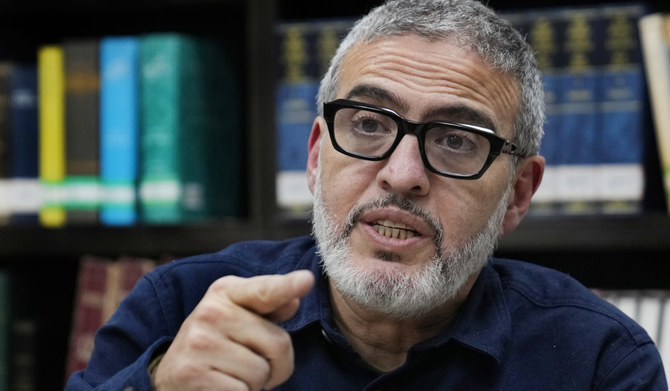

BEIRUT: A British Palestinian surgeon who spent weeks in the Gaza Strip during the current Israel-Hamas war as part of a Doctors Without Borders medical team said he has given testimony to a British war crimes investigation unit.
Ghassan Abu Sitta, a plastic surgeon specializing in conflict medicine, has volunteered with medical teams in multiple conflicts in Gaza, beginning as a medical student in the late 1980s during the the first Palestinian uprising. He has also worked in other conflict zones, including in Iraq, Syria and Yemen.
Abu Sitta crossed from Egypt into Gaza on Oct. 9, two days after the war began and remained in the besieged enclave for 43 days, working mainly in the Al-Ahli and Shifa hospitals in northern Gaza.
The war was triggered by a deadly Hamas-led incursion on Oct. 7 into southern Israel in which militants killed some 1,200 people, mostly civilians. Since then, Israel has launched a punishing air and ground campaign that has killed more than 17,700 people in Gaza, mostly women and children, according to the Health Ministry in the Hamas-controlled territory.
Abu Sitta told The Associated Press in an interview during a visit to the Institute for Palestine Studies in Beirut on Saturday that the intensity of other conflicts he experienced and the war in Gaza is like “the difference between a flood and a tsunami.” Apart from the staggering numbers of killed and injured, he said, the health system itself has been targeted and destroyed in Gaza.
“The worst thing was initially the running out of morphine and proper strong analgesics and then later on running out of anesthetic medication, which meant that you would have to do painful procedures with no anesthetic,” Abu Sitta said.
He said that when he returned to the UK, he was asked by the war crimes unit at the Metropolitan Police to give evidence in a possible war crimes investigation, and did so.
The police had issued a call for people returning from Israel or the Palestinian territories who “have witnessed or been a victim of terrorism, war crimes or crimes against humanity” to come forward.
Abu Sitta said much of his testimony related to attacks on health facilities.
He was working in Al-Ahli hospital in northern Gaza on Oct. 17 when a deadly blast struck the hospital’s courtyard, which had become a shelter for displaced people, killing hundreds. Israeli authorities, along with US and French intelligence agencies, have said the explosion was caused by a misfired Palestinian rocket.
Hamas maintained that it was an Israeli strike. Abu Sitta said many of the injuries he saw were more consistent with damage caused by an Israeli Hellfire missile which he said “disintegrates into shards of metal that cause amputations.”
The international group Human Rights Watch said the fragmentation pattern around the impact crater lacked the pattern typical of the Hellfire missile or others used by Israel.
Abu Sitta said while in Gaza he also treated patients who had burn wounds consistent with white phosphorus shelling, which he had also seen during the 2009 war.
Phosphorus shells cause a “chemical burn that ... bursts into the deep structures of the body rather than a thermal burn, which starts at the outside and (covers a) much larger surface area,” he said.
Human rights groups have alleged that Israeli forces have dropped shells containing white phosphorus on densely populated residential areas in Gaza and Lebanon during the ongoing Israel-Hamas war. Israel maintains it uses the incendiaries only as a smokescreen and not to target civilians.
Abu Sitta, who rotated between Al-Ahli and Shifa hospital, had left Shifa when Israeli forces encircled the hospital, eventually storming it in search of what they described as a Hamas command center. Israeli officials released visuals of an underground tunnel and rooms that they said were used by Hamas, but have not provided further evidence.
Abu Sitta, like other medical workers in the hospital, denied the allegations.
He said he had complete access to Shifa and there “was never, ever even any military presence.” He said policemen whose job was to control the crowds in front of the emergency department only carried truncheons.
The physician said he hopes the UK war crimes investigation will lead to prosecutions, locally or internationally.
The chief prosecutor of the International Criminal Court, Karim Khan, said after a visit to the West Bank and Israel last week that a probe by the court into possible crimes by both Hamas militants and Israeli forces is a priority for his office.


