

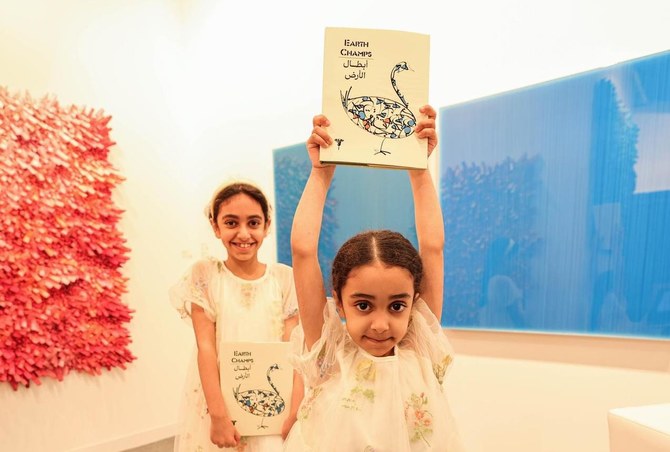
New book tackles climate change for children launched in English and Arabic

"Earth Champs" contains 44 diverse artworks made by youngsters aged 5-17 from around the globe. (Supplied)
Short Url
Updated 08 December 2023
Follow

New book tackles climate change for children launched in English and Arabic

RIYADH: How do young people feel about climate change? That question is being posed through a new children's picture book, published to coincide with the launch of the climate change conference COP28 in Dubai.  

The book, which is available in both English and Arabic, is called "Earth Champs," and it contains 44 diverse artworks made by youngsters aged 5-17 from around the globe.  

“We wanted to convey a message about an important cause, like climate change, through art. We wanted to see how children view climate change and we were surprised with the results," Lateefa Alnuaimi, the Emirati founder of LFE Art Culture, the institution that supported the book’s creation, told Arab News. "They know what it’s about, but they don’t how to express it, so we gave them a paper and a pen, and of course, they drew. Each young person expressed what's inside of them." 


The book is available in both English and Arabic. (Supplied)

To gather the work for the book, Alnuaimi put out an open call to international schools in Europe, Africa, and the Middle East. She received nearly 1,500 entries. The selected pieces range from sculpture to photography and drawing. They depict animals and plants, as well as environments that are in danger. There are elements of both hope and concern.  

“What shocked me was their way of thinking and how talented they are with the way they handle a paintbrush or a camera," Alnuaimi said. "They were professional, which indicates how educated they are."  

Alnuaimi also mentioned that today's generation of children are more aware of the urgency of climate change. 


To gather the work for the book, Alnuaimi put out an open call to international schools in Europe, Africa, and the Middle East. (Supplied)

“It was important to show people that children care about climate change. They’re not a silent voice — they 'spoke' about it through art,” she said.  

Thirty copies of the book have already been privately gifted to UAE ministers and sheikhs. After COP28 ends on Dec. 12, Alnuaimi hopes to make "Earth Champs" available to purchase online and in shops. “It’s a book from the UAE to the world,” she said.  

She also offered advice about how adults and educational institutions can encourage children in the region to look after the environment:  

"It's important to host workshops on climate change, educate students to properly use electricity, and partake in campaigns of cleaning the ocean and the desert," she said. 


Mini op-ed: Coffee, fasting and finding your rhythm this Ramadan

Updated 57 min 37 sec ago
Follow

Mini op-ed: Coffee, fasting and finding your rhythm this Ramadan

DUBAI: Ramadan is a month of reflection, balance and listening more closely to our bodies. It is also a time when everyday rituals, including coffee, naturally shift. Rather than giving it up completely, many people simply change how, when and what they drink. And that is where a little understanding can go a long way.

There is no single “right” way to enjoy coffee during Ramadan. Taste preferences, caffeine sensitivity, work schedules and sleep patterns are deeply personal. The key is finding what supports you during the fast.

Suhoor, the pre-dawn meal before fasting begins, is often where people think carefully about caffeine. Some find a small coffee helps them feel alert through the morning. Others prefer to avoid it so they can return to sleep more easily after the meal. How you metabolize caffeine plays a big role here, some people feel energized for hours, while others crash quickly or feel jittery.

Choosing a lower-caffeine option can help. Coffees made from 100 percent Arabica beans naturally contain less caffeine than Robusta, while still offering plenty of flavor and aroma.

Iftar, traditionally broken with water and dates, is usually followed by a light meal or soup. Coffee often comes later, once the body has rehydrated and blood sugar levels have stabilized. Enjoyed mindfully, it can be part of a beautiful evening ritual rather than a stimulant.

There is no single “right” way to enjoy coffee during Ramadan. Taste preferences, caffeine sensitivity, work schedules and sleep patterns are deeply personal. (Shutterstock) 

One of the most important things to remember during Ramadan is hydration. Coffee should never replace water, especially when fasting hours are long. Drinking enough water between iftar and suhoor helps reduce fatigue and headaches far more effectively than extra caffeine.

Added sugar in coffee can also cause blood sugar spikes, followed by dips in energy. If you enjoy sweetness, try reducing it slightly or pairing coffee with food to soften the impact.

If you are worried about caffeine withdrawal during Ramadan, decaffeinated coffee can be a very helpful bridge. High-quality decaf, such as coffee processed using the Swiss water method (which avoids chemical solvents), retains flavor while removing most of the caffeine.

Ramadan is not about restriction for restriction’s sake. It is about awareness, intention and care, including care for your own body. Coffee can absolutely remain part of that journey, as long as it’s enjoyed thoughtfully.

Whether you choose to drink less, switch origins, reduce caffeine or simply slow down and savor it more, the best coffee choice this Ramadan is the one that supports your rhythm, your rest and your well-being.

Here are a few RAW coffees that feel gentle, balanced and comforting during Ramadan:

RITUAL Blend
Created at the request of many customers from the Levant, this is our only blend that combines Arabica with a small amount of Robusta. The result is a bold, full body with very low acidity. Smooth and grounding, it works beautifully as espresso, Moka pot or Turkish coffee, and pairs well with milk.

Brazil — Serra Dos Ciganos (Single Origin)
A beautifully approachable coffee with tasting notes of roasted hazelnuts, nougat, baker’s chocolate and pear. Comforting and elegant, especially when brewed.

Guatemala — Pampojila Natural
Often chosen as a “breakfast coffee”, this is gently sweet with notes of brown sugar, nuts and orange, offering a medium body and soft fruit character.

Mexico — Mazateca
Another favourite for earlier in the day, with flavors of orange, malted barley and cacao, balanced, warm and easy to drink.

Kim Thompson is the founder and director of Culture & Brand at RAW Coffee Co.
