

Pakistan says Gaza war ‘alarming sign of apathy of the world’

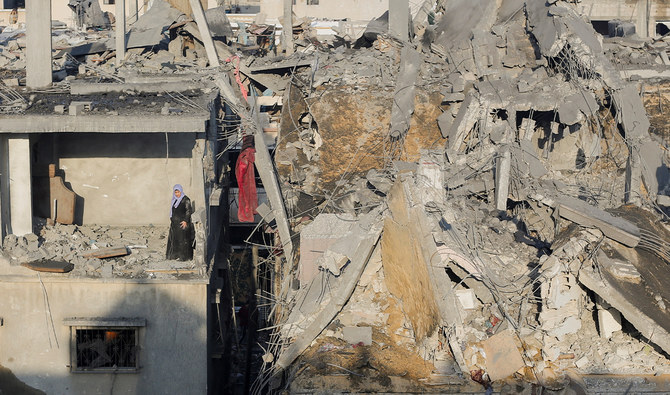
conflict between Israel and the Palestinian Islamist group Hamas, in Khan Younis in the southern Gaza Strip, on December 6, 2023. (REUTERS)
Short Url
Updated 06 December 2023
Follow

Pakistan says Gaza war ‘alarming sign of apathy of the world’

  • Israeli warplanes are bombarding targets across Gaza in one of the heaviest phases of fighting in two months
  • Gaza health ministry has confirmed over 15,800 dead and thousands missing, feared buried beneath rubble

ISLAMABAD: President Dr. Arif Alvi said on Wednesday the ongoing war in Gaza was an “alarming sign of the apathy of the world,” adding that the modern world needed an approach based on “love, empathy, and forgiveness.”

Israeli warplanes bombarded targets across the densely populated coastal territory on Wednesday in one of the heaviest phases of fighting in the two months since Israel began its military campaign in Gaza in October. Palestinian medics said hospitals were overflowing with the dead and wounded, many of them women and children, and supplies were running out. Hundreds of thousands of displaced people driven out of the north were seeking shelter in the dwindling number of places designated as safe areas by Israel. Gaza’s health ministry has confirmed over 15,800 dead and thousands missing, feared buried beneath the rubble, since the war began.

After largely gaining control of northern Gaza, Israeli troops and tanks pushed further south and encircled Khan Younis in the south after a week-long truce collapsed last week. 

“The civilized world today has forgotten the principles of morality and is witnessing the prevalence of wars waged by powerful against weaker segments,” Alvi said while addressing the inaugural session of the Islamabad Conclave 2023, themed, ‘Pakistan in a Changing World’ organized by the Institute of Strategic Studies Islamabad (ISSI).

“The situation in Gaza is an alarming sign of the apathy of the world which could not stop the massacre of innocent people including women and children.”

The president regretted that the “gruesome images” coming out of Gaza had failed to “awaken the world’s conscience.”

“The current world urgently requires an approach centered on love, empathy, and forgiveness,” he added.

Pakistan’s Special Representative to Afghanistan, Ambassador Asif Durrani, said the conflict between Hamas, which rules Gaza, and Israel had diverted global attention from war-torn Afghanistan, where over 95 percent of the population was living below the poverty line.

“For instance, humanitarian assistance promised last year was close to $4.2 billion and only one part of that has been committed and has actually been materialized,” Durrani said in his address at the conference.

Yara Mourad, Assistant Director of AUB Issam Fares Institute for Public Policy and International Affairs at the American University of Beirut, said the war by Israel had jeopardized growing stability in the Middle East.

“Following the reconciliation between Saudi Arabia and Iran and the establishment of relationships between the Kingdom and the United Arab Emirates with Qatar, this conflict, the most severe since Naqba [1948], has placed the region in greater danger than ever before,” she said.


Pakistan defense minister discusses regional, global developments with counterparts in Munich

Updated 5 sec ago
Follow

Pakistan defense minister discusses regional, global developments with counterparts in Munich

  • The high-powered meeting of government leaders, diplomats comes shortly before Russia’s war on Ukraine enters its fifth gruelling year
  • Bruised by President Donald Trump’s comments, European leaders at summit have pledged to shoulder more of the burden of shared defenses

ISLAMABAD: Pakistan’s Defense Minister Khawaja Asif on Friday met his Italian and Albanian counterparts to discuss bilateral cooperation and regional and global developments on the sidelines of the Munich Security Conference, the Pakistani embassy in Germany said.

The high-powered Munich meeting of government leaders, diplomats, defense and intelligence chiefs comes shortly before Russia’s full-scale war on Ukraine is set to enter its fifth gruelling year.

Bruised by President Donald Trump’s designs on Greenland and his often hostile comments about America’s traditional bedrock allies, European leaders at the conference have pledged to shoulder more of the burden of shared defenses.

Asif met his Italian counterpart Guido Crosetto during the conference, running from Feb. 13 till Feb. 15, with both sides agreeing to enhance bilateral ties, according to the Pakistani embassy.

“Asif met the Defense Minister of Republic of Albania, Mr. Pirro Vengu, on the sidelines of the 62nd Munich Security Conference,” the Pakistani embassy said on X.

“Discussed matters related to enhancing bilateral cooperation in the wake of recent regional and international developments.”

The development came as US Secretary of State Marco Rubio was set to address European leaders on Saturday as they try to step up their autonomy in defense while salvaging transatlantic ties badly strained under President Trump.

German Chancellor Friedrich Merz acknowledged a “rift” had opened up between Europe and the United States, fueled by culture wars, but issued an appeal to Washington: “Let’s repair and revive transatlantic trust together.”

“In the era of great power rivalry, even the United States will not be powerful enough to go it alone,” said the conservative leader, who has ramped up defense spending in the top EU economy.

Macron said a new framework was needed to deal with “an aggressive Russia” once the fighting in Ukraine ends.

Ukrainian President Volodymyr Zelensky, who has been in Munich since Friday and meeting multiple allies, was expected to address the meeting on Saturday. No Russian officials have been invited.

Kremlin critic Mikhail Khodorkovsky said he feared “a new cold war” between Europe and Russia in the coming decade, making reopening dialogue with Moscow essential.

“If it makes sense to talk, we are willing to talk,” said Merz, but he also charged that “Russia is not yet willing to talk seriously.”
