

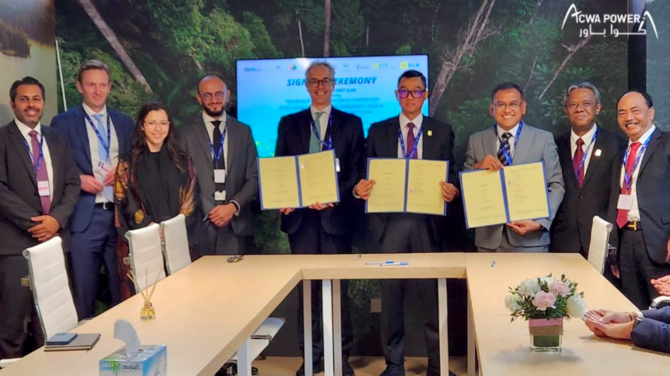

RIYADH: Indonesia is on course to develop its largest green hydrogen project yet, worth over $1 billion, thanks to Saudi Arabia’s energy firm ACWA Power.
The development, which was announced at COP28 in collaboration with Indonesian utilities company PT Perusahaan Listrik Negara, known as PLN, and chemicals entity PT Pupuk Indonesia, is projected to produce 150,000 tons of green ammonia annually, according to a statement.
Also referred to as Garuda Hidrogen Hijau, the project is expected to be powered by 600 megawatts of renewable energy.
This move is in line with ACWA Power’s global green hydrogen expansion endeavors, reinforcing the company’s commitment to a sustainable future.
In 2022, ACWA Power announced that it would work with Indonesia’s state-owned electricity provider to develop battery storage for renewable energy facilities and green hydrogen development in the Asian country.
The firm declared at the time that it had signed a memorandum of understanding with PLN at the B20/G20 Summit in Bali that coincided with the state visit of the Kingdom’s Crown Prince Mohammed Bin Salman to Indonesia.
According to the terms of that MoU, ACWA Power and PLN would jointly investigate several avenues of partnership, including a project study for pump storage for a 600-800 MW hydroelectricity facility, investigating the possibility of a 4 GW battery energy storage system and the development of a green hydrogen and ammonia facility powered by hydroelectricity.
Paddy Padmanathan, then-CEO and vice chairman of ACWA Power, said at the time: “As a nation that is fast-tracking economic growth, Indonesia is focused on advancing sustainable development through strategic partnerships.”
Indonesia’s National General Energy Plan states that 23 percent of the country’s power should be generated via renewable energy sources by 2025.
ACWA Power’s vision is to ensure the ingenuity and entrepreneurship of the private sector and make electricity and desalinated water available reliably and responsibly to support the social development and economic growth of nations.
To achieve this, the firm’s mission is to deliver power and desalinated water at low cost.


