Egypt’s FM heads to US for talks with top officials

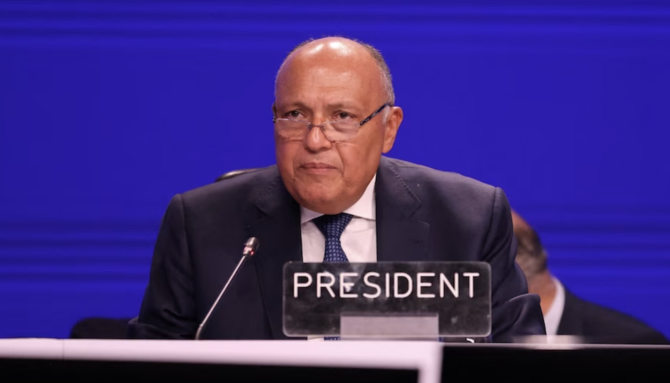
Egyptian Foreign Minister Sameh Shoukry traveled to the US on Tuesday to meet House of Representatives and Senate members in Washington. (Reuters/File Photo)
Short Url
Updated 05 December 2023
Follow

Egypt’s FM heads to US for talks with top officials

  • Shoukry will meet Congress foreign policy committee officials with the aim of advancing and strengthening strategic relations
  • Visit will also include talks with a number of American think tanks and research centers

CAIRO: Egyptian Foreign Minister Sameh Shoukry traveled to the US on Tuesday to meet House of Representatives and Senate members in Washington.

Shoukry will meet Congress foreign policy committee officials with the aim of advancing and strengthening strategic relations, according to Egyptian Foreign Ministry spokesman Ahmed Abu Zeid.

The visit will also include talks with a number of American think tanks and research centers, in addition to media engagements, he said.

Abu Zeid said that Shoukry will also join an Arab-Islamic ministerial committee meeting on Dec. 7.

The committee will hold meetings with the US secretary of state, a number of Congress members and the US media in an effort to stop the war in Gaza, in line with the mandate issued by the recent Arab-Islamic Extraordinary Summit.

Meanwhile, Shoukry affirmed Egypt’s categorical rejection of attempts to force Palestinians out of Gaza.

The foreign minister made the remarks during a phone call with Colombian counterpart Alvaro Leyva.

Shoukry and Leyva discussed the deteriorating security and humanitarian situation in the Gaza Strip, the necessity of an immediate ceasefire and the opportunity to establish humanitarian truces to bring in aid.


’Not much is standing’ in Gaza, says UN official

Updated 4 sec ago
Follow

’Not much is standing’ in Gaza, says UN official

  • “We can’t wait, we can’t procrastinate,” da Silva said, adding that Gazans across the territory were living in an “inhumane situation“
  • He said the launch of phase two of the Gaza truce plan marked a “historical” moment

JERUSALEM: A top United Nations official on Thursday called for accelerating reconstruction work in Gaza, saying Palestinians there were living in “inhumane” conditions, even as a US-backed truce entered its second phase.
“I wouldn’t have imagined what I saw today, which is total destruction, not much is standing,” Jorge Moreira da Silva, head of UN Office for Project Services (UNOPS) told journalists after a visit to the Gaza Strip.
“We can’t wait, we can’t procrastinate,” he said, adding that Gazans across the territory were living in an “inhumane situation.”
The two-year war between Hamas and Israeli forces has left Gaza facing destruction on a scale unseen in previous conflicts, with vast swathes reduced to rubble.
Entire residential neighborhoods, hospitals, schools and basic infrastructure have been heavily damaged or destroyed, forcing hundreds of thousands of people to live in makeshift shelters.
Da Silva said the launch of phase two of the Gaza truce plan marked a “historical” moment that should be seized to kick-start reconstruction efforts.
“This opens the opportunities for reconstruction, knowing that we will need $52 billion, according to the assessment conducted by the World Bank, UN and the European Commission, for the reconstruction of Gaza,” he said.
“But the point is we can’t wait for the big reconstruction, which requires billions, to immediately launch the early recovery that requires millions.”
On Wednesday, US Middle East envoy Steve Witkoff announced the start of phase two of the Gaza ceasefire, saying it aimed to pave the way for reconstruction and the demilitarization of all armed factions in the territory.
The war was triggered by the Palestinian Islamist group’s unprecedented attack on Israel on October 7, 2023.
The ensuing Israeli offensive has devastated Gaza, home to about 2.2 million people, a territory that was already suffering severely from previous rounds of fighting and from an Israeli blockade imposed since 2007.
Da Silva said the war had left about 60 million tons of rubble scattered across the strip.
“Gaza is flooded by rubble and debris,” he said.
“The problem is not just the volume of rubble, it’s also the fact that its content is quite a matter of concern, with unexploded ordnance in the rubble, dangerous waste, and unfortunately also human remains.”
The environmental and urban planning specialist said one of the most urgent priorities was ensuring reliable access to fuel — a critical resource in Gaza, where most electricity is generated by fuel-powered generators.
He also cited the need for demining, rebuilding water supply networks, lifting restrictions on the entry of aid, and allowing in spare parts required for repairs — long-standing demands by humanitarian organizations operating in Gaza.
Aid groups have for months complained of difficulties bringing in equipment and supplies, blaming Israeli restrictions.
Israel rejects those accusations, saying it oversees the entry of goods into Gaza to ensure its security.