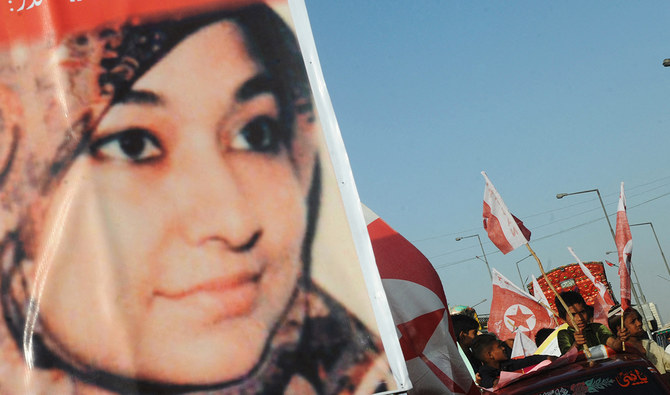

ISLAMABAD: Ailing Pakistani neuroscientist Aafia Siddiqui, who has been jailed in the United States (US) after being convicted of attacking US troops in Afghanistan, has been "raped" inside a US prison, her lawyer said on Tuesday.
Siddiqui, a 49-year-old mother of three, is currently serving an 86-year sentence at the Federal Medical Center (FMC) in Carswell, Texas after a New York court convicted her in 2010 of attempting to shoot and kill a group of US soldiers and FBI agents in Afghanistan who wanted to interrogate her for alleged links to Al-Qaeda.
Her sentencing by a US court has riled many in Pakistan, including former and current Pakistani governments that had campaigned for her release and paid for her legal defense.
Siddiqui's lawyer, Clive Stafford Smith, on Tuesday made shocking disclosures about mistreatment of Siddiqui, a day after his meeting with the Pakistani scientist at FMC Carswell.
"She has been raped in FMC Carswell, no question about it," Smith, a US-based human rights lawyer who is representing Siddiqui, said in an interview to a Pakistani broadcaster.
"Well, I mean, at least two times is a formal thing by guards, but in terms of abuse by the guards and prisoners, countless times."
As an American, Smith said, he was "ashamed of" what the US prison system had done to Siddiqui.
"I have filed a report on her abuse and what they have been doing to her is pretty unspeakable in terms of the sexual mistreatment," he said. "She has told me in great detail about how she has been abused."
Smith said Siddiqui's complaints were all "extreme" and "true," and that she had been meted out the "harshest" treatment by the US prison authorities.
"There are 10,250 women in the [US] federal prison system," the lawyer said. "The woman who has been treated the harshest of all those 10,250 is Aafia Siddiqui."
Siddiqui, who is reportedly ailing, earned advanced degrees from Brandeis University and the Massachusetts Institute of Technology before she was sentenced for assaulting US soldiers after being detained in Afghanistan two years earlier.
Her punishment sparked outrage in Pakistan among political leaders and her supporters, who viewed her as a victim of the US criminal justice system.
In the years since, Pakistani officials have publicly expressed interest in any sort of deal or swap that could result in her release from US custody, and her case has continued to draw attention from supporters.
The government of Nawaz Sharif, three-time former prime minister of Pakistan, as well as the outgoing Pakistani administration of his younger brother, Shehbaz Sharif, have made efforts for Siddiqui’s release during their tenure.
In March this year, the younger Sharif instructed Pakistan’s foreign ministry to remain engaged with the US government and the country’s mission in Washington for the release of jailed Pakistani neuroscientist, following his meeting with Siddiqui's sister, Dr. Fowzia Siddiqui.
Smith said he had apprised the Pakistani government of Siddiqui's abuse and was certainly going to let Pakistani authorities know of the "gruesome details."
He, however, said it was the duty of the Pakistani government to protect her from the abuse.
"That's her government, it is their duty to protect her," he said. "I will do what I can, I am an American, I apologize for what has happened to her. But it is actually, ultimately the job of the government in Pakistan."