

WHO says it was told by Israeli military to leave southern Gaza warehouse within 24 hours

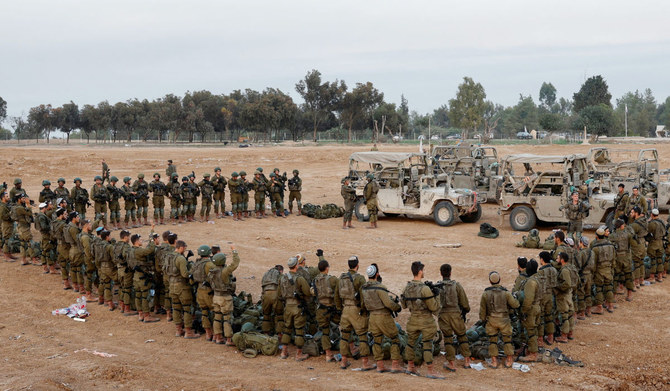
Israeli soldiers stand in order, amid the ongoing conflict between Israel and the Palestinian Islamist group Hamas, near Israel's border with Gaza, in southern Israel, December 4, 2023. (REUTERS)
Short Url
Updated 05 December 2023
Follow

WHO says it was told by Israeli military to leave southern Gaza warehouse within 24 hours

  • Israel killed 15,900 people, mostly women and children, according to the health ministry in Hamas-run Gaza
  • Twelve hospitals still remain operational in the south part of the Gaza Strip, according to the WHO

GENEVA: WHO chief Tedros Adhanom Ghebreyesus said Monday that the Israeli army had told the UN health agency to empty an aid warehouse in southern Gaza before ground operations in the area made it unusable.
“Today, WHO received notification from the Israel Defense Forces that we should remove our supplies from our medical warehouse in southern Gaza within 24 hours, as ground operations will put it beyond use,” Tedros wrote on X, formerly Twitter.
“We appeal to Israel to withdraw the order, and take every possible measure to protect civilians and civilian infrastructure, including hospitals and humanitarian facilities,” he wrote.
Hamas militants from Gaza launched an unprecedented attack on southern Israel on October 7, killing about 1,200 people, mostly civilians, and taking around 240 hostages, according to Israeli officials.
In response, Israel vowed to destroy Hamas and has conducted a relentless air, artillery and naval bombardment alongside a ground offensive, killing around 15,900 people, mostly women and children, according to the health ministry in Hamas-run Gaza.
Israel’s army on Monday sent dozens of tanks into southern Gaza as part of expanded action against Hamas, as communications was cut across the besieged territory.
The number of operational hospitals in Gaza has dropped from 36 to 18 in less than 60 days, according to the WHO, with three providing only basic first aid and others offering partial services.
Twelve hospitals still remain operational in the south part of the Gaza Strip, according to the WHO.
At a press conference earlier on Monday, the WHO regional director for the eastern Mediterranean, Ahmed Al-Mandhari, said the intensification of military ground operations in southern Gaza risked depriving thousands of people of health care.
“We saw what happened in the north of Gaza. This cannot serve as a model for the south,” he said.


WHO warns of health risks from ‘black rain’ in Iran

Updated 11 sec ago
Follow

WHO warns of health risks from ‘black rain’ in Iran

  • “The black rain and the acidic rain ​coming with it is indeed a danger for ​the population, respiratory mainly,” WHO spokesperson Christian Lindmeier told a press ‌briefing in Geneva, adding that Iran had advised people to stay indoors

GENEVA: The World Health Organization warned on Tuesday that the “black rain” falling in Iran ​after strikes on oil facilities could cause respiratory ‌problems, and it backed Iran’s advisory urging people to remain indoors.
The UN health agency, which has an office in ​Iran and works with authorities on health emergencies, ​said it has received multiple reports of oil-laden ⁠rain this week. 

HIGHLIGHT

Tehran was choked in black ​smoke on Monday after an oil refinery was hit, ​in an escalation in strikes on Iran’s domestic energy supplies as part of the US-Israeli campaign.

Tehran was choked in black ​smoke on Monday after an oil refinery was hit, ​in an escalation in strikes on Iran’s domestic energy supplies as part of the US-Israeli campaign.
“The black rain and the acidic rain ​coming with it is indeed a danger for ​the population, respiratory mainly,” WHO spokesperson Christian Lindmeier told a press ‌briefing in Geneva, adding that Iran had advised people to stay indoors.
Asked whether the WHO backed that advice, he said: “Given what is at risk right now, the ​oil storage facilities, ​the refineries that have been struck, triggering fires, bringing serious air quality concerns, that is ​definitely a good idea.”
One video sent to ​Reuters by a WHO staff member showed what they said was a cleaner mopping up black liquid at its office entrance ​in Tehran on March 8. ​