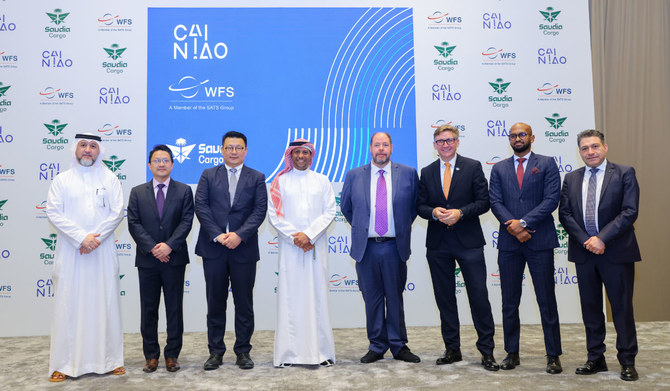
Saudia Cargo, Cainiao, and WFS partner to boost global logistics

Saudia Cargo, Cainiao, and Worldwide Flight Services will increase their collaboration to optimize the efficiency of global logistics operations.
Short Url
Updated 05 December 2023
Follow

Saudia Cargo, Cainiao, and WFS partner to boost global logistics

With the growth of online shopping on a global scale, the need for efficient and innovative e-commerce logistics solutions is paramount. In response, Saudia Cargo, Cainiao, and Worldwide Flight Services — a member of the SATS Group — have announced that the three parties will reinforce and increase their collaboration with an aim to optimize the efficiency of global logistics operations.
This collaboration strengthens their existing relationship, focusing on optimizing logistics processes by streamlining operations and adopting logistics innovations.
A key component of this collaboration is the establishment of a dedicated area in the air cargo station of Cainiao Liege eHub in Belgium, the company’s European regional hub. WFS/SATS, in close collaboration with Cainiao, operates in the air cargo station.

FASTFACT

A key component of this collaboration is the establishment of a dedicated area in the air cargo station of Cainiao Liege eHub in Belgium.

This initiative responds directly to the escalating demand for high-quality logistics operations in the cross-border e-commerce sector, particularly in the Middle East and European markets. Earlier this year, Cainiao unveiled its international express shipping service, Global 5-Day Delivery, in collaboration with AliExpress, now available in the UK, Spain, the Netherlands, Belgium, and South Korea.
Saudia Cargo and Cainiao boast a robust collaboration, with a history that spans several years. The latest agreement reinforces this long-standing relationship by giving precedence to specific Saudia Cargo freighter flights originating from Hong Kong and bound for Riyadh and Liege.
Additionally, the contract extension to WFS/SATS for handling more than 50,000 tons annually on flights connecting Liege and Riyadh underscores Saudia Cargo’s commitment to operational excellence and reliable logistics services.


Teddy Zebitz, CEO of Saudia Cargo

Teddy Zebitz, CEO of Saudia Cargo, said: “Our collaboration with Cainiao and WFS/SATS represents a natural evolution of our strong collaborations. By building on our existing commitments, we are poised to redefine the industry landscape, offering innovative and customer-centric solutions. Our collaboration ensures a seamless flow of e-commerce materials from Hong Kong to Liege. With high frequency flights on our Hong Kong to Liege via Riyadh route, we have a significant capacity exclusively dedicated to Cainiao. Utilizing a meticulous process involving pre-built ULDs, we facilitate an uninterrupted supply chain, supporting Cainiao in achieving their key performance indicators.”

We anticipate expanding our e-commerce network in Asia and Europe to meet evolving industry demands and customer logistics needs.

Teddy Zebitz, CEO of Saudia Cargo

He added: “This collaboration significantly strengthens our e-commerce operations, positioning us as a trusted industry provider. We anticipate expanding our e-commerce network in Asia and Europe to meet evolving industry demands and customer logistics needs.”
Eric Xu, vice president of Cainiao Group, said: “Cainiao is committed to transforming the logistics industry through continuous innovation to enable a seamless e-commerce experience and we are delighted to find close partners like Saudia Cargo and WFS/SATS on this path. Through continuously equipping our Liege eHub with cutting-edge technology solutions, we managed to boost the efficiency of logistics operations while improving customer experience through greater transparency and traceability. We are confident that this win-win collaboration will further reinforce Cainiao’s position as the world’s leading cross-border e-commerce logistics provider by offering the valued customers of us three companies with enhanced experience.”
John Batten, chief executive, Europe, Middle East, Africa and Asia, WFS, said: “E-commerce is extremely important to WFS/SATS, our customers, our industry, and, of course, consumers, but up to now, it has been processed within a traditional air cargo handling environment. With the growth projections for e-commerce, the industry response must be more dynamic and tailored, and this is what WFS/SATS aims to deliver in Liege working alongside Saudia Cargo and Cainiao. This three-party collaboration leverages operational excellence skills and requirements from the airline, cargo handler, and e-commerce logistics perspectives, and will exemplify our commitment to innovation, speed, and real-time information for the future of the e-commerce logistics ecosystem.”
Inaugurating on March 1, 2024, the strategic collaboration between Saudia Cargo, Cainiao, and WFS/SATS aims to make a transformative leap in global logistics and to set a new benchmark, which propels cross-border logistics into a new era, driven by efficiency and innovation.



Kuwait Fund for Development: Six decades of humanitarian and developmental impact across globe

Updated 22 January 2026
Follow

Kuwait Fund for Development: Six decades of humanitarian and developmental impact across globe

On Dec. 31, the Kuwait Fund for Development marks the anniversary of its establishment, opening a new chapter of success and ambition as one of the most prominent pioneers of development on both regional and global levels. Founded in 1961, the fund became the first and oldest development institution to operate in Arab countries and other developing nations.

Today, after more than six decades of continuous work, the Kuwait Fund for Development remains steadfast in its mission and has never ceased its efforts to support development causes in developing countries. As it celebrates its 64th anniversary, the fund has drawn a national portrait under the theme “Partners in Development,” reflected through its projects spread across the globe, all of which aim to build brighter and more sustainable future.

An external development arm

The establishment of the Kuwait Fund for Development embodied a wise and visionary decision by the leadership of Kuwait at the time. Kuwait was the only developing country that chose to share the challenges of development with other developing nations, cooperating with them through the provision of concessional loans, grants, financial assistance, and technical support tailored to their development priorities.

Since its inception, the Kuwait Fund for Development has served as Kuwait’s external development arm, sparing no effort in supporting development causes and extending assistance to developing countries worldwide.

Vision and early beginnings

In the early 1960s, the late Amir Sheikh Jaber Al-Ahmad Al-Sabah, then head of the financial department, proposed the idea of establishing a development entity that would serve Kuwait’s foreign policy and assist Arab and other developing countries in achieving development across various sectors. The idea received strong support from the late Amir Sheikh Abdullah Al-Salem Al-Sabah, as it aligned with Kuwait’s vision at the time to build a modern state.

Consequently, an Amiri decree was issued on Dec. 31, 1961, establishing the Kuwait Fund for Development with an initial capital of 50 million Kuwaiti dinars ($162.6 million).

Global reach and development impact

The fund’s activities have extended to all corners of the world, contributing to the financing of projects in 106 countries, including 16 Arab countries, 41 African countries, 19 in East and South Asia and the Pacific, 17 in Central Asia and Europe, and 12 in Latin America and the Caribbean.

This support was delivered through 1,037 concessional loans provided to the governments of these countries, with a total value of approximately 7 billion Kuwaiti dinars. In addition, the fund has provided grants and technical assistance to support a wide range of development services, helping beneficiary countries implement their development programs. A total of 420 grants and technical assistance operations were extended, amounting to approximately 401 million Kuwaiti dinars.

Loan agreements

During the past year, the Kuwait Fund for Development signed several loan agreements supporting development across different regions of the world. Among these were two loan agreements with the government of Bahrain. The first loan, valued at 31.25 million Kuwaiti dinars, contributed to financing the Electricity Transmission Networks Development Project. The second loan, valued at 10 million Kuwaiti dinars, supported the Sheikh Jaber Al-Ahmad Al-Sabah Highway Development Project (Phase II).

On the sidelines of the World Bank Group meetings held in Washington, D.C., the fund has also signed a 4 million Kuwaiti dinar-worth loan agreement with Saint Lucia to help finance the Sir Julian R. Hunte Highway Project, as well as another 4 million Kuwaiti dinar-worth loan agreement with Belize to support the George Price Highway Project.

Supporting and assisting refugees

The Kuwait Fund for Development’s contributions to humanitarian action stand out at both regional and international levels. Since its establishment, the fund has represented a unique model in supporting and assisting refugees in countries affected by disasters, conflicts, and wars, in line with Kuwait’s moderate and balanced policy.

These efforts have helped strengthen Kuwait’s relations with Arab and international partners. The fund has played a significant role in the reconstruction of Lebanon and Iraq following periods of crisis, and its assistance to the Palestinian people has never ceased.

International Participation

Over the past year, the Kuwait Fund for Development recorded notable participations in major international forums. These included taking part in the 2025 annual meetings of the World Bank Group and the International Monetary Fund in Washington, D.C., with a delegation headed by the fund’s Acting Director General Walid Shamlan Al-Bahar. The fund also took part in the Tokyo International Conference on African Development, held in Tokyo, Japan.

Additional international engagements included participation in the Third UN Conference on Landlocked Developing Countries, held in Awaza, Turkmenistan, and the Fourth International Conference on Financing for Development, organized by the UN in Seville, Spain.