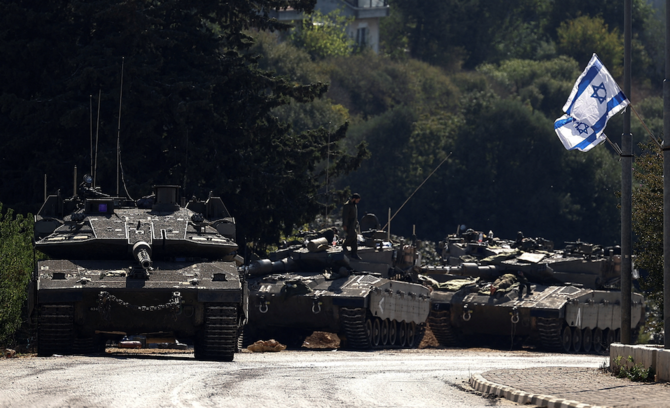

BEIRUT: Hostilities escalated on Monday on the southern front of Lebanon between Hezbollah and the Israeli army.
A preliminary report said that a Syrian national was injured as a result of Israeli shelling targeting the Al-Wazzani border village. Avichay Adraee, the Israeli army spokesperson, said that “three soldiers were slightly injured” after Hezbollah had targeted the Israeli military outpost of Shtula.
In parallel with the mounting confrontations in the Gaza Strip, Hezbollah launched 20 missiles from southern Lebanon toward the Western Galilee, between the Shomera and Mattat settlements. The Israeli army said that “the missiles landed in open areas and that its air force targeted military infrastructure for Hezbollah in southern Lebanon.”
Speaking on behalf of Hezbollah, Nabil Kaouk, a member of the group’s central council, said: “We will harshly respond to any attack against civilians in the south, and we will not let any attack against any civilian in Lebanon pass without a harsh and severe response.”
Kaouk revealed that during the truce “pressure was exerted on Hezbollah to avoid a new confrontation, as they want Israel to wage war on Gaza without the support of southern Lebanon.”
He claimed that Israel “is unable to win in Gaza or in south Lebanon, and cannot protect its settlers and ships in the Gulf and Red Sea.”
He added: “Israel is incapable of rescuing the hostages, as they were freed through negotiation only.”
According to Hezbollah’s statements, the militant group’s hostilities on the southern border had targeted on Monday morning “a gathering of the Israeli occupation soldiers in the Shtula Forest, the Al-Raheb outpost, the Al-Baghdadi outpost, and the Rowaysat Al-Alam outpost in the Kfarchouba Hills and the Shebaa Farms.”
The Israeli army activated the Iron Dome after a series of missiles were launched from the central part of southern Lebanon toward Israeli outposts.
Israel’s Channel 12 announced that “an anti-armor missile was launched toward the Misgav Am region in the Upper Galilee and that three soldiers were slightly injured after rockets were fired.”
Israeli ground and air shelling targeted the outskirts of southern villages including Naqoura, Aayta Al-Shaab, Labbouneh, Odaisseh, Kfarkila and Kfarchouba, using burning phosphorus missiles.
Israeli reconnaissance planes were seen flying at low altitude over the western and central parts of southern Lebanon, namely Naqoura, Alma Al-Shaab, Marwahin and Al-Dahira. They also reached the southern border villages of Aayta Al-Shaab, Rmaych and Yaroun. More Israeli reconnaissance planes were also seen over Rachaya and the eastern slopes of the Al-Sheikh Mountain, reaching Deir Al-Ashayer on the Lebanese–Syrian borders. They were also spotted hovering over Tripoli in northern Lebanon on Sunday.
On Sunday, Hezbollah targeted the Israeli Beit Hillel military outpost with guided missiles, directly hitting an M113 personnel carrier and injuring 11 members of the outpost.
A security source commented on Hezbollah’s attack, saying: “This escalation demonstrates Hezbollah’s capability to move more freely along the southern border.”
The source added: “Hezbollah is now capable of targeting deeper spots in Israel rather than hitting border areas. It is also using guided missiles increasingly.”
Sheikh Naim Kassem, Hezbollah’s deputy leader, said on Sunday that the group “is convinced that it will defeat Israel, and we are not in a rush to do so.”
Meanwhile, the Lebanese branch of Hamas announced on Monday “the establishment and launching of the Vanguards of Al-Aqsa Flood.”
It called on “young people and men in Lebanon and Palestine to join this movement to resist the occupation force through available and legitimate means, as a way to support the steadfastness and resistance of our Palestinian people.”
At the beginning of the confrontation in October, many Lebanese and Palestinian groups took part in the hostilities taking place on the Lebanese border, through armed members from the Al-Fajr forces — the military wing of the Islamic group — as well as through the military wings of Hamas and the Islamic Jihad. These groups, however, have retreated, leaving Hezbollah alone to fight from the Lebanese border.
The Sayydet Al-Jabal gathering, which opposes Hezbollah, said in a statement on Monday that “Lebanon doesn’t want to enter a new war decided by someone else.”
The party, which includes a number of politicians and public activists, believes that Hezbollah has two options: “Either it returns to Lebanon and abides by the Lebanese terms — which are the terms stipulated in the Constitution, the Taif Agreement, and the resolutions of international legitimacy 1559, 1701, and 1680 — or it remains a representative of Iran until the latter abandons it the moment it faces a real threat, similar to what it did to Hamas in the last Gaza war.”