

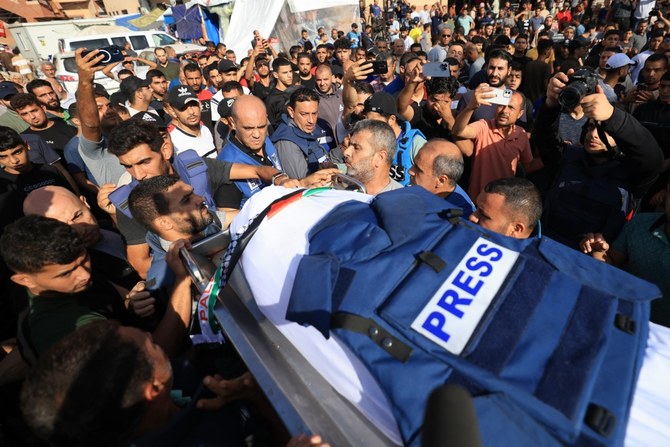
Journalist death toll in Israel-Hamas conflicts reaches 63, media watchdog confirms

On Monday, Israeli tanks were reported to have opened fire on journalists and photographers in Gaza. (AFP/File)
Short Url
Updated 05 December 2023
Follow

Journalist death toll in Israel-Hamas conflicts reaches 63, media watchdog confirms

  • Month of conflict represents deadliest for journalists since reports began 30 years ago
  • Israel authorities said they cannot guarantee safety of media workers in Gaza

LONDON: The toll on journalists amid the Israel-Hamas conflict has reached a grim milestone, with at least 63 media professionals confirmed dead, according to a report by the Committee to Protect Journalists on Monday.

The breakdown of casualties includes 56 Palestinian journalists, 4 Israeli journalists, and 3 Lebanese media workers, marking the deadliest month for journalists since the CPJ began documenting fatalities in 1992.

In addition, 11 journalists were also reported injured, 3 missing, and 19 arrested.

“As of December 4, CPJ’s investigations showed at least 63 journalists and media workers were among more than 16,000 killed since the war began on October 7,” CPJ wrote in a blog post.

It added: “This deadly toll is coupled with harassment, detentions, and other reporting obstructions in Gaza, the West Bank, Israel, and beyond.”

The organization has been investigating and independently verified all reports of journalists and media workers killed since Oct. 7.

CPJ said that it was also investigating unconfirmed reports of other journalists killed, missing, detained, hurt or threatened, and of damage to media offices and journalists’ homes.

Sherif Mansour, CPJ’s Middle East and North Africa program coordinator, said “that journalists are civilians doing important work during times of crisis and must not be targeted by warring parties.”

“Journalists across the region are making great sacrifices to cover this heart-breaking conflict. Those in Gaza, in particular, have paid, and continue to pay, an unprecedented toll and face exponential threats.”

Amid the escalating conflict, Israeli forces reported telling news agencies of their inability to ensure the safety of journalists working in Gaza, where the conflict resumed recently after a one-week truce.

Israel’s record on the protection of media workers has faced criticism, with calls for accountability directed at their leaders for not doing enough to prevent the targeting of journalists.

On Monday, Israeli tanks were reported to have opened fire on journalists and photographers in Gaza.

Palestinian journalist Motaz Azaiza shared the video of the incident in which he and a colleague are seen running from Israeli army projectiles fired from tanks and targeting civilians on the street, while wearing press vests.

On Sunday, Lama Al-Arian, a Beirut-based multi-Emmy-award-winning journalist, penned a poignant essay for The New York Times, recounting the loss of her friend Issam Abdallah near the Lebanese-Israeli border on Oct. 13.

She highlighted the conclusion drawn by Reporters Without Borders, stating that Issam Abdallah and the accompanying journalists were “explicitly targeted” in the attack originating from Israel.

Al-Arian underscored Israel’s persistent targeting of journalists, calling it a “deadly, decades-long pattern” for which there has been a lack of accountability for more than 22 years.


Pioneering Asharq Al-Awsat journalist Mohammed al-Shafei dies at 74

Updated 08 January 2026
Follow

Pioneering Asharq Al-Awsat journalist Mohammed al-Shafei dies at 74

  • Egyptian was known for his fearless coverage of terrorist, extremist groups
  • One of handful of reporters to interview Taliban leader Mullah Omar in 1970s

LONDON: Mohammed al-Shafei, one of Asharq Al-Awsat’s most prominent journalists, has died at the age of 74 after a 40-year career tackling some of the region’s thorniest issues.

Born in Egypt in 1951, al-Shafei earned a bachelor’s degree from Cairo University in 1974 before moving to the UK, where he studied journalism and translation at the University of Westminster and the School of Oriental and African Studies.

He began his journalism career at London-based Arabic papers Al-Muslimoon and Al-Arab — both of which are published by Saudi Research & Publishing Co. which also owns Arab News — before joining Al-Zahira after Iraq’s 1990 invasion of Kuwait.

Al-Shafei joined Asharq Al-Awsat in 1991 and spent 15 years on the sports desk before shifting to reporting on terrorism. He went on to pioneer Arab press coverage in the field, writing about all aspects of it, including its ideologies and ties to states like Iran.

His colleagues knew him for his calm demeanor, humility and meticulous approach, marked by precise documentation, deep analysis and avoidance of sensationalism.

Al-Shafei ventured fearlessly into terrorist strongholds, meeting senior terrorist leaders and commanders. In the 1970s he was one of only a handful of journalists to interview Mullah Omar, the leader of the Taliban, and conducted exclusive interviews with senior figures within Al-Qaeda.

He also tracked post-Al-Qaeda groups like Daesh, Hay’at Tahrir al-Sham and Boko Haram, offering pioneering analysis of Sunni-Shiite extremism and how cultural contexts shaped movements across Asia and Africa.

During the war on Al-Qaeda, he visited US bases in Afghanistan, embedded with international forces, and filed investigative reports from active battlefields — rare feats in Arab journalism at the time.

He interviewed Osama bin Laden’s son, highlighting a humanitarian angle while maintaining objectivity, and was among the few Arab journalists to report from Guantanamo, where his interviews with Al-Qaeda detainees shed light on the group’s operations.

Al-Shafei married a Turkish woman in London in the late 1970s, with whom he had a son and daughter. He was still working just hours before he died in London on Dec. 31.