

Pakistan aims to revitalize football after first-ever collaboration with Saudi Arabia

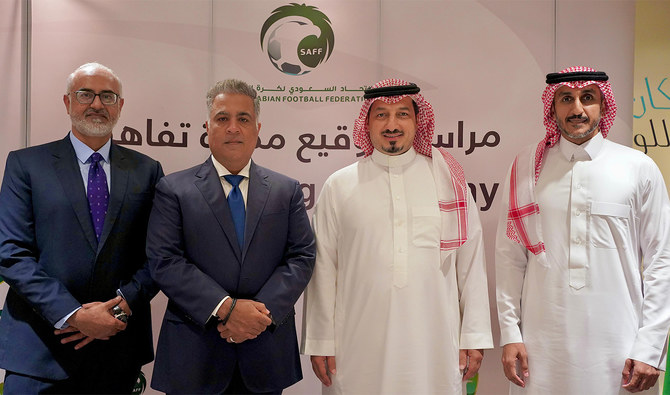
In this handout photo, taken and released by the Pakistan Football Federation on November 25, 2023, PFF Normalization Committee Chairperson Haroon Malik (2nd left), along with member Saud Hashimi (left), poses for a group photo with the Saudi Arabian Football Federation President Yasser Al Misehal (2nd right) and General Secretary Ibrahim Alkassim (right) after signing an MoU in Riyadh. (PFF)
Short Url
Updated 04 December 2023
Follow

Pakistan aims to revitalize football after first-ever collaboration with Saudi Arabia

  • Pakistan Football Federation signed an MoU with Saudi counterpart in Riyadh last month to promote the sport
  • PFF also wants to arrange visits from international teams to ensure that fans get to watch high-quality matches

LAHORE: Pakistan is looking to reshape the future of football in the country after reaching out to Saudi Arabia for first-ever international collaboration in the field, the top official of the FIFA-backed Normalization Committee (NC) currently running the Pakistan Football Federation (PFF), said in a recent interview.

Last week, the PFF announced its chairman, Haroon Malik, had signed a Memorandum of Understanding (MoU) with the Saudi Arabian Football Federation (SAFF) in Riyadh to foster strong ties for the mutual benefit, promotion, growth and success of the sport in both countries.

Pakistan has faced many challenges in international football over the years, including multiple suspensions of the country’s domestic premier division in the last six years. The last one was in April 2021, when FIFA banned PFF due to “third-party interference” after a “hostile takeover” of the body’s headquarters in Lahore and the ousting of a FIFA representative by a rival group.

The international sports governing body restored PFF’s membership in June 2022.

“I think the benefit [of signing the MoU] is that SAFF considers Pakistan to be a brotherly country and they want to develop football across Asia and they are making sure that it helps to raise the standard,” Malik told Arab News on Friday.

The PFF official said the federation was working on next year’s calendar, which will include friendly matches with Saudi Arabia.

“We are very happy that it covers not only the men’s national team but it also applies to the women’s national team,” he added. “On the youth side, we hope that we will play some games, under 16, under 19.”

Football recently came into the spotlight in the cricket-dominated country after Pakistan got its first-ever qualification for the second round of FIFA qualifiers, edging out Cambodia after ending a 13-match losing streak that dated back to 2018.

The faceoff was attended by over 13,000 fans in Islamabad as the country hosted its first international match after eight years, sparking jubilant celebrations not just for the victory but a homecoming of international football too.

The 193rd-ranked Pakistan, however, has suffered two consecutive setbacks in the first two matches of the second round and is currently the lowest-ranked team in Group G, which includes Saudi Arabia, Tajikistan, and Jordan.

‘Neutral venue’

Pakistan is scheduled to play its home matches of the FIFA qualifiers against Jordan and Saudi Arabia on March 21 and June 6, respectively, though the football federation appears to be facing challenges in hosting night matches against the two teams.

Asked about the situation, Malik said he was hopeful the PFF would be able to get floodlights installed under FIFA regulations by January.


“The [Pakistan vs Jordan] game on the 21st of March, I do not think can be played during the day,” he said, adding that his team was working with the government for requisite lighting to ensure they were in place for both matches.

“If not, we will have to consider a neutral venue,” he added.

‘PSL-like football league’

In a major boost for the sport, he said the PFF had been working on formalizing domestic football, promoting talent development through encouraging commercialization.

“If there is not enough commercial opportunity, the people, of course, will not choose [football] as a career option,” he maintained.

“We have All Pakistan Championship that is currently going on to find the best clubs that play in the country,” he said. “The second is to have a championship-style competition, something like the Pakistan Cricket League [Pakistan Super League].”


Discussing the national women’s team, the PFF chief said the federation was planning a football championship to establish a women’s league, to enable female footballers to display their talent and playing style.

The PFF, he noted, is also arranging visits from international teams to Pakistan, ensuring fans can enjoy high-quality matches.


Saudi Arabia opening doors for women athletes, says expert

Updated 10 sec ago
Follow

Saudi Arabia opening doors for women athletes, says expert

  • Lina Al-Maeena, chairperson of Jeddah United Club, lauds progress
  • Focus on female development at World Football Summit in Riyadh

RIYADH: The World Football Summit which ended here on Thursday has once again placed women’s football at the center of its global agenda, highlighting initiatives, insights, and the achievements of trailblazers shaping the sport’s future.

One of the summit’s standout moments was the Female Leaders Awards that celebrated individuals and organizations driving progress, innovation, and equity in the women’s game.

Another anchor of the summit was the Female Leaders Gathering, which in its third year has become a vital platform for discussing leadership pathways and gender equity.

The gathering was led by Farkhunda Muhtaj, captain of the Afghanistan women’s national team, who said she hoped the initiative “continues empowering women to lead and influence the game at every level.”

Among the year’s award winners was Lina Al-Maeena, chairperson of Jeddah United Club, who expressed pride in the rapid transformation taking place within the Kingdom.

“We have come a long way in a very short time,” she said. “Our under-17 girls’ football team is now competing across the country under the Saudi Football Federation, and it shows how fast the sport is evolving.”

She added that “women are now participating in international events, something that felt impossible only a few years ago.”

Al-Maeena emphasized that equal opportunity was a cornerstone of Saudi Vision 2030. “The Ministry of Sports has opened doors for girls and boys across more than 100 federations and committees,” she said.

She highlighted the power of grassroots involvement. “It starts with the community,” she said. “That’s where you find the everyday champions who then rise to clubs and national teams.”

Across multiple sessions at the WFS, experts emphasized that women’s football was entering a new phase marked by global expansion and the rise of nontraditional markets.

The country had launched a professional women’s league, hosted international tournaments, expanded youth programs, and introduced the region’s first Women’s Champions League.

Eileen Gleeson, who has worked extensively in international women’s football, said that emerging markets like Saudi Arabia were “changing the map of where the women’s game can grow.”

She explained that the needs of these regions differed from those of established football nations. “The ambition is there,” she said, “but it’s not always matched with resources. You might want to win, but you can’t invest equally in every area. So the question becomes: where do you put that money?”

For Gleeson, long-term sustainability had to be the guiding principle. “Your starting point is different,” she said. “You’re introducing women’s football while also trying to professionalize it. For long-term growth, investment must go into the developing areas.”

She cited Saudi Arabia’s progress, noting that “in just four years, they’ve moved into professional structures with real commitment.” Still, she cautioned that nurturing homegrown players had to remain a priority.

“You have to protect your domestic league,” she said. “You can’t let it become an international league for its own sake.”

Muhtaj echoed this point, offering her perspective as a player who grew up without a domestic league in Canada. “Many Canadian players had to go abroad,” she said.

“But when you go abroad, you’re not always given the best opportunities because domestic players take precedence.”

She argued that investment should focus on markets with high talent but limited infrastructure. “There is so much talent in Asia and Africa,” she said. “The only thing missing is opportunity.”

She also emphasized how investment could stretch further in developing regions.

She said $400 million in Canada’s National Women’s Soccer League “might get you two or three franchises. But that same amount in developing regions could build an entire league with strong infrastructure.”

Muhtaj pointed to Saudi Arabia as “an example of how quickly opportunity can transform the environment for women players.”