


DUBAI: There are two things that cinema can do better than any other form of artistic expression. First, it allows us to immerse ourselves in parts of the world we’ve never seen, and second, it empowers us to empathize with people we’ve never met. Tunisian megastar Dhafer L’Abidine’s lyrical directorial effort “To My Son,” which will hold its world premiere on December 3 at the Red Sea International Film Festival, excels at both. After scoring a huge global distribution deal the night the fest began, it is now poised to introduce the world to a part of Saudi Arabia never before immortalized on the big screen.
For L’Abidine, a cross-cultural performer who has long been one of Arab film and television’s most beloved stars, the Saudi-set film is a “love letter” to a country that has fully embraced him. It also marks a welcome return to a festival that helped launched the now-thriving next phase of his career, after his debut feature, the unforgettable politically-charged drama “Ghodwa,” screened to great acclaim at RSIFF 2021.
But while his last film was a deeply personal exploration of his home country’s political landscape in the wake of the 2011 Tunisian Revolution, “To My Son,” in which he also stars as a British-Saudi father named Feisal, is a leap outside of his lived experience — which has filled the 51-year-old with a range of emotions ahead of the film’s premiere.
“I’m thrilled to debut ‘To My Son’ in Jeddah. It’s exciting to share this story with this amazing community, a film that aims to capture humanity as well as the beauty of this astounding place. But there’s also a bit of excited nervousness, to be honest, because it’s so different from anything I’ve attempted before,” L’Abidine tells Arab News.

Tunisian megastar Dhafer L’Abidine in his debut feature ‘Ghodwa,’ which screened at RSIFF in 2021. (Supplied)
“My last film was about Tunisia, it was an idea born from my own culture. But with this film, I’m exploring a place I’m still discovering even years after first coming here. That carries with it a huge responsibility, which I kept at the front in my mind while making it. I knew that I had to do right by this place, these people, and this culture. It’s always challenging to step out of your comfort zone, but I’m always most attracted to making the choices that feel the least safe and easy, because that’s where I thrive,” he continues.
The film is set primarily in the Abha, a lush, mountainous city in the southwest of the Kingdom that is beloved by Saudis but largely unknown to an international community that has only just begun to explore the country. L’Abidine first found himself there three years ago filming a hit MBC series and was amazed by the place.
“I really didn’t know what I was in for. You have certain clichés in your head about Saudi Arabia, and then suddenly you find yourself in the middle of these huge green mountains, all with a very distinct quality to them, and so many historical places to discover. You feel really feel you’re somewhere unlike anywhere else in the world. After I left, I couldn’t get this place out of my head,” he explains.

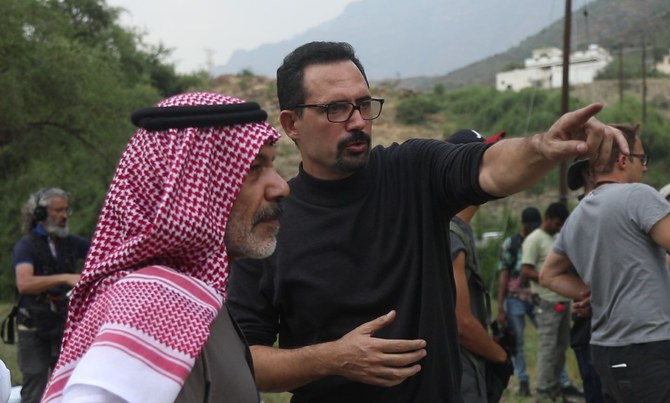
Dhafer L'Abidine on the set of ‘To My Son.’ (Supplied)
After the release of “Ghodwa,” L’Abidine was meeting with a producer friend, who was himself considering doing a film in Saudi Arabia. He and L’Abidine began to brainstorm, coming up with an idea that became the bones of the story that the film now explores — the story of a Saudi man living in London who, still mourning the death of his wife, decides to return with his son to the home he left 12 years ago. The man’s father, however, still resents him for having left the family, and refuses to accept him back into the fold.
“As we sat there and explored the concept, it became clear we needed to really highlight that these are people from two different worlds. And Jeddah and Riyadh — as they’re so cosmopolitan and modern — couldn’t capture that difference. I thought, ‘Oh my gosh, this needs to be set in Abha.’ I was brought back to this place that I fell in love with that helped me see Saudi Arabia in a different way and I knew that would be valuable to this story, so I went away to write and it all developed from there,” says L’Abidine.
While Abha helped inspire the story, what became more important to L’Abidine as he developed the film was that it not become a glorified travelogue or tourism campaign. The place, rather, had to serve as a character of sorts on its own, one that could help bring viewers deeper into the emotional journey of the people that live in it. And as he got further into his research of the place’s history, it he realized how universal their struggles really are.
“Ultimately, this film is an exploration of the humanity that we all share within us, no matter where we’re from. They could be from Abha, Jeddah, Tunis, or Marrakesh. I wanted to make a film that would resonate anywhere, a film that shows that the struggles of the people of Abha — a place cinema has never taken us — are rooted in the same shared experiences that define us all as human beings. We all share stories like this, and the more we focus on that, the closer it brings us,” says L’Abidine.
In zooming in on characters locked in the struggle between individual fulfillment and duty to family, and in exploring generational divides that require honest discussion in order to get to the heart of what divides them, L’Abidine soon realized this wasn’t just a story about Saudi Arabia, or Arab societies. It was a story about all of us, even himself.
Quickly, it became clear to him that once again he was making a film about fathers and their children, this time at a period in his life when he is raising a 13-year-old daughter in London who is herself growing up in a world so different that which shaped him back in Tunisia. In the end, as much as he thought he was stepping outside of himself to find the truths of another culture, many of the answers were to be found in his own experience all along.
“Storytelling is always personal, whether you intend it to be or not. There’s so much in our heads that we have to resolve. And in raising my daughter, there’s so many lessons I’ve had to learn, so much perspective I’ve gained,” says L’Abidine. “I wanted to explore that journey through the main character from both sides, because I think so many people can relate. We all share stories like this.”


