


PESHAWAR: The Peshawar High Court (PHC) has approved applications of more than a hundred Afghan nationals, who are married to Pakistanis, seeking Pakistan Origin Cards (POCs) and ordered authorities to process their applications once they fulfill legal formalities and rules, lawyers said on Saturday.
Based on their marriages with Pakistanis, around 109 Afghan nationals had filed petitions in the court seeking POCs, which are issued by Pakistan's National Database and Registration Authority (NADRA) to foreigners married to Pakistani citizens and allows them all rights except the rights to vote, contest election or to get a passport.
A two-member bench of the PHC, headed by Justice Waqar Ahmad and Justice Sayed Arshad Ali, gave the order on Friday after hearing arguments of lawyers representing the petitioners, the federal government and the National Database and Registration Authority (NADRA).
“This is a partial judgment and a written verdict will be released in the next few days,” Advocate Sanaullah Khan, an additional attorney general who represented the federal government, told Arab News.
"The judgment directed the federal government to proceed with their (Afghan spouses) cases to issue them POCs provided that the petitioners fulfill established rules."
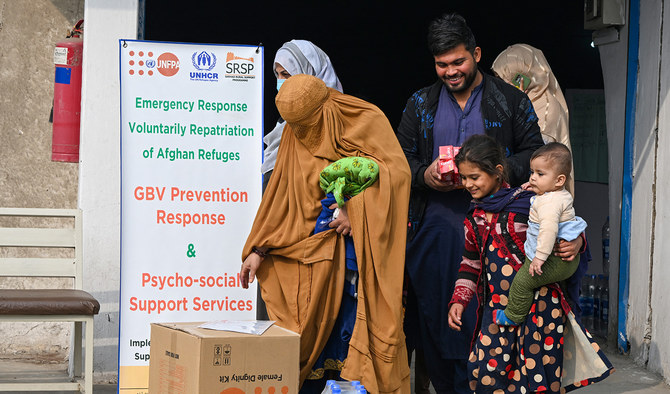
The development amid a crackdown on Afghan refugees in Pakistan following Islamabad’s directive for all undocumented foreigners to leave the country by November 1. Many of the Afghans have since gone underground, fearing for their lives upon return to a Taliban-ruled Afghanistan.
Pakistan has long been home to more than 4 million Afghan migrants and refugees and around 1.7 million of them were undocumented, according to official estimates. Hundreds of thousands more arrived after the Taliban retook Afghanistan in 2021, joining the large number living in Pakistan since the Soviet invasion of the neighboring country in 1979.
Advocate Saifullah Muhib Kakakhel, who appeared before the court on behalf of the petitioners, said most of his clients neither had passports nor other documents as they were born in Pakistan.
“After hearing arguments from all the sides, the august court allowed these cases of issuing POCs to Afghan spouses, making them entitled to enjoy all benefits except Pakistani passport and right to vote,” Kakakhel said. "It was a short verdict and the detailed judgement will come later."
He said that NADRA Rules (POC) 2002 provided for the grant of residence permits to spouses of Pakistani citizens and denying it would be a "clear violation of their basic rights."
Advocate Shahid Imran Gigyani, who represented NADRA, said one of the conditions for a foreigner to get the POC was that they must have a passport of their country of origin, but in this particular case, most of the petitioners had no documents at all.
He said he had argued before the court that these petitioners did not fall under the category of foreigners.
“Our main contention before the court was that there is a huge difference between refugees and foreigners. A refugee can’t claim that right (POC) because they’re already given refugees’ rights, which is defined in Geneva Convention 1951,” Gigyani said.
"But a foreigner is an individual who has a valid passport, visa and entry and exit rights."
More than 370,000 Afghans have left Pakistan since Islamabad ordered them to leave in early October and said many of them had been involved in militant attacks and other offences.
Khan Muhammad Babar, an Afghan national and a focal person at Peshawar's Afghan Commissionerate that provides humanitarian assistance to Afghan refugees, welcomed the judgement, saying the move would facilitate thousands of Afghan spouses and their children, who have been living in Pakistan for decades.
“Though the petition mentions 109 spouses only, but as per my information there are over 1,400 such cases,” he said. "This decision is a ray of hope for many Afghan spouses that their children will ultimately get some sort of recognition, identity and homeland at least."
Babar said the move by Pakistan to expel undocumented foreigners had put millions of Afghans in trouble, alleging that they were being "harassed" by Pakistani authorities.
“As per our assessment, Pakistani authorities have so far expelled almost 470,000 Afghan refugees via Torkham and Chaman, the two main border crossings in northwestern Khyber Pakhtunkhwa and southwestern Balochistan provinces,” he said.
“Those residing illegally or without valid documents should be expelled, but in a dignified manner. Secondly, Pakistan should facilitate those refugees who have valid documents.”


