

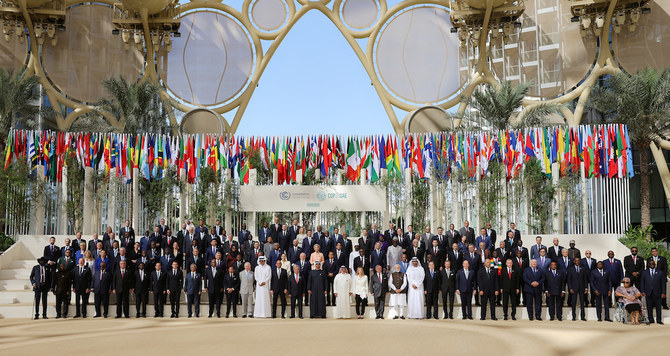
Global leaders accelerate pace for decarbonization at COP28

Global leaders, including heads of state and governments from over 117 countries, gathered at Expo City to set ambitious goals for transitioning toward more ecological and less carbon-intensive economies. Reuters
Short Url
Updated 03 December 2023
Follow

Global leaders accelerate pace for decarbonization at COP28

DUBAI: Capitalizing on the positive momentum from the opening day of the UN Climate Change Conference in Dubai, global leaders, including heads of state and governments from over 117 countries, gathered at Expo City to set ambitious goals for transitioning toward more ecological and less carbon-intensive economies.  

The boost to the mood was spurred by the announcement on Nov. 30 activating the “loss and damage fund” — a financial mechanism designed to assist countries affected by climate change. This initiative was endorsed last year during COP27 in Sharm El-Sheikh, Egypt, with the specific operational details ironed out just hours before the commencement of COP28.  

The operationalization of the “loss and damage fund” appears to have instilled a lot of confidence among participants at COP28, including leaders such as Kenyan President William Ruto, who welcomed the announcement as a sign of progress.  

“We are seeing signs of progress for the first time. The ‘loss and damage fund’ is now being operationalized with real money. The conversation here has changed dramatically. I think there is a renewed commitment to making sure that we match action with what we’ve seen many times,” Ruto told Arab News.  

He mentioned that he is aware of one of the problems associated with past meetings on climate change: there is rarely any follow-up to the lofty statements made during these gatherings.  

“The accusation has been (that) we talk too much and there are no results. But I am very impressed with what I am seeing; there is now tangible progress being made. And hopefully, by the end of this COP, we will not only have significant resources deployed but also serious commitments made,” Ruto said.  

African initiatives  

Even though it ranks at the bottom of the list of continents in terms of carbon emissions, Africa has been at the receiving end of the negative impacts of climate change, especially through cycles of alternating prolonged droughts and flash floods.  

In such a scenario, it is hardly surprising to see a large African delegation at COP28, and many African nations are now taking the lead in speaking up for themselves and launching their own initiatives. For instance, Ruto informed that Kenya was all set to announce a number of new initiatives.  

He added: “We will be launching later today (Friday), with France, an agreement that will give us the opportunity to discuss taxation as a new mechanism for bringing resources for sorting out climate change that is threatening the whole globe. Secondly, we are also having a serious conversation about the Africa Green Industrialization Initiative to unlock the huge potential and opportunities that exist in Africa for green manufacturing, which is, if I may say, the silver bullet for growth into the future.”  

Even on the issue of finance, which has blighted practically every single COP summit, Ruto seemed optimistic. “We need billions of dollars for climate adaptation, which is precisely why we are having a conversation about money already committed, and we are seeing traction in that money being released. That’s number one. Number two, we are looking at an opportunity where we have all agreed on a new international financial architecture that is, again, going to be much more fit for purpose with additional resources, with more money. And then number three, we are looking at new avenues of raising money, including carbon taxation and taxation on industries that will get more people on board,” Ruto said.  

Croatian Prime Minister Andrej Plenković said that the main objective of this COP is to expedite investments in green transition. “The main objectives here seem to be to speed up the investments in energy efficiency, to speed up the investments in the energy transition and also the diminishment of the use of the fossil fuels.”  

There were some substantive declarations on Nov. 30 but Plenković expressed his expectation that, over the course of the next couple of days, as confidence builds, “there will be more money available.” 

For Plenković, besides finance, another key development at COP28 is the global stocktaking that is taking place where various countries make a statement on where they stand currently vis-a-vis their commitments under the Paris Agreement for curbing their carbon emissions. 

“I believe that the exercise of global stocktaking is a necessary requirement for phasing out carbon in a fashion that is timely, intelligent, swift and systematic. I think that the political will is here and that a lot of ambition in order to fulfill, first of all, the Paris Agreement objectives. And I think the awareness has been really raised to the maximum level,” Plenković told Arab News.  

He said that his own country is moving rapidly toward a green transition across various sectors. “Well, we are investing heavily at the local level because, in a global sense, we are not a country that is polluting a lot. Our emissions are very low. On the contrary, they are below the thresholds that we have. But we are doing maximum to increase our investments in energy transition and energy efficiency.”  

The Croatian prime minister emphasized on the tourism sector because his country ranks as the 18th destination in the world in terms of guests, with the arrival of 20 million tourists. This figure is significant for a nation of less than 4 million people. “We put this in the context of global development goals. Therefore, all of our investments are aimed at balancing economic growth, maintaining a protected environment, and reducing emissions,” Plenković said.  

He added that the EU was very deeply engaged with climate change, not just internally but also at a global level. “There is no European Council that passes without climate as an issue and I think that we are really committed to provide as much as we can, both in terms of institutional framework investments and support to the countries that are in need,’’ Plenković explained.  

Funding gap

However, not everyone seemed content with the developments and the pace of change. Miguel Ceara Hatton, minister of environment and natural resources of the Dominican Republic, said he is very concerned about the “loss and damage fund” proving to be inadequate. “We understand that there is not enough money for the 183 countries. If we talk about this, $100 billion is not enough. If we have to change our way of production, consumption and transportation, then we need much more than what is currently there, especially if we are talking about 183 countries,” Hatton told Arab News.  

He added: “This crisis, the climate crisis is occurring at the same time in all countries in the world. So, for that reason, everybody needs money at the same time in order to get the transformation.” 

Hatton felt the problem is that, in the end, each government has to be prepared to finance the changes. “But also, we try to get money from outside of the country, which is not going to be enough. But, in any case, we have to do the transformation. That’s the point, and that is adaptation,” he explained. 

The Dominican Republic currently faces several challenges due to the climate crisis, Hatton informed. “The main problem is that we have a severe growth of Saragossa, a seaweed that is growing due to warmer seas. We also have the issues of transition of our energy and transportation. These are the three main things that we have to resolve in order to advance in the (fight against) climate change,” he said.  

Despite the issues, Hatton said that he stays positive. He added: “Yes, we are optimistic. Yesterday (Friday) was a good day. And I think that we are moving. Not so far, not so quickly. But we are moving very slowly. Very slowly. But I hope to gain speed.”  

The optimism despite challenges was also shared by Dan Smith, director of the Stockholm International Peace Research Institute, a think-tank that specializes in the study of conflicts and wars around the world.  

“Events like COP are very important. But don’t expect anything to be revolutionized next week, next month, or even next year. Probably in a year’s time when COP29 comes, we will still be saying, look, we have to be more aware of this linkage. We have to do more about it, and we have to grip the problem better. But the awareness is rising,” Smith told Arab News.  

He said the change in policy is visible. For example, more and more UN missions, international agencies, and indeed governments have advised them specifically on the link of climate and security attached to their operations. “So, there is progress. It’s slow. That’s not enough, but it’s something that’s good,” he explained.  

Smith said that there was a direct connection between climate change and conflicts, a hypothesis that his institute has been studying for decades. “I think that maybe 10 or 15 years ago, we believed that there would be a connection between climate change and increased risk of conflict. Today, it is no longer speculation.”  

Unfortunately, he said the hypothesis turned out to be correct, and “it is very clear that there is an increasing number of armed conflicts in which the impact of climate change plays a part in creating the conditions.”  

“It also plays a part in making some conflicts harder to resolve. It makes it difficult sometimes for the UN operations in the way it should, where you have extreme weather events happening. It also offers a chance for the insurgents, the militia, and the jihadists to exploit that, too. Very often they are the first providers that are the first ones to come when there’s a flood, and then they actually increase their recruitment as a result,” he said.  

Despite the positive mood around, for some NGOs (non-governmental organizations) like Terre Policy Centre, a Pune-based environmental policy organization, the real challenge lies in the day after COP28 gets over. “The issue of implementation and activation of all that has been said at the climate summit,” said Vinita Apte, chairperson of Terre Policy Centre.  

“Today (Friday), we heard Indian Prime Minister Narendra Modi, who gave a very good speech about green credit initiatives that India is launching. We have also seen many other leaders make major announcements. I always see people like the presidents and prime ministers come, and they give their statements and then they leave. Little of what is said is implemented and ultimately, it is for the common people around the world to deal with the aftereffects of climate change. But at least the governments should ensure that they help the populations and the NGOs deal with the challenges and provide finance,” Apte told Arab News.  


Saudi Arabia’s AI imperative: seizing the agentic enterprise to fulfill Vision 2030 goals

Updated 7 sec ago
Follow

Saudi Arabia’s AI imperative: seizing the agentic enterprise to fulfill Vision 2030 goals

  • Workers who use AI daily are 64% more productive and 81% more satisfied with their jobs

RIYADH: As Saudi Arabia advances its ambitious Vision 2030, a transformative shift in the global workplace underscores a critical opportunity for the Kingdom’s organizations.

Slack’s latest Workforce Index survey revealed an unprecedented surge in the adoption and impact of artificial intelligence, presenting a clear pathway for Saudi businesses to lead in the era of digital labor, drive economic diversification, and create high-value roles for the future workforce.
“Saudi Arabia has all the ingredients to lead this shift: a young population, a government willing to modernize at extraordinary speed and industries preparing for global competition,” Mohammad Al-Khotani, the senior vice president and general manager of Salesforce Middle East told Arab News.

From adoption to advantage
The evidence that AI is a decisive competitive advantage is now overwhelming. Slack’s research, which surveyed 5,000 global desk workers, found that daily AI usage has soared by 233 percent in just six months.
Workers who use AI daily are 64 percent more productive and 81 percent more satisfied with their jobs than their non-AI-using colleagues. This trend is even more pronounced in specific markets; in the UK, daily AI users report an 82 percent increase in productivity and a 106 percent boost in job satisfaction.
According to the report, this surge is fundamentally reshaping work. The data confirms that trust grows with use: workers who use AI agents daily are twice as likely to trust them in areas like data protection and accuracy. 
Furthermore, AI is enabling workers to expand their capabilities strategically. Some 96 percent of AI users have leveraged the technology to perform tasks they previously lacked the skills to do.
Workers are now 154 percent more likely to use AI agents to perform tasks better and more creatively, not merely to automate them. The top productivity boosts come from eliminating extensive research, assisting with communication, and overcoming creative blocks.
Given this, Al-Khotani emphasized the macroeconomic imperative for Saudi organizations to lead, not follow. 
“Saudi Arabia is one of the few countries where the public sector has already set a global benchmark for digital service delivery. This creates a macroeconomic condition in which private-sector organizations must now match the pace set by the state,” he said. 
He further noted that “the scale of Saudi Arabia’s transformation, megaprojects, tourism growth, manufacturing build-out and new digital sectors, requires the productivity lift that only digital labor and AI agents can provide. Organizations that adopt early will move faster, earn citizen trust and gain market share.”
This perspective is echoed by Mohamad El-Charif, founder of the Middle East’s first sovereign regulatory compliance platform, Qadi.
“When we talk about digital labor in Saudi Arabia, we have to acknowledge that legal and regulatory AI is not optional. If we wait and come in as fast followers, we’ll end up running our core legal and regulatory workloads elsewhere, governed, and updated elsewhere,” he explained to Arab News. 
He argued that early adoption creates a lasting advantage: “Moving early with governed, sovereign agents, lets Saudi organizations encode their own local laws, internal policies, escalation paths and audit trails into the infrastructure.”
He added: “Under Vision 2030, leading Saudi banks, insurers, telcos, and energy companies are not just serving the domestic market; they’re becoming global players. If they build their regulatory backbone early and on their own terms, they don’t just stay in bounds at home, but they also carry that infrastructure with them as they expand.”

From automation to the agentic enterprise
This ground-level adoption aligns with a strategic corporate pivot identified in the 2025 MuleSoft Connectivity Benchmark Report, produced in collaboration with Deloitte.
The report highlighted that generative AI has reshaped human-AI interaction, and the next frontier is the rise of the “agentic enterprise.” This model involves autonomous AI agents that can operate with unprecedented independence, responding to queries, managing sophisticated tasks, and optimizing workflows without continuous human intervention.
The report found that 93 percent of IT leaders intend to introduce such autonomous agents within two years, with 40 percent having already done so and another 41 percent planning deployment within the next year.
This shift is accelerating rapidly; the average number of AI models in use has already doubled from 2024 projections, and IT leaders predict a further 78 percent increase over the next three years.
Salesforce Middle East’s Al-Khotani elaborated on this strategic potential, stating: “AI agents offer a multiplier effect across sectors that Vision 2030 prioritizes. This same efficiency can shift the economics of different industries.”
He added: “Legacy sectors can automate routine compliance, scheduling, documentation, onboarding and case resolution. Public services can move from reactive to proactive, anticipating citizen needs and completing tasks autonomously.”
Qadi’s El-Charif described this as turning “compliance from a blockage into an API,” accelerating Vision 2030’s ambitions. 
“For a thriving economy, the biggest gift you can give businesses is predictable, low-friction compliance,” he said, adding: “When you encode local laws, regulations and internal policies into agents, those checks move inside the workflow. Approvals can happen in days, not months, without lowering standards.”
However, this potential is gated by integration. Some 95 percent of IT leaders cite integration challenges as the primary hurdle to effective AI implementation. 
Organizations use an average of 897 applications, with 46 percent using over 1,000, yet integration levels have stagnated.

Opportunity for the Kingdom
For Saudi organizations, moving early to adopt and integrate AI is no longer optional, but a strategic necessity to lead in digital labor and deliver on Vision 2030’s goals of a vibrant society, a thriving economy, and an ambitious nation.
First, deploying AI in ways that deliver positive outcomes for both business and employees is key. The Slack Index showed that AI enhances human connection, not replaces it.
Daily AI users are 246 percent more likely to feel more connected to colleagues and report a 62 percent higher sense of belonging. This counters fears of displacement, showing AI can augment teamwork and culture.
Al-Khotani stressed the principles for positive deployment, noting: “AI must be introduced as augmentation, not substitution. When people understand that agents are handling low-value tasks, while humans focus on creativity, judgment and customer relationships, acceptance is extremely high.” 
He added that Salesforce data shows 84 percent of AI users say the technology makes them enjoy their job more, largely because it reduces repetitive work.
El-Charif advocated for a practical Outcome-Workflow-Governance framework to achieve this symbiosis, saying: “We design agents to take over that ‘read, retrieve, reconcile’ loop. 
“This doesn’t replace humans, but it elevates them out of the infrastructural gridlock.” 
He added: “That, for me, brings a real opportunity of using agentic AI to remove the glue work that exhausts people, and free up talent to focus on strategy, relationships and judgment, which is exactly what Vision 2030 is asking our institutions to excel at.”
Agentic AI can directly accelerate Vision 2030 ambitions. As noted by Goldman Sachs Research, generative AI can streamline business workflows, automate routine tasks and give rise to a new generation of business applications.
For Saudi Arabia, this means modernizing legacy sectors, improving efficiency in health care and financial services, and supercharging nascent industries. 
The MuleSoft report confirmed that APIs and API-related implementations now account for 40 percent of company revenue on average, up from 25 percent in 2018, demonstrating the tangible economic value of a connected, AI-ready infrastructure.
El-Charif also highlighted the societal dimension, stating: “For a vibrant society, this technology drives transparency and trust. When rules are encoded into agents, their application becomes consistent and audit-ready. This builds confidence in the market and investors know that compliance isn’t subjective, but structural.”
Finally, this transition will create high-value roles for humans. The integration challenge itself is a source of future jobs. The MuleSoft report found that developers spend an estimated 39 percent of their time building custom integrations, and IT staffing budgets are expected to rise by 61.5 percent year-over-year to meet AI demand.
Al-Khotani foresees specific new roles emerging from the AI integration challenge, saying: “Salesforce’s research shows that organizations adopting AI expect their data and integration teams to grow nearly 50 percent over the next three years.” 
He went on explaining that this opens pathways for new roles such as AI integration architects, agent workflow designers, and responsible AI officers and digital trust specialists.
El-Charif identified the emergence of roles such as “Legal Engineer,” — someone who understands both the regulation and how to encode it into logic.
Furthermore, as AI handles routine tasks, workers are freed for more strategic, creative, and innovative work, precisely the skills needed for a knowledge-based economy. 
Al-Khotani envisioned this shift elevating Saudi Arabia’s broader economic structure: “As agents take on routine and administrative tasks, Saudi Arabia’s workforce will shift toward higher-value roles that emphasize creativity, human judgment, and strategic decision-making.”
He added that this shift increases productivity per capita, a core Vision 2030 outcome, because the workforce is no longer limited by the volume of manual work it can process. “The macroeconomic structure becomes more innovation-driven and less labor-intensive.”
Global AI adoption is accelerating, worker productivity and satisfaction are skyrocketing with its use, and the next wave of enterprise value lies in agentic AI.
For Saudi Arabia, the mandate is to build the robust, integrated digital foundations today that will allow its organizations and workforce to not just participate in this future, but to lead it, turning the promise of Vision 2030 into an intelligent, automated, and human-centric reality. 
As Al-Khotani concluded: “The future economy will not reward automation alone, it will reward nations that use AI to elevate human potential. Saudi Arabia is positioned to be one of them.”