

Ex-PM Khan’s lawyers accuse officials of flouting court order, limiting media access at state secrets trial

Intazar Hussain Panjutha, the lawyer of jailed former Pakistan prime minister Imran Khan, speaks with media representatives outside the Adiala Jail in Rawalpindi on December 2, 2023. (AN Photo)
Short Url
Updated 02 December 2023
Follow

Ex-PM Khan’s lawyers accuse officials of flouting court order, limiting media access at state secrets trial

  • Khan’s lawyers say three journalists were allowed to witness the trial after the legal team boycotted the proceedings
  • The former prime minister was said to be in high spirits, waiting for the hearing to start and media to move in

RAWALPINDI: Former prime minister Imran Khan’s legal team on Saturday accused the officials of a high-security prison in Rawalpindi for flouting court orders by not ensuring adequate media presence during his jail trial on charges of divulging state secrets, saying today’s proceedings could not be called an “open trial.”

A special court established to hear what has popularly come to be called the cipher case has been conducting the trial inside the Adiala prison in Rawalpindi since Khan was indicted under the Official Secrets Act last month after the government said he could not be moved to a courtroom for security reasons.

The Islamabad High Court (IHC) ruled last week, however, such hearings were illegal and ordered an open trial with media access.

A large number of journalists were present to attend the special court proceedings at the prison facility Saturday morning, though most of them were disappointed after the authorities only called three local journalists in to witness the trial.

“It was directed by the Islamabad High Court that an open trial in the cipher case will be given to Imran Khan,” the ex-PM’s lawyer, Intazar Hussain Panjutha, told Arab News. “But unfortunately, today’s hearing was in the violation of the order of IHC.”
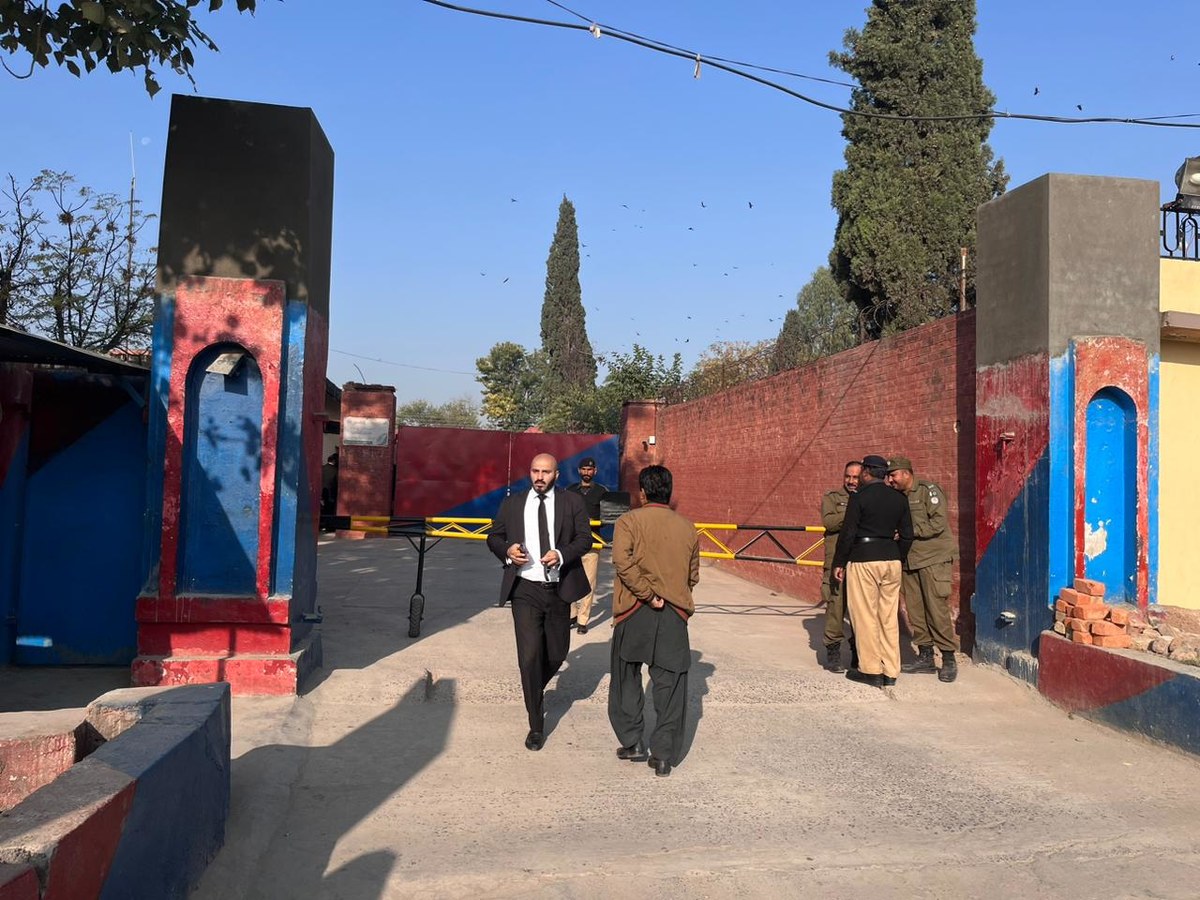


A lawyer is seen walking out of the gate of Adiala Jail in Rawalpindi, Pakistan, on December 2, 2023. (AN Photo)

“The proceedings were held in a similar manner as they were being held prior to the declaration of IHC,” he continued. “We protested this, we resisted it before the court. It was not an open trial.”

Asked about Khan’s morale, he said the former prime minister was in high spirits and looked confident.

“He was waiting for the hearing to start and he was waiting for the media to come in,” he added.

Khan’s spokesperson on legal affairs, Naeem Haider Panjutha, also weighed in, saying the cipher case hearings could not be described as part of fair trial.

He informed the three journalists were allowed to witness the trial only after Khan’s legal team boycotted the hearing.

“Khan said this is not a fair trial,” he added. “Fair trial means giving access to the media. Media is public. Media should be given permission [to cover the proceedings].”

According to Yasir Hakeem, a journalist working for Samaa TV who was allowed to witness the trial, the ex-premier objected to his treatment, saying he was made to feel like an animal while his rival, Nawaz Sharif, was “brought back” from exile in London after being convicted in a corruption reference.

“We are not even allowed to speak,” Hakeem quoted him as saying.

The former prime minister, who is the chairman of the Pakistan Tehreek-e-Insaf (PTI) party, is being held at Adiala jail where he is serving a three-year sentence in a separate case in which he was convicted in August of failing to disclose assets earned from the sale of state gifts while he was PM from 2018-2022.

Khan is also accused in a number of other cases, including the cipher case, which relates to an alleged diplomatic correspondence between Washington and Islamabad that Khan says was proof that his ouster as PM in a parliamentary vote of no-confidence in April 2022 was part of a US conspiracy to remove him. Washington has repeatedly denied Khan’s accusations.

Khan, arguably the most popular politician in the country, has not been seen in public since he was arrested in August. Prior to that, he regularly addressed his millions of followers via social media and held massive public rallies and protest marches.

The court adjourned its hearings until Monday.


Pakistan terms climate change, demographic pressures as ‘pressing existential risks’

Updated 06 December 2025
Follow

Pakistan terms climate change, demographic pressures as ‘pressing existential risks’

  • Pakistan has suffered frequent climate change-induced disasters, including floods this year that killed over 1,000
  • Pakistan finmin highlights stabilization measures at Doha Forum, discusses economic cooperation with Qatar 

ISLAMABAD: Pakistan’s Finance Minister Muhammad Aurangzeb on Saturday described climate change and demographic pressures as “pressing existential risks” facing the country, calling for urgent climate financing. 

The finance minister was speaking as a member of a high-level panel at the 23rd edition of the Doha Forum, which is being held from Dec. 6–7 in the Qatari capital. Aurangzeb was invited as a speaker on the discussion titled: ‘Global Trade Tensions: Economic Impact and Policy Responses in MENA.’

“He reaffirmed that while Pakistan remained vigilant in the face of geopolitical uncertainty, the more pressing existential risks were climate change and demographic pressures,” the Finance Division said. 

Pakistan has suffered repeated climate disasters in recent years, most notably the 2022 super-floods that submerged one-third of the country, displaced millions and caused an estimated $30 billion in losses. 

This year’s floods killed over 1,000 people and caused at least $2.9 billion in damages to agriculture and infrastructure. Scientists say Pakistan remains among the world’s most climate-vulnerable nations despite contributing less than 1 percent of global greenhouse-gas emissions.

Aurangzeb has previously said climate change and Pakistan’s fast-rising population are the only two factors that can hinder the South Asian country’s efforts to become a $3 trillion economy in the future. 

The finance minister noted that this year’s floods in Pakistan had shaved at least 0.5 percent off GDP growth, calling for urgent climate financing and investment in resilient infrastructure. 

When asked about Pakistan’s fiscal resilience and capability to absorb external shocks, Aurangzeb said Islamabad had rebuilt fiscal buffers. He pointed out that both the primary fiscal balance and current account had returned to surplus, supported significantly by strong remittance inflows of $18–20 billion annually from the Middle East and North Africa (MENA) and Gulf Cooperation Council (GCC) regions. 

Separately, Aurangzeb met his Qatari counterpart Ali Bin Ahmed Al Kuwari to discuss bilateral cooperation. 

“Both sides reaffirmed their commitment to strengthening economic ties, particularly by maximizing opportunities created through the newly concluded GCC–Pakistan Free Trade Agreement, expanding trade flows, and deepening energy cooperation, including long-term LNG collaboration,” the finance ministry said. 

The two also discussed collaboration on digital infrastructure, skills development and regulatory reform. They agreed to establish structured mechanisms to continue joint work in trade diversification, technology, climate resilience, and investment facilitation, the finance ministry said.