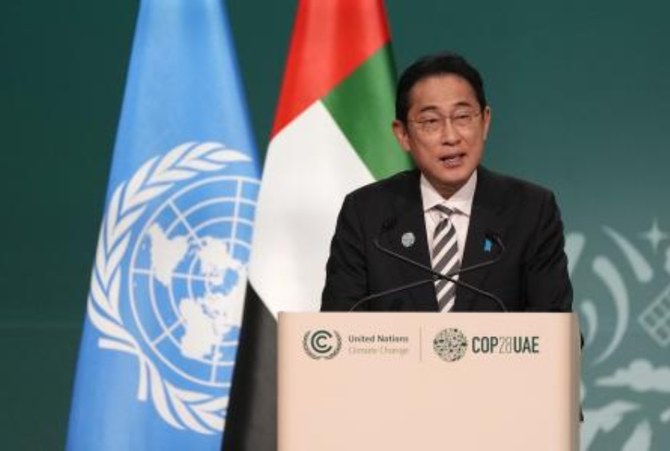
DUBAI: Japanese Prime Minister Kishida Fumio said more action was needed if the world was to achieve its climate change goal of keeping temperatures within 1.5 degrees Celsius of pre-industrial levels.
Speaking at the COP28 climate summit in the UAE, Kishida said Japan was on track to reach its target of reducing greenhouse gas emissions by 46 percent by 2030, compared with 2013 levels, and would continue to work toward its goal of net zero by 2050.
The country had already reduced its greenhouse gases by about 20 percent, he said.
As confirmed at the G7 Hiroshima Summit for economic growth and energy, and based on the GX (green transformation) Promotion Act, Japan has adopted a growth-oriented carbon policy.
Kishida said that Japan would next year become the first country in the world to adopt internationally certified transition bonds. At the same time, it would accelerate efforts to realize its green transformation and contribute to global decarbonization.
Under the framework of the Asian Zero Emission Community, Japan was committed to making renewable energy its main power source, he said.
Japan is currently the world’s third-largest producer of solar power and continues to diversify its clean energy supply chain.
“Each country will aim to achieve net zero according to its circumstances,” Kishida said.
“Coal-fired power plants that have not taken measures to reduce emissions should be addressed along the way. Japan has developed reduction measures for domestic coal without emission.”
He said Japan would end the construction of thermal power plants and was committed to providing $70 billion of public and private sector funding.
The country would also increase lending to the World Bank and Asian Development Bank to the tune of $9 billion and additional contributions would be made to the African Development Bank, he said.
Separately, Kishida and Israeli President Isaac Herzog took part in a summit on the sidelines of COP28.
Kishida said he welcomed the agreement with Hamas to release hostages and allow more humanitarian aid into the Gaza Strip, and asked for Israel’s cooperation to help make that happen.
He also stressed the importance of acting in accordance with international law and UN Security Council resolutions, and said Japan supported the two-state solution to allow Israel and Palestine to peacefully coexist.
Hertzog expressed his appreciation for Japan’s condemnation of terrorism and explained Israel’s position regarding the Gaza Strip, including its military actions there.


![]()

Japan on track to meet emissions targets, Kishida tells COP28
Short Url
https://arab.news/gm4e2
Japan on track to meet emissions targets, Kishida tells COP28
- But world must do more to achieve climate change goals
- ‘Each country will aim to achieve net zero according to its circumstances,’ PM says


Latest updates


Recommended


© 2026 SAUDI RESEARCH & PUBLISHING COMPANY, All Rights Reserved And subject to Terms of Use Agreement.