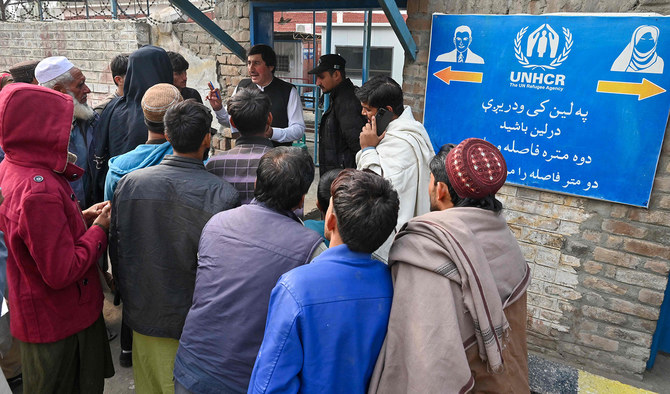
ISLAMABAD: Pakistan’s Supreme Court began hearings on Friday on a petition by rights activists seeking to halt deportation of Afghan refugees, a lawyer said, as authorities are combing refugee settlements in an effort to find and send home thousands.
More than 370,000 Afghans have fled Pakistan since Oct. 1, after Pakistan vowed to expel more than a million undocumented migrants, mostly Afghans, amid a row with Kabul over charges that it harbors anti-Pakistan militants.
“Due to the urgency, as thousands of people are suffering on daily basis, I’ve requested the court to take up the case as early as next week,” said Umar Ijaz Gilani, the lawyer representing the rights activists.
The panel of three judges hearing the case has asked the government, the interior (home) and foreign ministries, as well as a panel of government and top military officials, to furnish an explanation in reply, the lawyer said.
Thousands of Afghans have gone underground in Pakistan to avoid deportation, fearing for their lives if they return to Taliban-ruled Afghanistan following a hasty and chaotic withdrawal of US-led Western forces in 2021.
Children born to Afghan families in Pakistan could not be sent back due to their birthright, Gilani said.
Friday’s petition is separate from another focused exclusively on seeking Pakistani citizenship for such children, as guaranteed by the South Asian nation’s constitution, he said.
Pakistan is home to more than 4 million Afghan migrants and refugees, about 1.7 million of whom are undocumented.
Many arrived after the Taliban retook Afghanistan in 2021, joining a large number living there since the Soviet invasion of the neighboring nation in 1979.
Pakistani police have searched door-to-door in refugee settlements for any who have not left voluntarily, starting from the southern port city of Karachi, where hundreds of thousands of Afghans live. Any remaining are being forced to leave.
Islamabad has not heeded calls from international bodies and refugee agencies to reconsider its deportation plans.


Pakistan’s top court begins hearing challenge to expulsion of Afghans
https://arab.news/43m37
Pakistan’s top court begins hearing challenge to expulsion of Afghans

- Over 370,000 Afghans have fled Pakistan since Oct. 1, after Pakistan vowed to expel more than a million undocumented migrants
- Pakistan is home to more than four million Afghan migrants and refugees, about 1.7 million of whom are undocumented

Pakistan, UK discuss regional security, cross-border attacks as senior official visits Islamabad
- British envoy for Afghanistan Richard Lindsay’s visit comes at a time of a surge in militancy in Pakistan’s border regions
- Pakistani diplomat says both sides reviewed broader security challenges, emphasized coordination to address ‘shared concerns’
ISLAMABAD: Pakistani and British officials have discussed regional security challenges and cross-border attacks during talks in Islamabad, a Pakistani diplomat said on Tuesday, during a visit of the United Kingdom’s Afghanistan envoy, Richard Lindsay, to the Pakistani capital.
Pakistan and the UK regularly cooperate on counterterrorism and security, with a focus on intelligence-sharing to combat militant activity. Lindsay’s visit comes at a time of a rise in militancy in Pakistan’s western provinces, which border Afghanistan.
Mohammad Sadiq, Pakistan’s special representative for Afghanistan, said the discussions in Islamabad focused on the regional security situation, particularly the urgent challenge posed by cross-border attacks.
“We also exchanged views on the latest regional security developments and broader security challenges,” he said on X. “We emphasized the importance of continued cooperation and coordination to address shared concerns and promote regional stability.”
Islamabad frequently accuses Afghanistan of allowing its soil and India of backing militant groups, such as the Tehreek-e-Taliban Pakistan (TTP) and the Balochistan Liberation Army (BLA), for attacks against Pakistan. Kabul and New Delhi deny this.
In recent years, Pakistan and the UK have engaged with each other on counterterrorism and cross-border crimes as part of bilateral cooperation.
Both sides held the second round of the Pakistan-UK Counter Terrorism Dialogue in London in February last year, reviewing global and regional threats and exchanging best practices. Over the years, armed forces of both countries have also maintained close cooperation, particularly in counterterrorism efforts and professional military training.


