Emirates Team New Zealand sail into early lead as America’s Cup gets underway in Jeddah

1 / 3
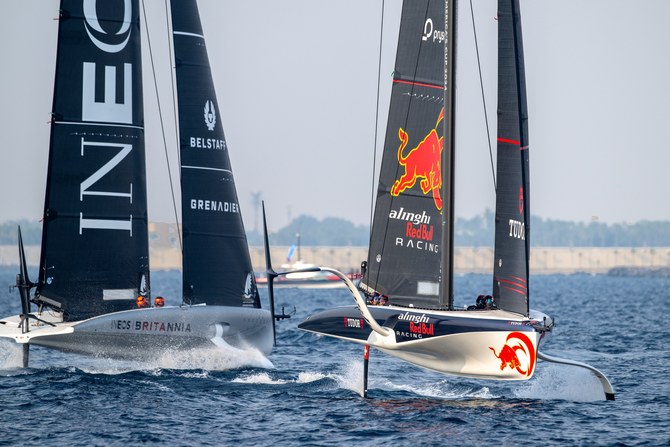
Emirates Team New Zealand dominated the first day of racing with two wins as the America’s Cup Preliminary Regatta in Jeddah began on Thursday. (Supplied)
2 / 3
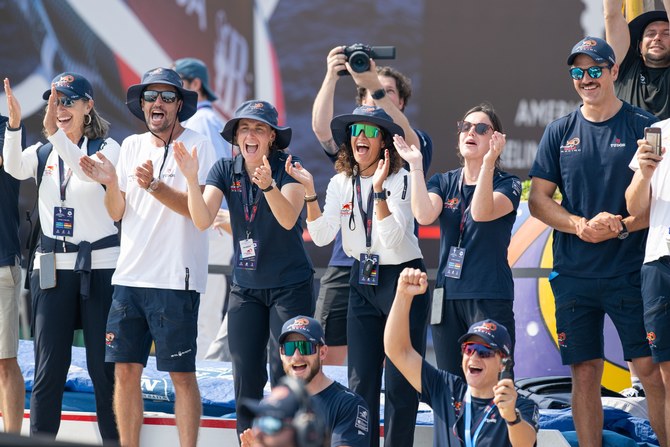
Emirates Team New Zealand dominated the first day of racing with two wins as the America’s Cup Preliminary Regatta in Jeddah began on Thursday. (Supplied)
3 / 3
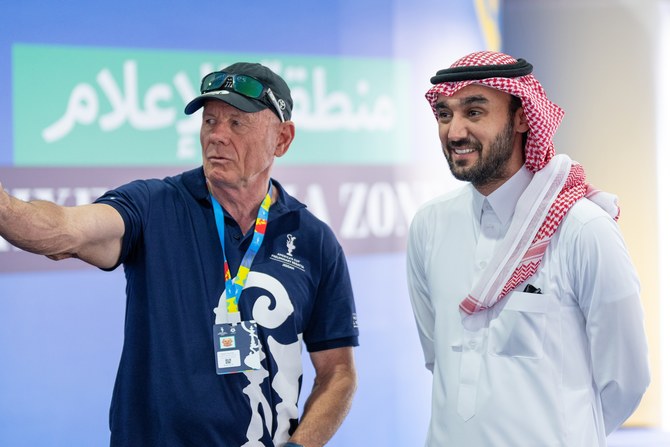
Saudi minister of sport Prince Abdulaziz bin Turki Al-Faisal with Grant Dalton, CEO of the America's Cup. (Supplied)
Short Url
Updated 01 December 2023
Follow

Emirates Team New Zealand sail into early lead as America’s Cup gets underway in Jeddah

  • The New Zealanders win the first 2 of the day’s 3 races to top the overnight standings on 22 points, ahead of Italian team Luna Rossa Prada Pirelli on 18

JEDDAH: Emirates Team New Zealand dominated the first day of racing with two wins as the America’s Cup Preliminary Regatta in Jeddah began on Thursday. They topped the overnight standings with 22 points, followed by Luna Rossa Prada Pirelli of Italy on 18.

In the first race of the day, the New Zealanders finished ahead of British team INEOS Britannia, Swiss team Alinghi Red Bull Racing, and Orient Express Racing Team of France. American Magic were disqualified for leaving the regatta boundaries.

New Zealand’s success continued in race two, in which they finished ahead of Alinghi, INEOS, Luna Rossa, who had problems at the start, French team Orient Express and American Magic.

In the third race, Luna Rossa put in a very strong and controlled performance to win by a good margin, easily finishing clear of Orient Express, Alinghi, INEOS and New Zealand. American Magic once again were disqualified.

“It was a good start for us today, despite the error we committed in the third race, but we managed to be on the top,” Peter Burling, New Zealand’s skipper, told Arab News.

Ruggero Tita, helmsman for Luna Rossa, said: “We are super happy about this last-race win. Of course, it was a super-tricky race but we managed to arrive at the end on the foils which means that we did a really good job.”

The Swiss team of helmsmen Arnaud Psarofaghis and Maxime Bachelin, and trimmers Yves Detrey and Bryan Mettraux, faced lighter than expected winds as they put their full focus on staying up on the foils. The crew challenged for a podium place in the first race, finished second in race two, and then successfully chased down several boats from behind after a start penalty in in the third race to grab third place. They finished the day tied for third with INEOS on 15 points.

“It was a solid day for the team, one of those days where you come back (to be) in the middle of the standings and you say, ‘It could have been better but it also could have been a lot worse,’” said Pietro Sibello, their performance coach.

“So overall, I think it was a good day. We should all be happy and hungry for an even better day tomorrow.”

Arnaud Psarofaghis, the Swiss skipper said: “It was really tough conditions. Today was about sailing the boat as well as we could, and mainly about staying on the foils. The last week of training was really useful for us out there, given the marginal conditions.”

Three races are scheduled for Friday, followed by two on Saturday, after which the top two teams will advance to the final.


Arab Cup 2025 attendance surpasses recent AFCON and AFC Asian Cup

Updated 5 sec ago
Follow

Arab Cup 2025 attendance surpasses recent AFCON and AFC Asian Cup

  • The tournament, held under FIFA jurisdiction for the second time, achieved a record average attendance of 38,644 fans per match
  • Total attendance more than doubled since 2021, with Algeria vs. UAE quarter-final pushing it past one million spectators

RIYADH: For a tournament often dismissed by critics as little more than a friendly or “B-team” competition, the 2025 Arab Cup delivered a compelling response.

A total of 1,236,600 people attended the 32 matches across the tournament, an average of 38,644 spectators per game, as the Arab Cup returned to Qatar for a second consecutive time after its successful staging in 2021. That earlier tournament, initially launched as a Confederations Cup-like test event ahead of the World Cup, drew 571,605 spectators in total.

Despite those figures, the Arab Cup has faced persistent criticism. Questions have been raised around the quality of play and refereeing standards, with some supporters – both within and beyond the Arab world – branding the tournament “meaningless.”

Yet when placed alongside recent continental competitions, the attendance figures tell a different story.

The 2023 African Cup of Nations in Ivory Coast attracted 1,109,593 fans across 52 matches, an average of 21,338 per game. Meanwhile, the 2023 AFC Asian Cup, also hosted in Qatar, recorded 1,507,790 spectators over 51 matches — roughly 29,565 per game, the highest average in the competition’s history.

Direct comparisons, however, require context. Continental — as opposed to regional — competitions draw support from across vast geographies, while the Arab Cup benefits from strong expatriate communities based in the host nation. Expecting the same travel patterns from fans in East Asia or West Asia would be, to say the least, unrealistic.

Even so, the attendance of more than 38,000 fans per game is significant. The Arab Cup was not always popular, with the attendance in 2021 struggling to rise above an average of 17,000 per game. Only four games at the 2025 edition fell below the 20,000 mark.

Historical context further underlines this shift. The 2011 AFC Asian Cup in Qatar, along with multiple editions of the West Asian Football Federation Championship held across the region, struggled to surpass a figure of 13,000 fans per game.

While Morocco will bask in the glory of the 2025 Arab Cup, the tournament itself has shown a broader shift in football engagement across the Arab World — one no longer driven solely by interest in European leagues, but by growing confidence in domestic teams, national projects and regional competitions.

From Saudi Arabia’s ambitions in club football to Morocco’s recent international success and Qatar’s continued role as a host, momentum continues to build across the Middle East and North Africa, with the Arab Cup one of the latest competitions offering tangible evidence of that change.