

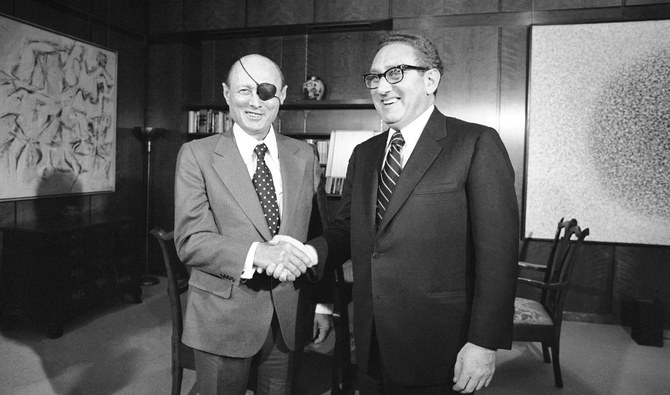

TOKYO: Global leaders paid tribute to former US Secretary of State Henry Kissinger on Thursday, but there was also sharp criticism of the man who remained an influential figure decades after his official service as one of the most powerful diplomats in American history.
Kissinger, who died on Wednesday at 100, drew praise as a skilled defender of US interests. On social media, though, he was widely called a war criminal who left lasting damage throughout the world.
“America has lost one of the most dependable and distinctive voices” on foreign affairs, said former President George W. Bush, striking a tone shared by many high-level officials past and present.
“I have long admired the man who fled the Nazis as a young boy from a Jewish family, then fought them in the United States Army,” Bush said in a statement. “When he later became Secretary of State, his appointment as a former refugee said as much about his greatness as it did America’s greatness.”
Kissinger served two presidents, Richard Nixon and Gerald Ford, and dominated foreign policy as the United States withdrew from Vietnam and established ties with China.
Criticism of Kissinger, who was awarded the Nobel Peace Prize for his role in negotiating a ceasefire in Vietnam in 1973, was especially strong on social media, where many posted celebratory videos in reaction to his death.
A Rolling Stone magazine headline said, “Henry Kissinger, war criminal beloved by America’s ruling class, finally dies.”
Across South America, Kissinger is remembered as a key figure that helped prop up bloody military dictatorships, claiming they would put the brakes on socialism in the region.
Documents have shown Kissinger’s and Nixon’s support for the 1973 coup that deposed Chile’s president. Gen. Augusto Pinochet’s dictatorship went on to violate human rights, murder opponents, cancel elections, restrict the media, suppress labor unions and disband political parties.
“A man has died whose historical brilliance never managed to conceal his profound moral misery,” Chile’s Ambassador to the United States, Juan Gabriel Valdes, wrote on X. Chile’s leftist President Gabriel Boric retweeted the message.
The head of the independent Documentation Center of Cambodia, Youk Chhang, described Kissinger’s legacy as “controversial” though not widely debated in the country. Well over half of the population was born after the Khmer Rouge were ousted in 1979, and even those who lived through the civil war and the group’s brutal rule recall the US involvement and its B-52 bombers, “but not Henry Kissinger,” he said.
“Henry Kissinger’s bombing campaign likely killed hundreds of thousands of Cambodians — and set (a) path for the ravages of the Khmer Rouge,” Sophal Ear, a scholar at Arizona State University who studies Cambodia’s political economy, wrote on The Conversation.
Nixon’s daughters, Tricia Nixon Cox and Julie Nixon Eisenhower, said their father and Kissinger enjoyed “a partnership that produced a generation of peace for our nation.”


