Leaders, experts gather in Riyadh to push limits of human healthspan

1 / 3
The summit aims to foster meaningful discussion and encourage advancement, investment, and international cooperation. (Supplied)
2 / 3
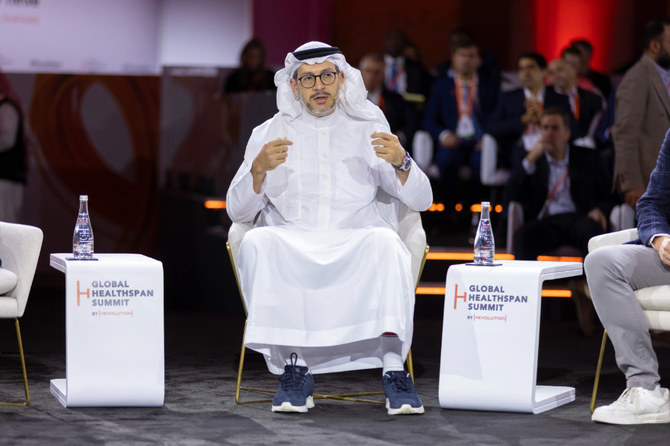
The panel explored the Kingdom’s role in extending a healthy human lifespan, in line with Vision 2030. (Supplied)
3 / 3
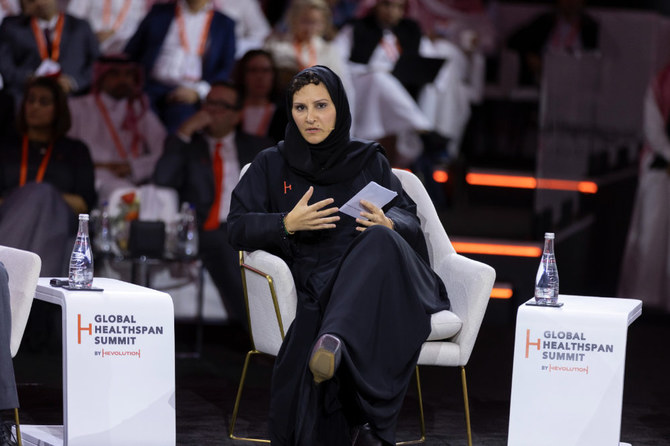
“The foundation has a very simple, clear, and impactful message, that is extending healthy lifespan for the benefit of all humanity," said Princess Haya. (Supplied)
Short Url
Updated 29 November 2023
Follow

Leaders, experts gather in Riyadh to push limits of human healthspan

  • ‘Health of humans comes first under Vision 2030,’ says ministry official

RIYADH: Leaders and industry experts have gathered at the Global Healthspan Summit this week to turn a spotlight on promises to revolutionize views on aging, life expectancy, and healthspan science.  

Issues related to chronic diseases and socioeconomic disparities because of inequalities and other factors will be among topics discussed at the event, organized by the Hevolution Foundation and being held in Riyadh until Thursday.  

Princess Haya bint Khaled, the foundation’s vice president of strategy and development, was part of a first-day session titled “Making the Case for the Healthspanned Society — What Now, What Next.” 

She was joined by Tareef Alaama, deputy minister of health for curative services, Peter Fedichev, co-founder of Gero, Henk Heidekamp, managing director of the European Research Institute for the Biology of Aging, and Jerry McLaughlin, CEO of Life Biosciences. 

The talk was one of several aimed at fostering meaningful discussion and encouraging advancement, investment, and international cooperation.  

Princess Haya said: “The foundation has a very simple, clear, and impactful message — (we are working to) extend healthy lifespan for the benefit of all humanity and develop breakthroughs or innovative tools to address diseases that we see increasing.”  

On Saudi Arabia’s role in extending a healthy human lifespan, in line with Vision 2030, Alaama said: “The health of humans comes first under Vision 2030. Among the promises is to increase the life expectancy of individuals from what it used to be in 2016, which is (from) 74 to 80 years of age by 2030. 

“To achieve that, we have developed a strategy that looks at scientific methods and data-driven methods … we utilize data, we collect statistics, we go to the nitty-gritty details, looking at variability aging among sectors and regions.” 

Ultimately, this would mean interventions could be designed and implemented in ways most effective for increasing human life expectancy, he added. 

Examples of those by the Ministry of Health included looking at modifiable risk factors and treating hypertension, both of which could add two years to life expectancy. 

The panel also examined challenges faced by the health sector as it moved forward to expand lifespan. One such issue was the lack of funding for the biology of aging. 

Heidekamp said: “In the Netherlands, we have the foundations for cancer research and Alzheimer’s research, but there’s no funding for aging.”  

The Hevolution Foundation has committed to advancing age sciences by investing up to $1 billion annually in aging research and healthspan science. 

It recently announced the selection of 11 Saudi researchers in the field of aging sciences to receive two-year grants worth SR10 million ($2.6 million), making the program one of the most impactful initiatives in the field of aging in the Kingdom.  

The development of diagnostics and therapeutics together was identified as another challenge.  

Mehmood Khan, the foundation’s CEO, said: “As a patient, as a consumer, to have your aging biology tested determines not just how old the body is but also how old the different organ systems in your body are.” 

But he noted that aging was not so straightforward. 

“Not everybody ages the same way. So, to go to a doctor and say, ‘just tell me how old I am,’ is way too simplistic. 

“We all know people who, for example, have very young bodies but their minds are aged. We know others whose bodies are aged, but their minds are still very young. 

“We are now evaluating the best technologies in the world, bringing them all under one roof to see what that looks like,” Khan added.


Rooted in memory: How Rola Daftardar turns Saudi heritage into living art

Updated 5 sec ago
Follow

Rooted in memory: How Rola Daftardar turns Saudi heritage into living art

  • Ma Maison by Rola curates, produces home accessories
  • Aim to reflect Kingdom as ‘authentic, layered and artistic’

RIYADH: For Rola Daftardar, creativity is not simply about design — it is about memory, emotion and belonging.

Saudi by birth, originally from Madinah and raised in Jeddah, Daftardar carries a layered identity shaped further by her Lebanese mother. That blend of cultures, she says, taught her early on to see beauty in contrast and turn it into strength.

“My identity has always been a mix,” she said during a recent interview. “It taught me how to appreciate detail, emotion and storytelling through objects.”

From childhood, she was drawn to art and pieces with soul — objects that feel lived with rather than merely displayed. She went on to study arts, history and media, developing a philosophy that creativity is not only aesthetic but deeply emotional.

“Design is a way of sharing parts of myself,” she explained. “It’s storytelling through material, color and scent.”

Four years ago, that philosophy became Ma Maison by Rola — a brand that began as a personal creative outlet and gradually grew, season by season, into a carefully curated world of home accessories and tablescaping pieces.

Each year, she approaches her collections as chapters. “Every season has its own breath,” she said. “Every year carries a new intention.”

Her work comes most alive during Ramadan and national occasions, when gatherings take center stage and homes become spaces of shared ritual. Between winter and summer, ideas quietly bloom. But this year’s message feels especially personal.

Daftardar’s latest collection is deeply rooted in Saudi heritage, inspired by cities including Jeddah, Riyadh, AlUla and Taif — places she sees as emotional landscapes as much as geographic ones.

“With Saudi Arabia opening to the world, I felt a responsibility to present my country as I see it — authentic, layered and artistic,” she said.

Candles became the starting point of that story. More than fragrance, they are tributes to memory. Musk reflects the warmth of Jeddah, rose captures the calm elegance of Taif, and oud represents the depth and strength of Riyadh.

Hand-painted details and carefully chosen colors complete the sensory narrative.

The idea for her foldable side tables emerged during a walk along Jeddah’s corniche. Watching families gather spontaneously by the sea reminded her of the informal spaces that connect people — a feeling she also associates with historic Al-Balad.

“I wanted to create something simple and functional that carries that spirit of gathering,” she said.

The concept expanded to Diriyah — old and new — and to AlUla, where history and futurism coexist.

Yet it is tablescaping that remains closest to her heart. “I never choose pieces randomly,” she said. “I imagine the people around the table, the dishes being served, the conversations happening.”

For Daftardar, every bowl, riser and glass element forms part of a complete narrative. Every table tells a story.

Her ultimate aim is clear: to reflect Saudi Arabia as she feels it — warm, generous and deeply rooted. A place where modernity meets origin, and tradition evolves without losing its soul.

That is where Ma Maison by Rola lives — in the space between memory and modernity — and it is a story she is proud to tell.