Where We Are Going Today: ‘MiSora’ - Japanese fusion food in Jeddah

1 / 2
Photo/Supplied
2 / 2
Photo/Supplied
Short Url
Updated 29 November 2023
Follow

Where We Are Going Today: ‘MiSora’ - Japanese fusion food in Jeddah

  • Abrahams told Arab News: “From the kitchen to the table, from the preparation to the presentation, our dishes will exude the traditions of Japan and I am confident that the locals will notice”

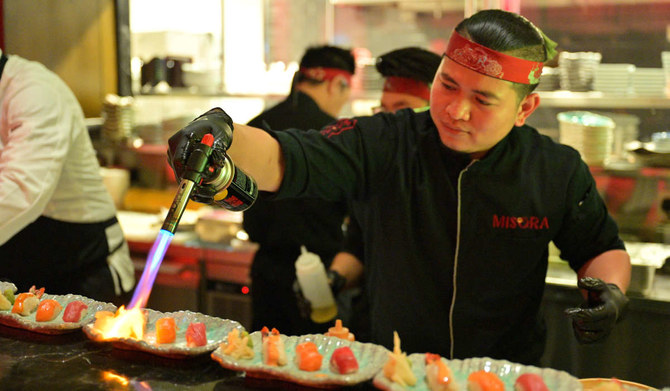
Following its recent grand opening, MiSora has become the latest addition to a growing list of restaurants in Jeddah offering Japanese fusion food.

Located on Prince Sultan Road in the city’s Al-Rawdah district, the fine-dining eatery has placed its focus on serving authentic Japanese cuisine.

Dishes include traditional sashimi and specialty rolls prepared with a regional approach, fresh ingredients, and eye-catching presentations.

Head chef Rafiq Abrahams has worked under the wings of top Middle East chefs such as Shane Macneill and Colin Clague.

Abrahams told Arab News: “From the kitchen to the table, from the preparation to the presentation, our dishes will exude the traditions of Japan and I am confident that the locals will notice.”

The restaurant’s interior creates a relaxing ambiance enhanced by attentive staff, while its menu contains seafood options including prawn tempura, duck and king crab salads, and sashimi salmon.

As well as lamb cuttles, there is a range of desserts such as banoffee, and five types of petit fours, and diners can sample drinks such as a Pink Lady and You’re So Beautiful, or speciality coffees.

For updates and more information, go to Instagram at @misora_sa.


Chef serves up a taste of Spain at Ithra Cultural Days in Saudi Arabia 

Updated 20 January 2026
Follow

Chef serves up a taste of Spain at Ithra Cultural Days in Saudi Arabia 

DHAHRAN: Among the attractions of the Ithra Cultural Days: Spain at the King Abdulaziz Center for World Culture (Ithra), visitors can try a tantalizing selection of Spanish foods — none more renowned than its famous paella. 

Arab News spoke with chef Jose Zafra at the event, which runs until Jan. 31, who flew in from Spain to offer a taste of his homeland to the people of Saudi Arabia. 

A “master rice cook, paella researcher and promoter,” according to his business card, his logo is even designed around the recognizable cooking pan and the phrase “Pasion por la paella,” or “Passion for paella.”

“That's why the pan is round because people get around and eat all together — to share culture and passion and life,” Zafra told Arab News as foodies lined up behind him, eager to try a plateful.

Arab News spoke with chef Jose Zafra at the event, which runs until Jan. 31. (Supplied)

“It’s not just a food. It’s a link, a connection. Paella is the symbol of unity and sharing. And people now are going to try it — authentic Spanish paella in Saudi Arabia.”

The word “paella” comes from the Latin “patella,” meaning pan.

In Spanish, it refers both to the rice dish itself and the pan in which it is cooked.

Paella was introduced to Spain during Moorish rule. It originated in Valencia, on the country’s eastern coast, as a rural peasant dish that was cooked by farm workers over open fires using local ingredients. Over time, the dish’s popularity spread and other versions evolved, for example featuring seafood and meat.

It is different to Saudi Arabia’s kabsa, a communal dish which similarly uses rice and meat. Kabsa is cooked in a deep pot to ensure the rice stays soft and aromatic from the meaty broth, whereas paella uses a wide, shallow pan to fully absorb flavors evenly, often creating a prized crispy layer at the bottom. 

Visitors to Ithra’s Culture Days can enjoy the flavors of Spain made with a sprinkling of local love — true to the origins of the dish.

Find the scoops of Spanish joy near the food truck area and try chicken paella, seafood paella —or both! You will see the signs offering a plate, at SR35 ($9) for chicken and SR40 for seafood, or let your nose lead you there.

Zafra concluded: “The chicken is from here, the seafood is from here — and the passion, well, that is from Spain.”