

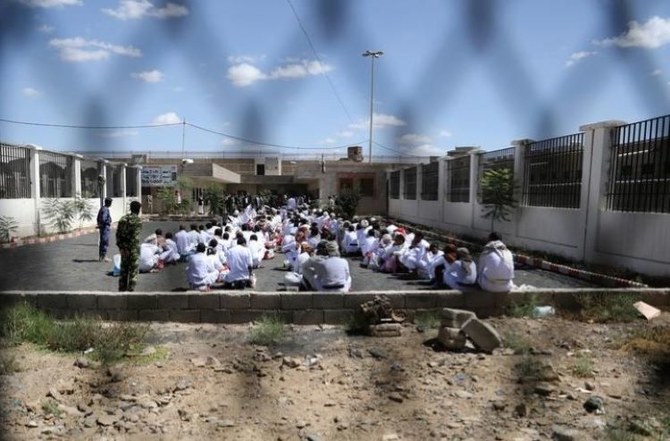

AL-MUKALLA: A Yemeni government soldier has died of torture inside a Houthi detention facility in Sanaa, the fourth confirmed prisoner dying as a result of torture in less than a month, Yemeni government officials and activists said.
The Houthis recently requested that the family of Yanouf Hassan Ali Al-Batenah collect his remains without providing details regarding the cause of death.
Al-Batenah, a soldier of the Yemeni army’s 7th Military Region, was seized by the Houthis in November 2020 while fighting with Yemeni government troops in the Mas area in the province of Marib.
For three years, the Houthis had forcefully disappeared the Yemeni soldier and refused his family’s repeated requests to see him or learn his location.
Yemeni human rights advocates and authorities reported that the 26-year-old soldier was mercilessly tortured to death in a notorious Houthi intelligence jail in Sanaa.
Al-Batenah’s death occurred only days after the Houthis said that Yemeni government soldier Mohammed Ahmed Wahban, who was captured by the Houthis during the same fight in Mas, committed suicide inside the military prison in Sanaa by hanging himself.
Yemeni activists, citing a Houthi death sentence against him, contradicted the Houthis’ assertions, saying that the Houthis brutally tortured and murdered Wahban.
Two more inmates have died within Houthi detentions since late last month, including a Yemeni citizen working for the international organization Save the Children.
The Houthis repeatedly rejected pleas from Save the Children, local and international rights organizations, and foreign envoys in Yemen to provide explanations for the deaths of captives in their hands.
Yemeni Information Minister Muammar Al-Eryani said on Monday that 350 inmates died of abuse within Houthi detention facilities out of 1,635 recorded cases of torture since 2015 and that the Houthis maintain 237 official jails and another 128 hidden prisons throughout territories under their control.
“We reaffirm our request to the International Committee of the Red Cross and international and local human rights groups to launch an open inquiry into the crimes of murder and torture committed by Houthi militia in detention facilities,” the Yemeni minister said on X.
Meanwhile, a delegation of EU ambassadors to Yemen completed their visit to Yemen’s temporary capital, Aden, on Tuesday by expressing their support for the Presidential Leadership Council and the Yemeni government’s efforts to improve revenues and combat corruption.
“They praised the government’s work aimed at raising revenue and stabilizing the economy, continuing implementing reforms and improving service delivery under extremely challenging circumstances in a very complex regional context,” the EU ambassadors to Yemen said in a joint statement.


