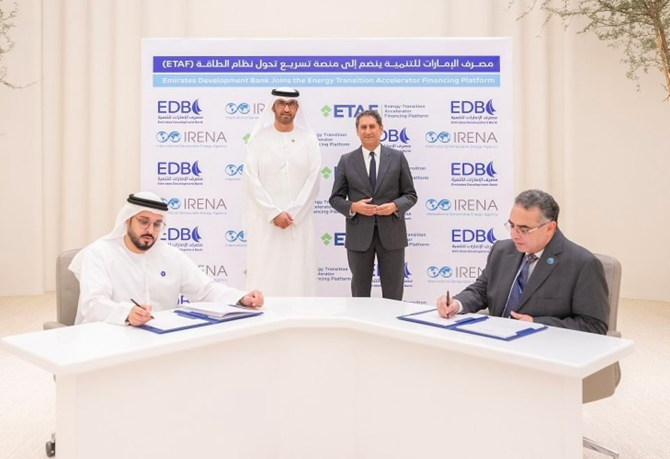

RIYADH: Renewable energy projects in emerging economies are set to receive a 1.3 billion dirhams ($350 million) financial injection from the UAE’s development bank.
This announcement came as the Emirates Development Bank and the International Renewable Energy Agency signed a collaborative partnership agreement.
This involves the Energy Transition Accelerator Financing Platform, an international renewable energy agency multi-stakeholder body aimed at expediting financing for projects in developing nations and facilitating funding for such initiatives, as reported by the UAE news agency, WAM.
The deal was inked by Ahmed Mohamed Al-Naqbi, EDB’s CEO and Ahmed Badr, director of IRENA’s project facilitation and support division. The signing was attended by Sultan Al-Jaber, minister of industry and advanced technology, UN Climate Change Conference president and chairman of EDB, and Francesco La Camera, IRENA’s director general.
Under the agreement, EDB will offer financing for projects endorsed by IRENA that align with the Paris Agreement and the UN Sustainability Development Goals through the ETAF Platform. EDB will leverage its project financing expertise and engage in collaboration with other ETAF partners to secure funding for the suggested projects.
Al-Jaber said that they are very pleased to sign “this timely agreement with IRENA, just days ahead of COP28, where we will rally the world around the goal of keeping 1.5 degrees Celsius within reach,” adding that the event marks the first global stocktake since the Paris Agreement.
He further noted that the agreement is a significant milestone in providing adequate climate financing to drive global investments that meet the 2030 global goals and fast-track a just, equitable, orderly, and responsible energy transition.
“The UAE is one of the largest investors globally in renewable energy, having invested over 183 billion dirhams in renewable energy projects in 70 countries. Therefore, as a key enabler of the UAE’s national development and diversification agenda, EDB continues to drive investments to accelerate the deployment of renewable energy and drive economic growth,” Al-Jaber said.
He emphasized that the EDB-IRENA agreement reflects the nation’s commitment to bolster global collaboration and scale up financing of renewable energy projects to achieve global climate goals. “We are proud of this new collaboration which will scale up climate change mitigation and adaptation efforts on the road to COP28 and beyond,” Al-Jaber explained.
The new agreement reinforces the long-term partnership between the UAE and IRENA. It underscores the country’s commitment to contribute 1.46 billion dirhams in funding from the Abu Dhabi Fund for Development to support ETAF’s objective of mobilizing funds. The goal is to achieve an additional deployment of 1.5 gigawatts of clean renewable energy generation and storage by 2030.
IRENA’s director general emphasized that rapidly falling costs have positioned renewable energy as the most cost-effective climate solution. This development addresses the challenge of rising emissions and the increasing demand for energy.
“This is why, together with the COP28 presidency, we are advocating for a tripling of global renewable power by 2030, a key step to limit temperature rise to 1.5 degrees Celsius,” Camera said.
Al-Naqbi expressed the commitment to support the nation’s aspirations for a just, equitable, orderly, and responsible energy transition.
“EDB offers bespoke financing solutions to support businesses addressing the challenges and opportunities in the renewables sector. Our new partnership with IRENA comes at a critical time as the UAE prepares to host COP28 and bolster global efforts towards sustainable economic development,” he said.
Al-Naqbi added that through the ETAF platform, they will cultivate a robust pipeline of bankable renewable energy projects and support entrepreneurs in bringing high-quality, sustainable, and financially viable clean energy businesses to the market.
“This will not only help EDB deliver strong economic, social and environmental impact, but will consolidate the UAE’s position as a pioneering global hub for renewable energy technology and manufacturing,” he concluded.