

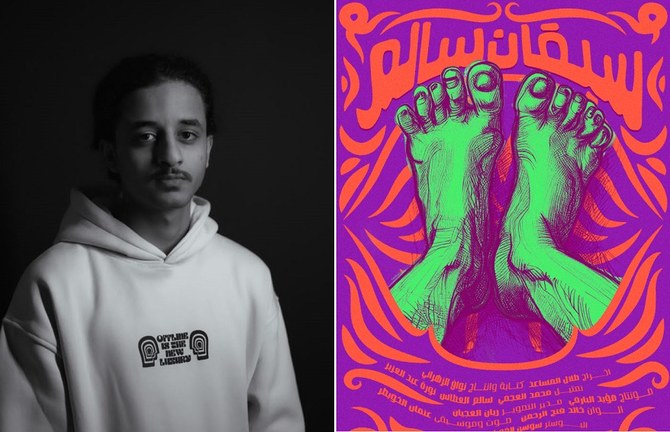

RIYADH: At just 18, Saudi filmmaker Talal Almusaad is making his cinema debut with a short film titled “Salem’s Legs” at the Red Sea International Film Festival.
Almusaad was raised in the Eastern Province city of Dhahran at a time when cinemas were nonexistent in the Kingdom. Nevertheless, he saw films, notably the “Halloween” movie franchise, during visits to Bahrain. He cites Hollywood film giants Stanley Kubrick and Quentin Tarantino as among his favorite directors.
“From childhood, all I wanted to do was tell stories,” Almusaad, who is based in Riyadh, told Arab News.
The fledgling director said that he is interested in making films about Saudi culture for non-Arab audiences, but also wants to surprise Arab audiences with “creepy and weird” plots.
“I want to make something new in Saudi cinema,” he said.
“Salem’s Legs,” which runs for just five minutes, is an Arabic-language dark comedy about two young friends, Salem and Mohammed. When the former swallows an anonymous pill and collapses, Mohammed panics and believes that his friend has died. He tries to get rid of Salem’s body by rolling it up in a carpet. Their adventures lead them to the Saudi desert.

‘Salem’s Legs,’ which runs for just five minutes, is an Arabic-language dark comedy. (Supplied)
“It’s a weird, psychedelic movie. You can even see that in our poster,” said the director of the fluorescent pop-art design.
“There is no message in the film, but that is the message: You don’t have to do a film with a message just to brag and say you’re an artist.”
The plotline was put together by scriptwriter Nawaf Alzahrani and the film features three actors, Mohammed Alajmi, Salem Alattas, and Norah Abdalaziz.
“I told the group, ‘Let’s make something we love. Don’t think about if we win or lose at the Red Sea Festival.’”
The film was shot in just 48 hours and will be screened at Vox Cinema in the Red Sea Mall on Dec. 5 and 8.
It is a surreal experience for Almusaad to showcase his work at the festival, as he only recently graduated from high school and hopes to study filmmaking abroad.
He would like to shoot one more film in his homeland, which has recently undergone a major transformation in terms of cinema access and production. At the festival alone, there are more than five Saudi feature films screening this year.
“If you told me five years ago that many filmmakers will do films in Saudi Arabia, I would not have believed that. It’s crazy,” Almusaad said.


