

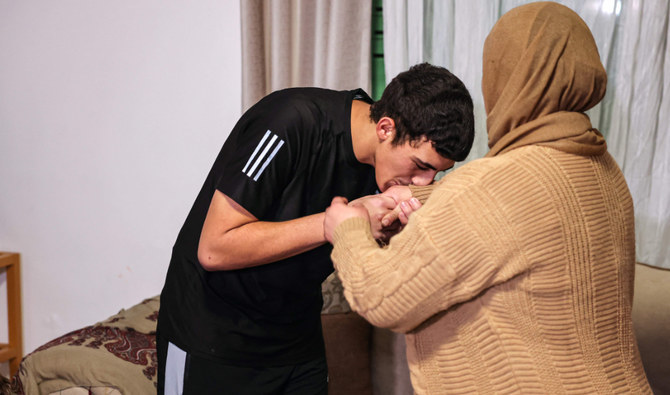

TEL AVIV, Israel: Israel and Hamas agreed to extend their cease-fire for two more days past Monday, raising the prospect of further exchanges of militant-held hostages for Palestinians imprisoned by Israel and a longer halt to their deadliest and most destructive war.
Eleven Israeli women and children, freed by Hamas, entered Israel Monday night after more than seven weeks in captivity in Gaza in the fourth swap under the original four-day truce, which began Friday and was due to run out. Thirty-three Palestinian prisoners released by Israel arrived early Tuesday in east Jerusalem and the West Bank town of Ramallah. The prisoners were greeted by loud cheers as their bus made its way through the streets of Ramallah.
The deal for two additional days of cease-fire, announced by Qatar, raised hopes for further extensions, which also allow more aid into Gaza. Conditions there have remained dire for 2.3 million Palestinians, battered by weeks of Israeli bombardment and a ground offensive that have driven three-quarters of the population from their homes.
Israel has said it would extend the cease-fire by one day for every 10 additional hostages released. After the announcement by Qatar — a key mediator in the conflict, along with the United States and Egypt — Hamas confirmed it had agreed to a two-day extension “under the same terms.”
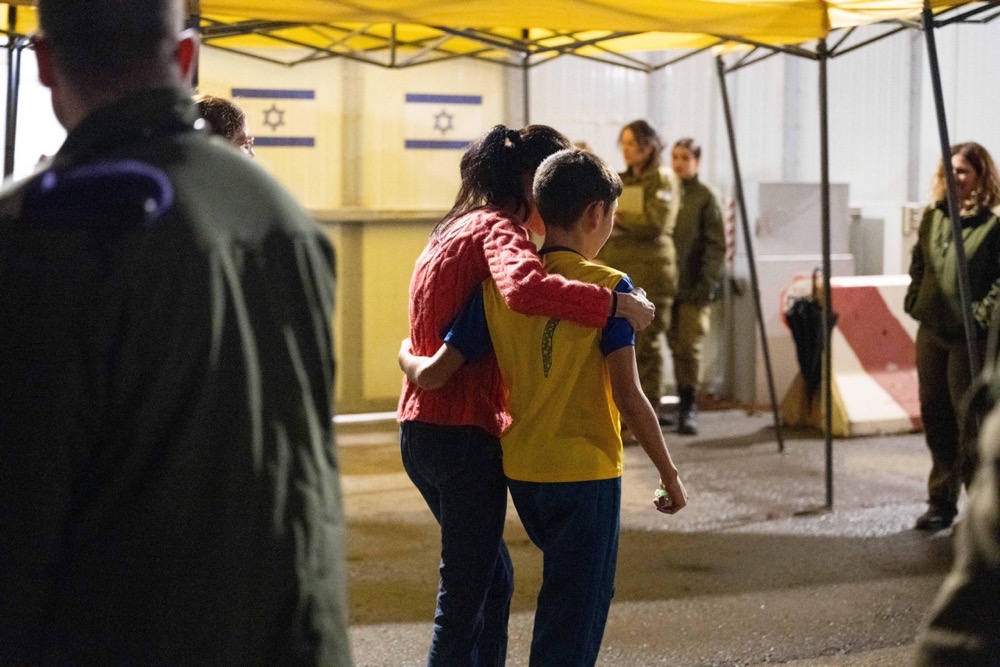
Eitan Yahalomi, 12, walks with his mother at the Kerem Shalom border crossing. (Reuters)
But Israel says it remains committed to crushing Hamas’ military capabilities and ending its 16-year rule over Gaza after its Oct. 7 attack into southern Israel. That would likely mean expanding a ground offensive from devastated northern Gaza to the south.
Monday’s releases bring to 51 the number of Israelis freed under the truce, along with 19 hostages of other nationalities. So far, 150 Palestinians have been released from Israeli prisons.
After weeks of national trauma over the roughly 240 people abducted by Hamas and other militants, scenes of the women and children reuniting with families have rallied Israelis behind calls to return those who remain in captivity.
“We can get all hostages back home. We have to keep pushing,” two relatives of Abigail Edan, a 4-year-old girl and dual Israeli-American citizen who was released Sunday, said in a statement.
Hamas and other militants could still be holding up to 175 hostages, enough to potentially extend the cease-fire for two and a half weeks. But those include a number of soldiers, and Hamas is likely to make much greater demands for their release.
FOURTH RELEASE
The newly released hostages included three women and nine children — including 3-year-old twin girls and their mother — from the kibbutz Nir Oz, a community near Gaza that was hard hit in Hamas’ Oct. 7 attack. The kibbutz said 49 of its residents remain in captivity, including the father of the twins. The Israeli military said late Monday that the hostages were undergoing initial medical checks in Israel before being reunited with their families.
Most of the hostages freed so far have appeared to be physically well. But 84-year-old Elma Avraham, released Sunday, was airlifted to Israel’s Soroka Medical Center in life-threatening condition because of inadequate care, the hospital said.
Avraham’s daughter, Tali Amano, said her mother was “hours from death” when she was brought to the hospital. Avraham is currently sedated and has a breathing tube, but Amano said she told her of a new great-grandchild who was born while she was in captivity.
Avraham suffered from several chronic conditions that required regular medications but was stable before she was kidnapped, Amano said Monday.
So far, 19 people of other nationalities have been freed during the truce, mostly Thai nationals. Many Thais work in Israel, largely as farm laborers.
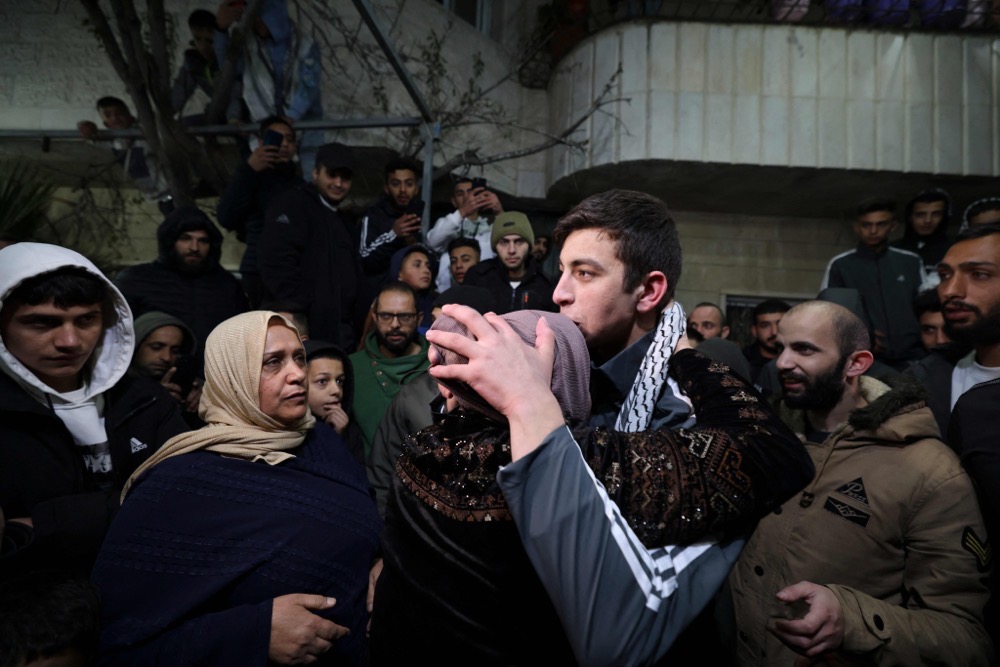
Palestinian prisoner Khalil Zama' (R) hugs his mother after being released from an Israeli jail. (AP)
France said three of the hostages released Monday were French-Israeli dual citizens, two 12-year-olds and one 16-year-old. The French government is ‘’working tirelessly’’ to free five other French citizens held hostage, the French Foreign Ministry said in a statement.
The Palestinian prisoners released so far have been mostly teenagers accused of throwing stones and firebombs during confrontations with Israeli forces, or of less-serious offenses. But some were convicted in alleged attempts to carry out stabbings, bombings and shootings. Many Palestinians view prisoners held by Israel, including those implicated in attacks, as heroes resisting occupation.
The freed hostages have mostly stayed out of the public eye, but details of their captivity have started to trickle out.
Merav Raviv, whose three relatives were released Friday, said they had been fed irregularly and lost weight. One reported eating mainly bread and rice and sleeping on a makeshift bed of chairs pushed together. Hostages sometimes had to wait for hours to use the bathroom, she said.
In Washington, White House National Security Council spokesman John Kirby welcomed the extension of the truce.
“We would, of course, hope to see the pause extended further, and that will depend upon Hamas continuing to release hostages,” Kirby told reporters.
RESPITE IN GAZA
More than 13,300 Palestinians have been killed since the war began, roughly two-thirds of them women and minors, according to the Health Ministry in Hamas-ruled Gaza, which does not differentiate between civilians and combatants. More than 1,200 people have been killed on the Israeli side, mostly civilians killed in the initial attack. At least 77 soldiers have been killed in Israel’s ground offensive.
The calm from the truce allowed glimpses of the destruction wreaked by weeks of Israeli bombardment that leveled entire neighborhoods.
Footage showed a complex of several dozen multistory residential buildings that had been pummeled into a landscape of wreckage in the northern town of Beit Hanoun. Nearly every building was destroyed or severely damaged, some reduced to concrete frames half-slumped over. At a nearby UN school, the buildings were intact but partially burned and riddled with holes.
The Israeli assault has driven three-quarters of Gaza’s population from their homes, and now most of its 2.3 million people are crowded into the south. More than 1 million are living in UN shelters. The Israeli military has barred hundreds of thousands of Palestinians who fled south from returning north.
Rain and wind added to the hardship of displaced Palestinians sheltering in the compound of Al-Aqsa hospital in central Gaza. Palestinians in coats baked flatbreads over a makeshift fire among tents set up on the muddy grounds.
Alaa Mansour said the conditions are simply horrendous.
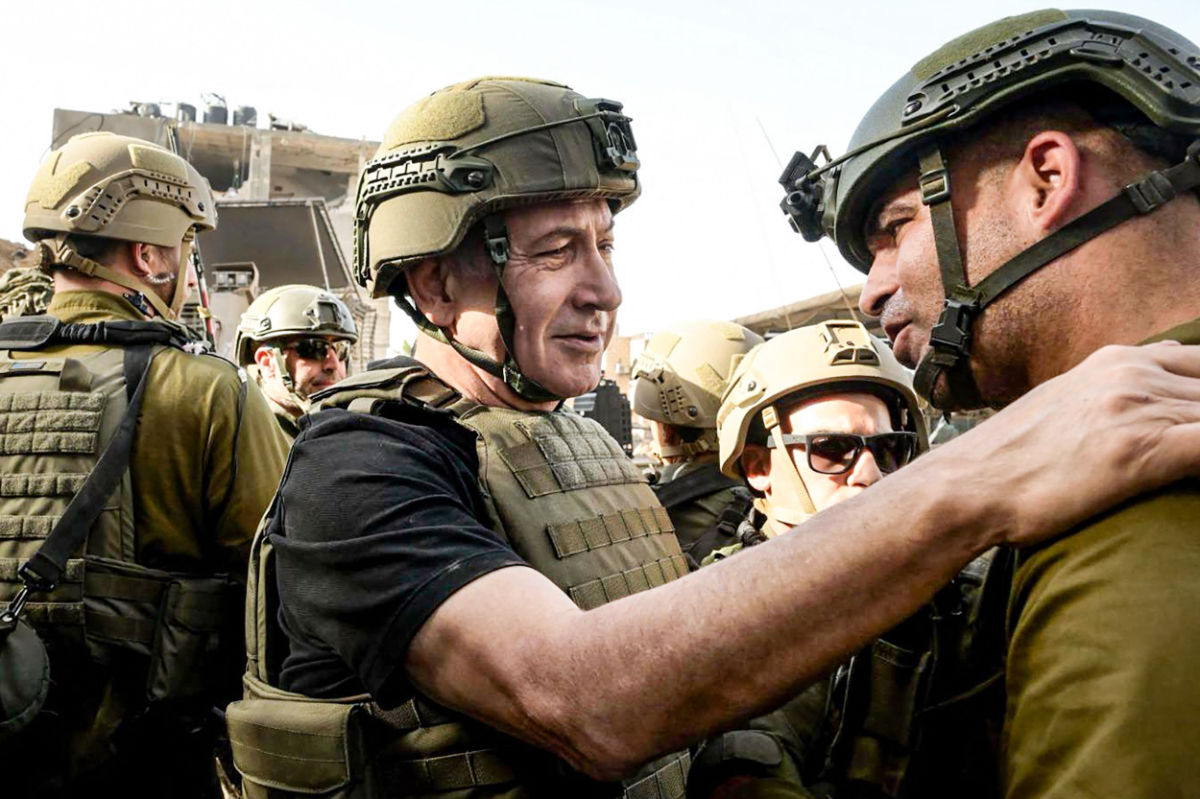
In this handout picture taken and released by the Israeli Prime Minister's Office on November 26, 2023 Israeli Prime Minister Benjamin Netanyahu (C) meets soldiers at undisclosed location in the Gaza Strip. (AFP)
“My clothes are all wet, and I am unable to change them.” said Mansour, who is disabled. “I have not drunk water for two days, and there’s no bathroom to use.”
The UN says the truce made it possible to scale up the delivery of food, water and medicine to the largest volume since the start of the war. But the 160 to 200 trucks a day is still less than half what Gaza was importing before the fighting, even as humanitarian needs have soared.
Long lines formed outside stations distributing cooking fuel, allowed in for the first time. Fuel for generators has been brought for key service providers, including hospitals and water and sanitation facilities, but bakeries have been unable to resume work, the UN said.
Iyad Ghafary, a vendor in the urban Nuseirat refugee camp in central Gaza, said many families were still unable to retrieve the dead from under the rubble left by Israeli airstrikes, and that local authorities weren’t equipped to deal with the level of destruction.
Many say the aid is not nearly enough.
Amani Taha, a widow and mother of three who fled northern Gaza, said she had only managed to get one canned meal from a UN distribution center since the cease-fire began.
She said the crowds have overwhelmed local markets and gas stations as people try to stock up on basics. “People were desperate and went out to buy whenever they could,” she said. “They are extremely worried that the war will return.”


