

The Oslo Accords are now dead, says an architect of deal

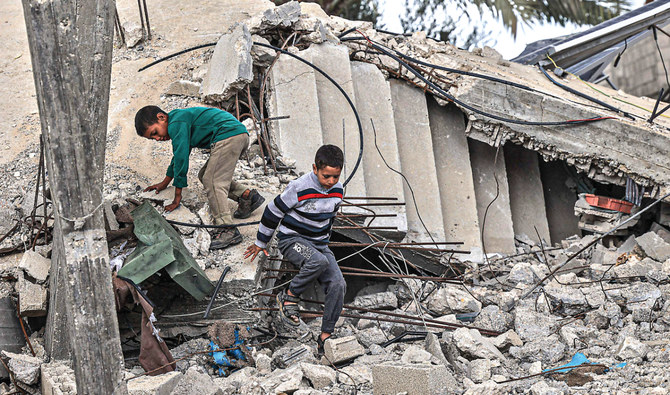
Palestinian boys walk amid the destruction caused by Israeli strikes in the village of Khuzaa, east of Khan Younis, on Monday. (AFP)
Short Url
Updated 27 November 2023
Follow

The Oslo Accords are now dead, says an architect of deal

  • Norwegian peace worker Jan Egeland: International mediation is the only viable way out of the conflict

OSLO: The Oslo Accords, which aimed to bring “peaceful coexistence” to Israel and the Palestinians, are now dead, one of the deal’s architects, said Norwegian peace worker Jan Egeland.

The agreement produced the iconic image of Palestinian President Yasser Arafat and Israeli Prime Minister Yitzhak Rabin shaking hands Sept. 13, 1993, on the White House lawn as President Bill Clinton watched.

It was the start of a delicate process: Israel and the Palestine Liberation Organization mutually recognized each other and created Palestinian self-government for an interim period of five years.

The aim was to give the two sides enough time to iron out several key issues, such as the status of Jerusalem, Israeli settlements, and the fate of Palestinian refugees — a process that struggled to make headway.

Now, 30 years later, with a new bloody war raging between Israel and Hamas in Gaza, Egeland was asked by AFP whether the accords were “pretty much dead.”

“Absolutely,” he said in an interview in his office in the Norwegian capital.

“The Oslo Accords are gone as an accord. Now, there will be another accord, and it will have to be led by the US, the EU, and the Arab countries.”

The accords were the culmination of 14 rounds of secret talks in Oslo, initiated and organized by, among others, Egeland, who was, at the time, a state secretary in the Foreign Ministry.

International mediation is the only viable way out of the conflict for the 66-year-old former diplomat who now heads the Norwegian Refugee Council humanitarian organization.

“It’s not possible for Israel and Hamas to negotiate the future of these lands (alone). There will be zero trust,” he said.

“Israel has waged (war) to destroy Hamas. Hamas is there to eliminate Israel.”

He said the “leaderships on either side are not at all at the level they were at the time of the Oslo Accords.”

Egeland said: “Those were visionary leaders, they were strong leaders, really leaders. Now we have populists on both sides.”

Pictures hanging on the wall behind Egeland show him shaking hands with Arafat and US President George Herbert Walker Bush. 

The current conflict erupted on Oct. 7 when Hamas fighters broke through Gaza’s militarized border in an attack Israeli officials said killed about 1,200 people.

Israel’s retaliatory strikes alongside a ground offensive have killed about 15,000 people.

“After this, there will be so much bitterness and hatred on both sides that there will be more violence,” Egeland said.

“It’s an illusion that Israel can bomb itself to security and peace.

“It is an illusion that by killing Israeli civilians, as (Hamas) did massively, and taking civilians as hostages (that) you can solve the problem of Israel existing.”

But the international community is not up to the task, he lamented.


Pakistan army chief tells Kabul to choose Islamabad or Taliban militants

Updated 21 December 2025
Follow

Pakistan army chief tells Kabul to choose Islamabad or Taliban militants

  • Pakistan blames Afghanistan for facilitating cross-border attacks in its territory, allegations Kabul denies
  • Ties have been strained since October, when border clashes left dozens dead on both sides

ISLAMABAD: Pakistan’s Chief of Defense Forces Field Marshal Syed Asim Munir has told Afghanistan to choose between Islamabad and the outlawed Tehreek-e-Taliban Pakistan militants, state media reported on Sunday as ties between both neighbors remain strained. 

Pakistan’s army and civilian government have both blamed the Afghan Taliban recently for facilitating cross-border attacks in Pakistan, a charge Kabul denies. Afghanistan said it does not allow its territory to be used for attacks against Pakistan and cannot be held responsible for Islamabad’s security challenges. 

Both countries were involved in border clashes in October in which dozens of soldiers were killed and wounded on both sides. Officials from Afghanistan and Pakistan have held peace talks in Qatar, Turkiye and Saudi Arabia over the past few months but failed to reach an agreement. 

“Chief of Army Staff and Chief of Defense Forces Field Marshal Syed Asim Munir has said Afghanistan will have to choose between Fitna Al-Khawarij and Pakistan,” state broadcaster Radio Pakistan reported. 

Munir was addressing the National Ulema and Mashaikh Conference in Islamabad earlier this month, state media said.

“Fitna Al-Khawarij” is a term the Pakistan military frequently uses for the TTP. 

Munir pointed out that 70 percent of the TTP’s formations that enter Pakistan from Afghanistan comprise Afghan citizens. 

“He said innocent citizens, including children, are being targeted through terrorism with the backing of the Afghan Taliban,” Radio Pakistan reported. 

While Pakistan and Afghanistan have agreed to a temporary ceasefire, tensions persist between the two countries as militant attacks persist in Pakistan. 

Pakistan summoned Afghanistan’s deputy head of mission on Friday and demanded “decisive action” against TTP militants after four Pakistani soldiers were killed in an attack on a military camp in northwest Pakistan. 

The foreign office said the Afghan government had been informed that Pakistan “reserves the right to defend its sovereignty and protect its citizens” and would take all necessary measures to respond to attacks originating from Afghan territory.

Afghanistan has warned Pakistan in the past against attacking its territory, saying it reserves the right to respond to such provocations.