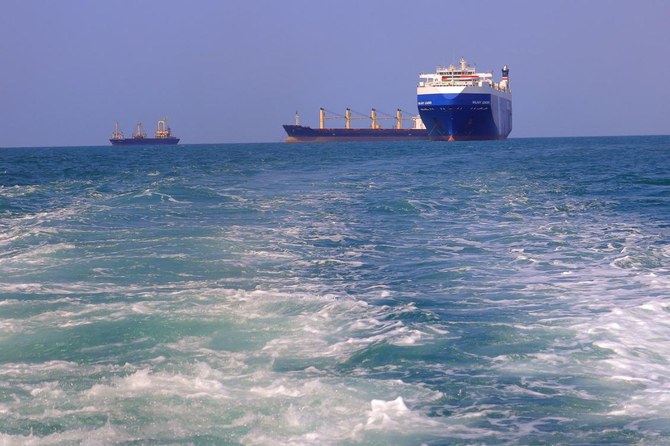
DUBAI: A container ship owned by an Israeli billionaire came under attack by a suspected Iranian drone in the Indian Ocean as Israel wages war on Hamas in the Gaza Strip, an American defense official said Saturday.
The attack Friday on the CMA CGM Symi comes as global shipping increasingly finds itself targeted in the weekslong war that threatens to become a wider regional conflict — even as a truce has halted fighting and Hamas exchanges hostages for Palestinian prisoners held by Israel.
The defense official, who spoke to The Associated Press on condition of anonymity to discuss intelligence matters, said the Malta-flagged vessel was suspected to have been targeted by a triangle-shaped, bomb-carrying Shahed-136 drone while in international waters. The drone exploded, causing damage to the ship but not injuring any of its crew.
“We continue to monitor the situation closely,” the official said. The official declined to explain why the US military believed Iran was behind the attack.
Al-Mayadeen, a pan-Arab satellite channel that is politically allied with the Iranian-backed Lebanese militant group Hezbollah, reported that an Israeli ship had been targeted in the Indian Ocean. The channel cited anonymous sources for the report, which Iranian media later cited.
CMA CGM, a major shipper based in Marseille, France, did not immediately respond to a request for comment. However, the vessel’s crew had been behaving as though they believed the ship faced a threat.
The ship had its Automatic Identification System tracker switched off since Tuesday when it left Dubai’s Jebel Ali port, according to data from MarineTraffic.com analyzed by the AP. Ships are supposed to keep their AIS active for safety reasons, but crews will turn them off if it appears they might be targeted. It had done the same earlier when traveling through the Red Sea past Yemen, home to the Iranian-backed Houthi rebels.
“The attack is likely to have been targeted, due to the vessel’s Israeli affiliation through Eastern Pacific Shipping,” the private intelligence firm Ambrey told the AP. “The vessel’s AIS transmissions were off days prior to the event, indicating this alone does not prevent an attack.”
The Symi is owned by Singapore-based Eastern Pacific Shipping, which is a company ultimately controlled by Israeli billionaire Idan Ofer. A phone number for Eastern Pacific Shipping in Singapore rang unanswered Saturday, while no one responded to a request for comment sent by email. The Israeli military also did not respond to a request for comment.
In November 2022, the Liberian-flagged oil tanker Pacific Zircon, also associated with Eastern Pacific, sustained damage in a suspected Iranian attack off Oman.
Iran’s mission to the United Nations did not respond to a request for comment. However, Tehran and Israel have been engaged in a yearslong shadow war in the wider Middle East, with some drone attacks targeting Israeli-associated vessels traveling around the region.
In this Israel-Hamas war, which began with the militants’ Oct. 7 attack, the Houthis seized a vehicle transport ship in the Red Sea off Yemen. Iranian-backed militias in Iraq also have launched attacks on American troops in both Iraq and Syria during the war, though Iran itself has yet to be linked directly to an attack.

Israeli-owned ship targeted in suspected Iranian attack in Indian Ocean
https://arab.news/p6k7w
Israeli-owned ship targeted in suspected Iranian attack in Indian Ocean
- US official said the Malta-flagged vessel was suspected to have been targeted by a triangle-shaped, bomb-carrying Shahed-136 drone
Secrecy, mines and Israeli strikes complicate removal of Assad-era chemical weapons, says Syrian envoy
- Nevertheless, new authorities made significant progress in their work with Organization for the Prohibition of Chemical Weapons, he tells UN Security Council
- Syrian authorities grant OPCW experts unrestricted access to 23 sites and since October have been hosting the organization’s longest continuous presence in the country
NEW YORK CITY: Syria’s envoy to the UN said on Thursday that secrecy surrounding the nation’s former chemical weapons program, security risks from land mines and other unexploded ordnance, and Israel’s targeting of suspected weapons sites continue to complicate his government’s efforts to eliminate Assad-era chemical weapons.
Speaking at a UN Security Council meeting about Syria’s chemical weapons, Ambassador Ibrahim Olabi said the nation’s new authorities had nevertheless made significant progress over the past year in their work with the Organization for the Prohibition of Chemical Weapons.
Despite what he described as “major challenges,” Syria had moved the issue “from a stage of suspicion and manipulation to one of partnership with the OPCW,” he said, adding: “Syria has achieved a qualitative leap in its cooperation with the OPCW.”
This shift is reflected in recent decisions by the watchdog’s executive council and changing positions among its member states, Olabi noted.
Syria’s chemical weapons program has been under international scrutiny since the early years of the country’s civil war, when repeated chemical attacks killed or injured large numbers of civilians. The deadliest incident occurred in 2013 in the Damascus suburb of Eastern Ghouta, when a sarin attack killed hundreds and triggered international efforts to dismantle the country’s chemical arsenal.
Olabi said the authorities that took over after President Bashar Assad and his regime were toppled in December 2024 were confronting what he called the “heavy legacy of the Assad era,” during which chemical weapons were widely used against civilians. He described the program as an inherited burden rather than a policy of the new government.
“The chemical file is a prime example of these inherited issues, issues of which we were victims,” he added.
Syrian authorities have granted OPCW experts unrestricted access during eight deployments that included visits to 23 sites, he said, and since October have been hosting what he described as the organization’s longest continuous presence in the country.
“This marks the beginning of a sustained presence of the OPCW in Syria,” Olabi added.
Adedeji Ebo, the UN’s deputy high representative for disarmament affairs, said OPCW teams visited 19 locations in Syria last year, four of them previously declared chemical weapons sites and 15 suspected locations, where they conducted interviews and collected samples in their attempts to determine the full scope of undeclared chemical weapons activity.
Some other sites are in dangerous areas, he added, which poses significant risks to both Syrian and international personnel.
“On-site destruction may be required where conditions prevent safe removal,” Ebo said, noting that a recent OPCW decision authorizing expedited on-site destruction of weapons marked a positive step forward.
He also highlighted the reestablishment of Syria’s National Authority for the OPCW and the watchdog’s current, continuous presence in Damascus.
Olabi said Syrian national teams had identified two sites containing empty cylinders previously used to store toxic chemicals and had immediately reported them to the OPCW. Syrian authorities also handed over about 6,000 documents relating to the former regime’s chemical weapons program, he added, and helped arrange interviews with 14 witnesses, including individuals who were involved with the program.
Syrian authorities were also cooperating with international investigators examining chemical attacks by Assad’s government, he said, and accountability and justice for the victims are priorities for the new authorities.
“Syria reiterates its determination to continue the efforts to close this chapter,” Olabi said, adding that there was “no place for chemical weapons in today’s world.”


