

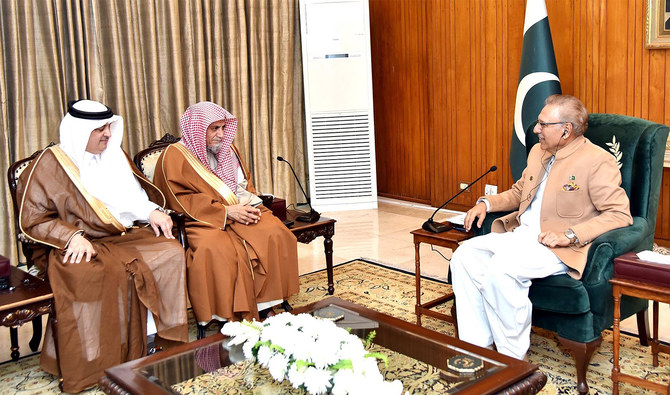

ISLAMABAD: Pakistan’s President Dr. Arif Alvi, in his meeting with Imam-e-Kaaba Sheikh Saleh bin Humaid on Thursday, reiterated his country’s firm support for a just and peaceful resolution of the Palestine issue, based on the two-state solution.
The meeting came during a four-day visit of Sheikh Saleh, an adviser to the Kingdom’s Royal Court, to Islamabad, which is aimed at enhancing brotherly ties between Pakistan and Saudi Arabia.
The Imam-e-Kaaba is scheduled to lead Friday prayers at Islamabad’s iconic Faisal Mosque and meet top Pakistani officials during the visit.
“Pakistan strongly supports a just and peaceful solution to the Palestinian issue based on the two-state solution,” Alvi was quoted as saying in a statement issued by his office.
“The world should realize the suffering of the Palestinian people and play its role to stop Israeli atrocities in Gaza.”
Pakistan, which does not recognize the state of Israel, has historically supported an independent Palestinian state based on “internationally agreed parameters” and the pre-1967 borders, with Al-Quds Al-Sharif as its capital.
The two figures held discussions on the Gaza situation, Islamophobia and other challenges faced by the Muslim world at the meeting, which was also attended by Saudi Arabia’s ambassador to Pakistan, Nawaf bin Said Al-Malki, according to the statement.
The Pakistan president stressed the need for unity and solidarity to deal with common challenges facing the Muslim world. He expressed his gratitude to Saudi Arabia for various development projects in Pakistan and helping the South Asian country in difficult economic times.
During the meeting, the statement read, the Imam-e-Kaaba emphasized the need for joint efforts to end Israeli atrocities in Palestinian territories.
“Joint efforts of the Muslim world, humanitarian and diplomatic assistance are needed to stop the ongoing atrocities in Palestine,” he was quoted saying.
In a separate statement, the Pakistani army also expressed its support for the people of Palestine and the two-state solution. It came after a meeting of the army's Formation Commanders Conference, presided over by Army Chief General Asim Munir.
"The forum expressed unequivocal diplomatic, moral and political support to the people of Palestine and reiterated Pakistan's principled stance supporting the two-state solution, based on pre-1967 borders with Al-Quds Al-Sharif as the capital of Palestine.
Additionally, Pakistan's Caretaker Religious Affairs Minister Aneeq Ahmed also met with the Imam-e-Kaaba and discussed with him unity among the Muslim world and other important affairs.
“Pakistan is an important country and the Muslim world looks toward it with hope,” the Pakistani religious affairs ministry quoted Sheikh Saleh as saying.
Earlier in the day, the Imam-e-Kaaba said the ongoing massacre of innocent people in Gaza marked “one of the darkest periods in human history” and called on global powers to intervene and halt crimes against humanity in Palestine.
He expressed these views while addressing the fourth international conference on the protection of human life in Shariah and law, jointly organized by International Islamic University Islamabad and International Islamic Fiqh Academy Jeddah.
“Allah has sworn to protect human life, and those who unjustly take a life face the promise of hell,” he said.


