

Pakistan stocks hit all-time high on IMF review success, election announcement

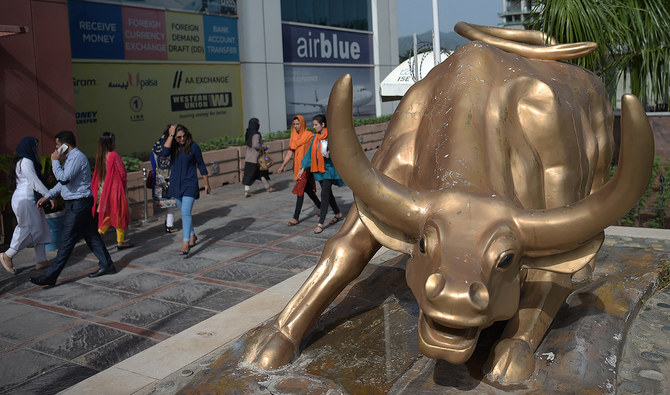
In this file photo, taken on October 9, 2018, Pakistani pedestrians walk past a bronze bull statue outside the Pakistan Stock Exchange (PSE) building in Islamabad. (AFP/File)
Short Url
Updated 22 November 2023
Follow

Pakistan stocks hit all-time high on IMF review success, election announcement

  • Agreement between IMF and Pakistan on first review of $3 billion bailout will unlock $700 million in funding
  • Announcement of elections playing positive role in growth of bourse on expectation of peaceful political transition

KARACHI: Pakistan’s stock market hit an all-time high on Wednesday on the back of a staff-level agreement reached last week with the International Monetary Fund (IMF) on the first review of a $3 billion bailout, which will unlock $700 million in funding for the cash-strapped country.
Pakistan’s benchmark share index, the KSE 100 index, gained 827 points to close at 58,198, another all-time high in one of the fastest recoveries witnessed at the Pakistan Stock Exchange (PSX).
The benchmark index has gained over 13,000 points or 29 percent since September this year, according to PSX data.
Pakistani financial experts attribute the historic growth to the completion of the first review of the IMF program and an expected cut in inflation and interest rates, as well as the expectation of political stability in the coming months as general elections are scheduled to be held in February.
“Investors at PSX think that the inflation and interest rates have peaked out, which would push the monetary easing cycle into motion as early as January 2024,” Tahir Abbas, head of research at Arif Habib Limited, told Arab News.
Abbas said the profitability of listed companies at PSX was continuously increasing but market valuation had not increased comparatively.
“The PE [price to earning] ratio which was 11.5 times and now is 4.3 times, which shows that the market is still attractive for investors,” he added.
“The completion of the first review of the IMF program and expected inflows of $700 million from the fund is also playing a contributing role in the upsurge of the stock market,” Samiullah Tariq, director research at Pakistan Kuwait Investment Company, told Arab News.
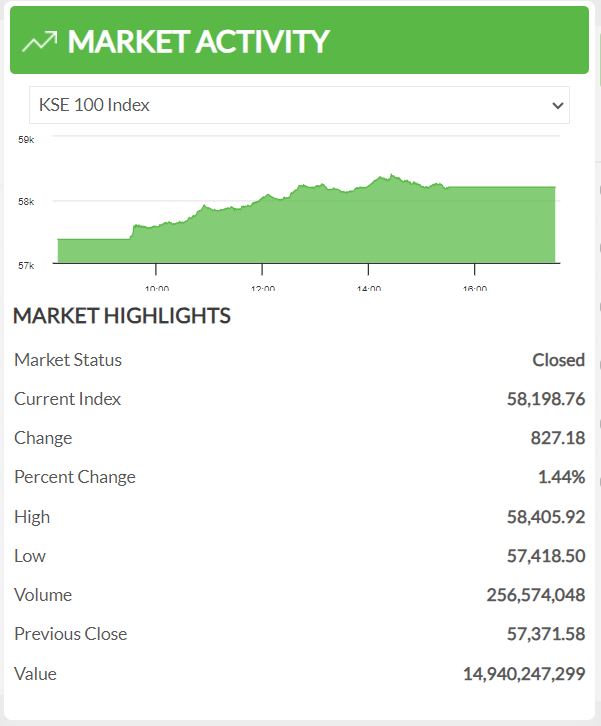


This graph shows Pakistan’s benchmark share index, the KSE 100 index, after closing of the session on November 22, 2023. (PSX)


“Generally, all the signals are positive,” he said, adding that the announcement of general elections in February was a “feel good factor” playing a positive role in the growth of the bourse on the expectation of a peaceful political transition.
Financial experts said they believed the stock market would continue to rally.
“Overall, there is more stability, and optimism compared to the situation a year ago,” Ali Farid Khwaja, chairman at Karachi-based KASB Securities, told Arab News, pointing to five contributing factors.
“Firstly, valuations were very cheap, especially compared to other assets such as real estate. Secondly, high inflation means that there is a lot more currency in circulation. Thirdly, there is a marked improvement in business sentiment since May last year,” the analyst said.
The fourth factor, Khwaja said, was that the caretaker government of Prime Minister Anwaar-ul-Haq Kakar had initiated credible reforms, which were giving confidence to investors.
“Lastly, there is expectation of foreign direct investment from Saudi Arabia and China for the privatization of state assets,” he added.
The national currency of Pakistan also posted slight gains on Wednesday against the United States dollar.
The rupee ended 0.23percent higher at Rs285.13 against the greenback in the interbank market.


Tens of thousands flee northwest Pakistan over fears of military operation

Updated 28 January 2026
Follow

Tens of thousands flee northwest Pakistan over fears of military operation

  • More than 70,000 people, mostly women and children, have fled remote Tirah region bordering Afghanistan 
  • Government says no military operation underway or planned in Tirah, a town in Khyber Pakhtunkhwa province

BARA, Pakistan: More than 70,000 people, mostly women and children, have fled a remote region in northwestern Pakistan bordering Afghanistan over uncertainty of a military operation against the Pakistani Taliban, residents and officials said Tuesday.

Pakistan’s Defense Minister Khawaja Mohammad Asif has denied the claim by residents and provincial authorities. He said no military operation was underway or planned in Tirah, a town in Khyber Pakhtunkhwa province.

Speaking at a news conference in Islamabad, he said harsh weather, rather than military action, was driving the migration. His comments came weeks after residents started fleeing Tirah over fears of a possible army operation.

The exodus began a month after mosque loudspeakers urged residents to leave Tirah by Jan. 23 to avoid potential fighting. Last August, Pakistan launched a military operation against Pakistani Taliban in the Bajau r district in the northwest, displacing hundreds of thousands of people.

Shafi Jan, a spokesman for the provincial government in Khyber Pakhtunkhwa, posted on X that he held the federal government responsible for the ordeal of the displaced people, saying authorities in Islamabad were retracting their earlier position about the military operation.

Khyber Pakhtunkhwa Chief Minister Suhail Afridi, whose party is led by imprisoned former Prime Minister Imran Khan, has criticized the military and said his government will not allow troops to launch a full-scale operation in Tirah.

The military says it will continue intelligence-based operations against Pakistani Taliban, who are known as Tehrik-e-Taliban Pakistan, or TTP. Though a separate group, it has been emboldened since the Afghan

Taliban returned to power in 2021. Authorities say many TTP leaders and fighters have found sanctuary in Afghanistan and that hundreds of them have crossed into Tirah, often using residents as human shields when militant hideouts are raided.

Caught in the middle are the residents of Tirah, who continued arriving in Bara.

So far, local authorities have registered roughly 10,000 families — about 70,000 people — from Tirah, which has a population of around 150,000, said Talha Rafiq Alam, a local government administrator overseeing the relief effort. He said the registration deadline, originally set for Jan. 23, has been extended to Feb. 5.

He said the displaced would be able to return once the law-and-order situation improves.

Among those arriving in Bara and nearby towns was 35-year-old Zar Badshah, who said he left with his wife and four children after the authorities ordered an evacuation. He said mortar shells had exploded in villages in recent weeks, killing a woman and wounding four children in his village. “Community elders told us to leave. They instructed us to evacuate to safer places,” he said.

At a government school in Bara, hundreds of displaced lined up outside registration centers, waiting to be enrolled to receive government assistance. Many complained the process was slow.

Narendra Singh, 27, said members of the minority Sikh community also fled Tirah after food shortages worsened, exacerbated by heavy snowfall and uncertain security.

“There was a severe shortage of food items in Tirah, and that forced us to leave,” he said.

Tirah gained national attention in September, after an explosion at a compound allegedly used to store bomb-making materials killed at least 24 people. Authorities said most of the dead were militants linked to the TTP, though local leaders disputed that account, saying civilians, including women and children, were among the dead.