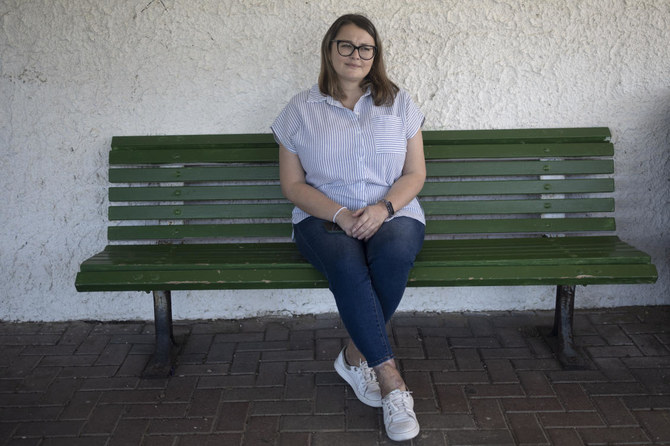
ASHKELON, Israel: Tatyana Prima thought she’d left the bombs behind when she fled Ukraine more than a year and a half ago, after Russia decimated her city, Mariupol.
The 38-year-old escaped with her injured husband and young daughter, bringing the family to safety in southern Israel.
The calm she was slowly regaining shattered again on Oct. 7, when Hamas militants invaded.
“All these sounds of war that we hear now, they sometimes work as a trigger that brings back memories of what we’ve gone through in Mariupol,” she said. “It’s hard feeling like that you’re the one responsible for your child, the one who wants what’s best for them, and in some way like you’ve failed them.”
Since Russia invaded Ukraine in February 2022, more than 45,000 Ukrainians have sought refuge in Israel, according to the Central Bureau of Statistics and aid groups. Like Prima, most of them were slowly picking up the pieces of their lives and finding ways to cope when the war in Israel erupted. Now they are reliving their trauma. Some have left Israel, but many remain — refusing to again flee a war. Most have lost in-person support systems due to restrictions around gatherings. Others have lost hope of reuniting with loved ones they left behind.
On Oct. 7, when Hamas militants attacked, killing some 1,200 people and taking about 240 hostages, Prima awoke to the sound of alarms. She lives in the coastal city of Ashkelon, a few kilometers (miles) from the Gaza Strip. The thud of airstrikes and shelling is constant as Israel pushes forward with its offensive. She describes it as “deja vu,” reminding her of the morning in Mariupol that forever changed her life.
Mariupol has been one of Ukraine’s hardest-hit cities, besieged and bombarded for weeks as people scrounged for food, water and heat and were cut off from the world with no telecommunications. During the war’s early weeks, Prima cooked over an outdoor fire, used snow for drinking water, and sheltered with a dozen relatives on the outskirts of the city, she said.
But the shelling intensified, and rockets fell around them. After her husband’s hand was blown off fetching water, she decided to leave.
“That day marked a descent into hell,” she said.
The family joined a convoy of cars fleeing the city, passing corpses as black ash fell from airstrikes. They went through countless Russian checkpoints and by April 2022 arrived in Israel, where her husband’s relatives lived in Ashkelon. Many Ukrainians live in the country’s south. There’s a large Russian-speaking community, and rent is often lower than in bigger, central cities.
Ashkelon residents were accustomed to occasional rockets from Gaza, but attacks have surged in the war. Air raid sirens are a constant sound. While most rockets are intercepted, about 80 have landed since the war in populated areas or empty fields, accounting for nearly one-third of all Hamas rocket incidents in Israel, according to the Armed Conflict Location & Event Data Project.
Shelling sounds remind Prima of her agony in Ukraine, yet she remains stoic when speaking about Israel’s war, convinced the army and the country’s Iron Dome defense system will protect her family.
But the war has intensified feelings of isolation, she said. Her community support groups have moved online — in-person gatherings are restricted to buildings with bomb shelters because of the threat of attacks.
“There is this tremendous hopelessness that these people are facing,” said Dr. Koen Sevenants, a mental health specialist with experience in conflict zones. Sevenants and other experts warn that when people who haven’t fully recovered from a traumatic incident are revictimized, the triggering event can often be worse, with risk for depression and anxiety.
Refugee organizations have adapted some of their programs, providing financial assistance and bringing food to people who don’t feel safe leaving their homes. But they can’t do it all, said Rabbi Olya Weinstein of The Project Kesher, which helps some 6,000 people who fled the war in Ukraine and brings families groceries or provides food vouchers.
“Under rockets, it’s very hard to be available for everyone,” said Weinstein, who hears people’s concerns for the future. “They’re asking what will happen ... what will happen with Israel, will we remain here forever, will we remain alive, what will happen to our kids?“
Some Ukrainians have been forced to move within Israel since the war began. About 100 children sheltering at a Jewish home in Ashkelon fled soon after Hamas attacked to the center of the country, said Yael Eckstein, of The International Fellowship of Christians and Jews, a philanthropic organization that supports the children.
It was the second time they were forced from their home in less than two years — they fled a city near Ukraine’s capital and evacuated to Israel during the early weeks of that war. They’re struggling to process everything, Eckstein said, with one asking: “Since he’s now living in a war zone, why can’t he go back to Ukraine?”
Other Ukrainians are trapped in Gaza, with 160 evacuated so far, according to Ukrainian President Volodymyr Zelensky. It’s unclear how many remain in Hamas-ruled Gaza, where more than 12,700 Palestinians, most of them women and minors, have been killed since the war began, according to the Gaza Health Ministry, which doesn’t differentiate between civilian and militant deaths.
In Israel, Veronika Chotari thought she’d see her 18-year-old daughter, Tereza, for the holidays. Her daughter stayed in Ukraine last year when Chotari sought cancer treatment in Israel for her youngest child, moving into the quiet central town of Petah Tikva. Until October, she’d never heard a siren there, she said.
Now, instead of planning to see each other, the two spend hours texting from bomb shelters, making sure the other is alive.
“I’m worried about you mom, please I know it’s impossible but let’s find another place for you,” Tereza wrote. “I’m tired of all this, I hate these wars.”


![]()
![]()

Ukrainians who fled their country for Israel find themselves yet again living with war

Short Url
https://arab.news/wrp9f
Ukrainians who fled their country for Israel find themselves yet again living with war
- Since Russia invaded Ukraine in February 2022, more than 45,000 Ukrainians have sought refuge in Israel
- Ashkelon residents were accustomed to occasional rockets from Gaza, but attacks have surged in the war


Latest updates


© 2026 SAUDI RESEARCH & PUBLISHING COMPANY, All Rights Reserved And subject to Terms of Use Agreement.