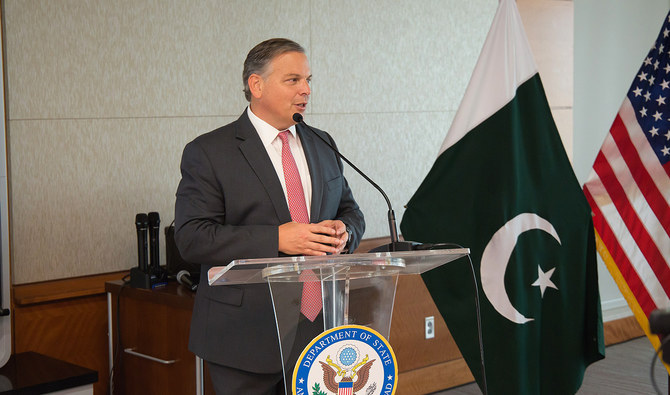
KARACHI: US Ambassador to Pakistan Donald A. Blome on Monday unveiled four new initiatives to bolster the capabilities of Pakistani law enforcement in their efforts to safeguard local communities in the country’s southwest, the embassy said in a statement.
The United States and Pakistan have cooperated on civilian security and rule of law for more than 40 years. Their partnership involves justice institutions and providing law enforcement agencies with tools to secure Pakistan’s border, fight narcotics trafficking and combat terrorism.
During a visit to Quetta on Monday, Blome announced four new projects, including the expansion of an anti-terror training facility, constriction of new police stations, upgradation of existing ones and equipment support.
“A $4 million assistance package will facilitate the expansion of Balochistan Police’s Anti-Terrorist Force training facility, doubling its current capacity, and allowing simultaneous instruction for an additional 800 trainees,” the embassy said, referring to a southwestern Pakistani province.
The US also allocated $2 million to repair and upgrade 10 flood-damaged police stations. These facilities will include modern infrastructure, such as digital record management and support for alternative dispute resolution mechanisms to support more responsive services for local communities. The facilities will also feature dedicated gender desks that will provide a private space for vulnerable populations to report crimes and receive special care for problems or injuries resulting from those crimes.
“An additional $2 million will be dedicated to constructing 10 new police stations to improve service to women, girls, and all Pakistanis,” the embassy added. “Recognizing the risks faced by law enforcement officers, the United States announced a $250,000 equipment grant to better protect enforcement officers as they undertake their duties.”
The four projects are funded and will be implemented in collaboration with the Department of State’s Bureau of International Narcotics and Law Enforcement (INL). INL currently provides approximately $20 million in assistance nationwide.
Blome, along with Inspector General of Police Shaikh and representatives from the United Nations Office on Drugs and Crime (UNODC), also on Monday inaugurated Balochistan’s first Women and Juvenile Facilitation Center. The center was constructed in collaboration with UNODC and enhances the ability of law enforcement to protect and serve women and girls.
During the trip, Blome also met with Chief Minister of Balochistan Ali Mardan Khan Domki.
Discussions covered a range of topics including US assistance programs, and the ambassador “reaffirmed strong US support for the economic development of all parts of Pakistan, including Balochistan.”


US announces new initiatives to bolster counterterrorism abilities in southwest Pakistan
https://arab.news/v6vm7
US announces new initiatives to bolster counterterrorism abilities in southwest Pakistan

- United States and Pakistan have cooperated on civilian security and rule of law for more than 40 years
- Partnership involves justice institutions, tools to secure Pakistan’s border, fight drugs and terrorism

Pakistan IT exports rise nearly 20 percent to $2.61 billion in first seven months of fiscal year
- January ICT exports climb to $374 million year-on-year
- Sector remains country’s top-earning services export
KARACHI: Pakistan’s information and communication technology (ICT) export earnings rose 19.78 percent year-on-year to $2.61 billion in the first seven months of the fiscal year ending June 2026, the IT ministry said on Tuesday, highlighting the sector’s growing role as a source of foreign exchange.
Pakistan’s IT and IT-enabled services sector has emerged as one of the country’s fastest-growing sources of foreign exchange, generating over $3 billion annually and employing roughly a million freelancers in addition to formal software firms.
Unlike traditional manufacturing exports, the industry relies primarily on remote digital labor, from software development to back-office services, making it resilient during economic crises but constrained by payment barriers, talent migration and infrastructure reliability challenges. However, IT services require minimal imports and benefit from a large pool of young workers and freelancers, making the sector central to government plans to boost dollar inflows and reduce pressure on the balance of payments.
“ICT export remittances surged 19.78 percent, reaching $ 2.61 billion during the first seven months of FY 2025-26 compared to $ 2.18 billion achieved during the corresponding period last year,” the IT ministry said in a statement.
Monthly exports also expanded, with ICT services exports reaching $374 million in January 2026, up 19.5 percent from $313 million a year earlier, according to the ministry’s data.
The ministry said ICT remained the country’s highest-earning services sector, well ahead of “other business services,” which generated $1.21 billion over the same July-January period.
Pakistan has increasingly relied on technology exports, including software development, outsourcing and freelance services, to generate foreign exchange as the economy adjusts under structural reforms and tight import controls following a balance-of-payments crisis.
Officials say continued growth will depend on easing payment bottlenecks, improving digital infrastructure and expanding higher-value technology services beyond traditional outsourcing.


