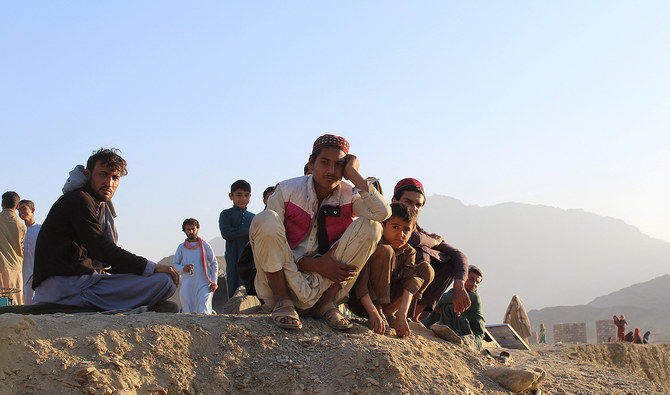
ISLAMABAD: More than 400,000 Afghans have returned to their home country following the ongoing crackdown on illegal foreigners in the country, Pakistani authorities said Monday.
Zabihullah Mujahid, chief spokesperson of the Taliban-led government in Afghanistan, confirmed the number and told The Associated Press that the majority have been using the border crossings of Torkham and Spin Boldak to return home.
An estimated 1.7 million Afghans had been living in Pakistan when authorities announced its nationwide crackdown, saying that anyone without proper documents had to leave the country by October 31 or else get arrested.
However, Pakistani officials said the other 1.4 million Afghans registered as refugees need not worry as only people without proper documentation were sought after.
In the 1980s, millions of Afghans fled to neighboring Pakistan during the Soviet occupation of their country. The numbers witnessed a spike after the Taliban takeover of Afghanistan in 2021.
Pakistan also introduced plans under which hundreds of thousands of residents in the southwestern border town of Chaman would need visas to cross between the two countries. They previously had special permits.
On Monday, hundreds briefly blocked a key road leading to the Chaman border, disrupting traffic and the repatriation of some of the Afghans.
Residents in Chaman have been protesting repeatedly, asking Pakistan to allow them to continue using the special permits for business purposes and to meet with relatives who live in the Afghan border city of Spin Boldak.
Since November 1, police in Pakistan have been going door-to-door to check migrants’ documentation. Pakistani officials had said before that the crackdown involves all foreigners in the country, but most of those affected are Afghan nationals.
The latest development comes days after the World Health Organization warned that about 1.3 million Afghans were expected to return to their country of origin from Pakistan despite the onset of cold weather. Such expulsions have drawn widespread criticism from international and domestic human rights groups.
The Taliban-led administration in Afghanistan said it was providing shelter and food to returnees.


More than 400,000 Afghans have returned home from Pakistan following crackdown on migrants
https://arab.news/6yvpg
More than 400,000 Afghans have returned home from Pakistan following crackdown on migrants

- Since November 1, police in Pakistan have been going door-to-door to check migrants’ documents
- Pakistani says crackdown involves all foreigners but most of those affected are Afghan nationals

Pakistan army chief says future warfare will rely on technology over battlefield maneuvers
- Asim Munir cites drones, electronic warfare and surveillance as central to future war operations
- Remarks follow Pakistan’s 2025 military conflict with India that highlighted role of technology
ISLAMABAD: Pakistan’s army chief said on Thursday future conflicts would be shaped more by technology than traditional battlefield maneuvers, as the military accelerates its shift toward drone warfare, electronic systems and networked command structures, according to a statement issued by the Pakistan military.
Field Marshal Syed Asim Munir, who also serves as Chief of Defense Forces, made the remarks while visiting the Bahawalpur Garrison in southern Punjab, where he observed a high-intensity field exercise focused on integrating new technologies into conventional military operations, the Inter-Services Public Relations (ISPR) said.
The exercise, titled Steadfast Resolve, involved unmanned aerial systems, advanced surveillance assets, electronic warfare capabilities and modern command-and-control mechanisms, reflecting what the military described as a move toward “technology-enabled multi-domain operations.”
“Character of war has evolved massively, with technological advancements driving the evolution, dictating huge mental transformation at all tiers,” Munir said while addressing troops, according to the ISPR statement.
“In future, technological maneuvers will replace physical maneuvers and will fundamentally alter the way offensive and defensive operations are undertaken,” he added.
Militaries worldwide are reassessing combat doctrine as drones, electronic warfare and real-time data increasingly shape outcomes on modern battlefields. In South Asia, those shifts gained renewed attention following military exchanges between Pakistan and India in May 2025, when both sides employed surveillance, electronic countermeasures and precision capabilities alongside conventional forces, underscoring the growing role of non-kinetic domains.
Munir said the Pakistan army was “embracing and absorbing technology at a rapid pace,” adding that “innovation, indigenization and adaptation shall remain fundamental” as the military prepares for future battlefield and security challenges.
The army chief also reiterated that Pakistan’s armed forces remained prepared to defend the country’s sovereignty and territorial integrity, while emphasizing the need to maintain readiness as warfare increasingly expands across physical, cyber and electronic domains.


