US appeals court to hear arguments on whether to reinstate gag order against Donald Trump

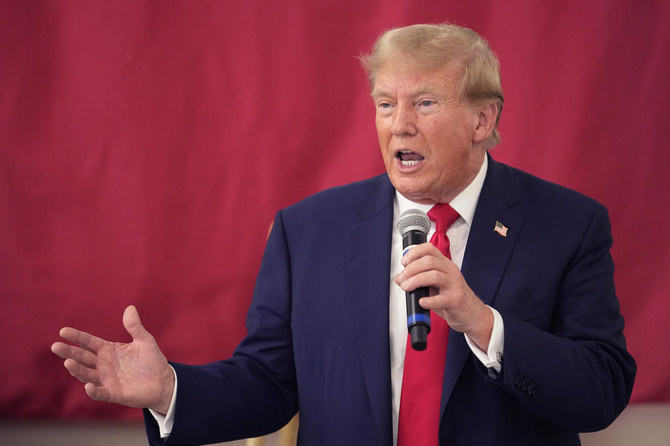
Prosecutors say the restrictions are necessary to prevent Donald Trump from undermining confidence in the court system and intimidating people who may be called to testify against him. (AP)
Short Url
Updated 20 November 2023
Follow

US appeals court to hear arguments on whether to reinstate gag order against Donald Trump

  • Defense lawyers have called the gag order an unconstitutional muzzling of former president’s free speech rights

WASHINGTON: A federal appeals court is hearing arguments Monday on whether to reinstate a gag order against Donald Trump in the federal case charging him with plotting to overturn the results of the 2020 presidential election.
Prosecutors with special counsel Jack Smith’s team will urge a three-judge panel of the Washington-based appeals court to put back in place an order barring the former president from making inflammatory statements about lawyers in the case and potential witnesses.
The prosecutors say those restrictions are necessary to prevent Trump from undermining confidence in the court system and intimidating people who may be called to testify against him. Defense lawyers have called the gag order an unconstitutional muzzling of Trump’s free speech rights and say prosecutors have presented no evidence to support the idea that his words have caused harm or made anyone feel threatened.
The gag order is one of multiple contentious issues being argued ahead of the landmark March 2024 trial. Defense lawyers are also trying to get the case dismissed by arguing that Trump, as a former president, is immune from prosecution and protected by the First Amendment from being charged. The outcome of Monday’s arguments won’t affect those constitutional claims, but it will set parameters on what Trump as both a criminal defendant and leading presidential candidate can and cannot say ahead of the trial.
The order has had a whirlwind trajectory through the courts since US District Judge Tanya Chutkan imposed it last month in response to a request from prosecutors, who cited among other comments Trump’s repeated disparagement of Smith as “deranged.”
The judge lifted it days after entering it, giving Trump’s lawyers time to prove why his words should not be restricted. But after Trump took advantage of that pause by posting on social media comments that prosecutors said were meant to sway his former chief of staff against giving unfavorable testimony, Chutkan put it back in place.
The US Court of Appeals for the District of Columbia Circuit later lifted it as it considered Trump’s appeal.
The judges hearing the case include Cornelia Pillard and Patricia Millett, both appointees of former President Barack Obama, and Brad Garcia, who joined the bench earlier this year after being nominated by President Joe Biden.
The panel is not expected to immediately rule on Monday. Should the judges rule against Trump, he’ll have the option of asking the entire court to take up the matter. His lawyers have also signaled that they’ll ask the Supreme Court to get involved.
The four-count indictment in Washington is one of four criminal cases Trump faces as he seeks to reclaim the White House in 2024.
He’s been charged in Florida, also by Smith’s team, with illegally hoarding dozens of classified documents at his Mar-a-Lago estate. He’s also been charged in state court in New York in connection with hush money payments to a porn actress who alleged an extramarital affair with him, and in Georgia with scheming to subvert the 2020 presidential election in that state.


2025 among world’s three hottest years on record, WMO says

Updated 14 January 2026
Follow

2025 among world’s three hottest years on record, WMO says

  • All eight datasets confirmed that the last three years were the planet’s three hottest since records began, the WMO said
  • The slight differences in the datasets’ rankings reflect their different methodologies and types of measurements

BRUSSELS: Last year was among the planet’s three warmest on record, the World Meteorological Organization said on Wednesday, as EU scientists also confirmed average temperatures have now exceeded 1.5 degrees Celsius of global warming for the longest since records began.
The WMO, which consolidates eight climate datasets from around the world, said six of them — including the European Union’s European Center for Medium-Range Weather Forecasts (ECMWF) and the British national weather service — had ranked 2025 as the third warmest, while two placed it as the second warmest in the 176-year record.
All eight datasets confirmed that the last three years were the planet’s three hottest since records began, the WMO said. The warmest year on record was 2024.

THREE-YEAR PERIOD ABOVE 1.5 C AVERAGE ⁠WARMING LEVEL
The slight differences in the datasets’ rankings reflect their different methodologies and types of measurements — which include satellite data and readings from weather stations.
ECMWF said 2025 also rounded out the first three-year period in which the average global temperature was 1.5 C above the pre-industrial era — the limit beyond which scientists expect global warming will unleash severe impacts, some of them irreversible.
“1.5 C is not a cliff edge. However, we know that every fraction of a degree matters, particularly for worsening extreme weather events,” said Samantha Burgess, strategic ⁠lead for climate at ECMWF.
Burgess said she expected 2026 to be among the planet’s five warmest years.

CHOICE OF HOW TO MANAGE TEMPERATURE OVERSHOOT
Governments pledged under the 2015 Paris Agreement to try to avoid exceeding 1.5 C of global warming, measured as a decades-long average temperature compared with pre-industrial temperatures.
But their failure to reduce greenhouse gas emissions means that target could now be breached before 2030 — a decade earlier than had been predicted when the Paris accord was signed in 2015, ECMWF said. “We are bound to pass it,” said Carlo Buontempo, director of the EU’s Copernicus Climate Change Service. “The choice we now have is how to best manage the inevitable overshoot and its consequences on societies and natural systems.”
Currently, the world’s long-term warming level is about 1.4 C above the pre-industrial era, ECMWF said. Measured on a short-term ⁠basis, average annual temperatures breached 1.5 C for the first time in 2024.

EXTREME WEATHER
Exceeding the long-term 1.5 C limit would lead to more extreme and widespread impacts, including hotter and longer heatwaves, and more powerful storms and floods. Already in 2025, wildfires in Europe produced the highest total emissions on record, while scientific studies confirmed specific weather events were made worse by climate change, including Hurricane Melissa in the Caribbean and monsoon rains in Pakistan which killed more than 1,000 people in floods.
Despite these worsening impacts, climate science is facing political pushback. US President Donald Trump, who has called climate change “the greatest con job,” last week withdrew from dozens of UN entities including the scientific Intergovernmental Panel on Climate Change.
The long-established consensus among the world’s scientists is that climate change is real, mostly caused by humans, and getting worse. Its main cause is greenhouse gas emissions from burning fossil fuels like coal, oil and gas, which trap heat in the atmosphere.