

Pakistani PM says Afghan government aware of TTP militants’ whereabouts

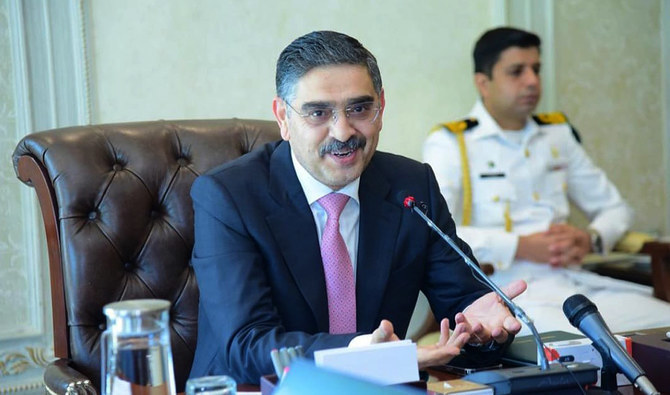
In this file picture, taken and released by the Prime Minister's Office on October 12, 2023, Pakistan's interim prime minister Anwaar-ul-Haq Kakar speaks during a meeting with journalists in Islamabad. (PMO)
Short Url
Updated 20 November 2023
Follow

Pakistani PM says Afghan government aware of TTP militants’ whereabouts

  • Caretaker PM Kakar warns Pakistan will ‘not sit silently’ as militants attack its civilians, security forces personnel
  • Kakar says militants cannot force negotiations at gunpoint, laying down arms pre-condition for talks with state

ISLAMABAD: Caretaker Prime Minister Anwaar-ul-Haq Kakar alleged on Sunday that the Afghan government was aware of the whereabouts of the Pakistani Taliban or the Tehreek-e-Taliban Pakistan (TTP) militants, warning that Pakistan would not “sit silently” as militants attack its territory from Afghan soil. 

In an unprecedented move, Kakar lashed out at the Afghan government on Nov. 8, accusing Kabul of not doing enough to clamp down on militants he said were operating from Afghan soil and launching attacks against Pakistan. 

Officials in Islamabad have blamed a recent surge in militant violence in Pakistan on the proscribed TTP, whose leaders are said to be based in Afghanistan. The Taliban government in Afghanistan has rejected Pakistan’s accusations and urged Islamabad to handle its security challenges internally. 

The TTP has launched some of the deadliest attacks against Pakistan since over a decade-and-a-half, killing thousands of Pakistanis. The militant group seeks to enforce its own brand of strict, Islamic law and has stepped up attacks in Pakistan once again after a fragile truce between the state and TTP militants broke down in November 2022. 

“We are communicating with them [Afghan government] through various channels and they know very well where the TTP [militants] are present,” Kakar said in an exclusive interview with Geo News. 

Kakar pointed out that Pakistan held talks with TTP militants in 2022 which were brokered by the Afghan government. 

“So, where were they [TTP militants] present? They weren’t there in Central Asia, talks with them were being held somewhere on Afghan soil,” he added. 

In response to a question, Kakar said it was up to the Afghan authorities to decide whether they wanted to take action against TTP militants or hand them over to Pakistan. However, he said Pakistan cannot allow Afghan authorities to not do anything while its citizens and security personnel suffered attacks. 

“The response for that will be given,” Kakar said. “It can’t happen that we keep on suffering silently.” 

The Pakistani prime minister reiterated that if any group wanted to hold talks with the government, it would have to lay down its arms against the state “unconditionally.” 

“But if they [militants] think that they can force the state to negotiate on gunpoint, I would like to tell them, very humbly, that it would be better for them to clear up this misunderstanding,” Kakar said. 


Pakistani president arrives in Iraq to deepen trade, energy cooperation

Updated 20 December 2025
Follow

Pakistani president arrives in Iraq to deepen trade, energy cooperation

  • Visit follows recent high-level contacts as Islamabad seeks to expand limited commercial ties with Baghdad
  • Talks are expected to cover investment, manpower and facilitation of Pakistani pilgrims visiting holy sites in Iraq

ISLAMABAD: President Asif Ali Zardari arrived in Iraq on Saturday on an official visit aimed at expanding cooperation in trade, energy and investment, as Pakistan seeks to deepen ties with Baghdad after years of limited engagement.

Pakistan and Iraq established diplomatic relations in 1947 and have traditionally maintained cordial ties, though commercial links remain modest, with officials and business groups identifying scope for cooperation in construction services, pharmaceuticals, manpower and agricultural exports.

“President Asif Ali Zardari arrived in Baghdad on a four-day official visit to Iraq,” his office said in a post on X. “He was received by Culture Minister Dr. Ahmed Fakkak Al-Badrani. During the visit, meetings with senior Iraqi leadership are expected to advance cooperation and further strengthen Pakistan-Iraq relations.”

Zardari’s visit follows a series of recent high-level contacts between the two countries, reflecting efforts to broaden bilateral engagement beyond traditional diplomatic ties and explore collaboration across economic, political and people-to-people domains.

According to Pakistan’s foreign office, the president is expected to hold meetings with Iraq’s senior leadership to discuss cooperation in various areas such as trade and investment, energy, technology, education and manpower.

He is also expected to discuss regional and international issues with Iraqi officials.

Earlier this month, Pakistan’s Interior Minister Mohsin Naqvi met his Iraqi counterpart, Abdul Ameer Al-Shammari, on the sidelines of meetings in Brussels, where both sides agreed to enhance cooperation on security and facilitate travel for Pakistani Shia pilgrims to Najaf and Karbala.

The two officials discussed measures to ensure the smoother movement of these pilgrims and their compliance with visa regulations.