

Pakistan's Punjab makes wearing face masks mandatory in smog-hit districts

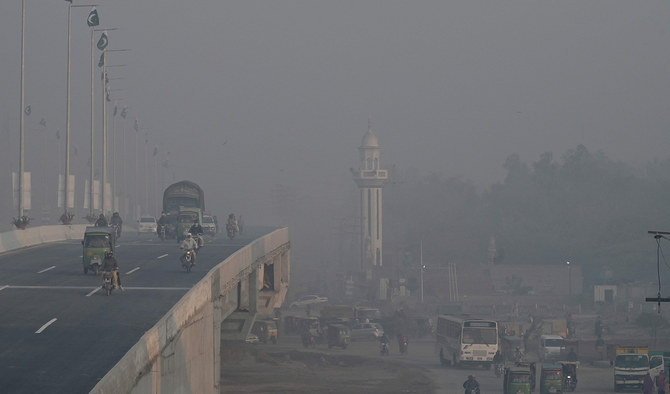
Commuters make their way along a street amid smog in Lahore, Pakistan, on November 17, 2023. (AFP)
Short Url
Updated 19 November 2023
Follow

Pakistan's Punjab makes wearing face masks mandatory in smog-hit districts

  • Punjab government makes it mandatory for all citizens to wear face masks from Nov. 20-26 in Gujranwala, Lahore divisions
  • Not only does smog disrupt life in Punjab, it also causes serious health problems, flight delays and accidents in Punjab

ISLAMABAD: Caretaker Punjab Chief Minister Mohsin Naqvi announced on Sunday that the government has made it mandatory for people to wear face masks in Punjab's smog-hit districts for a week, amid rising levels of air pollution in the province. 

The smog season peaks between October and February every year due to the common practice of burning crop residue, particularly in Indian Punjab, to prepare the soil for the upcoming planting season. This smoke significantly contributes to the presence of hazardous particles in the air and causes smog on the Pakistani side of the Punjab region, especially in Lahore. 

The smog situation in Punjab intensified earlier this week to the extent that a Pakistani court on Monday ordered authorities to close schools and colleges on Saturdays and adopt a two-day work-from-home policy. 

"In response to deteriorating Air Quality, the Punjab Government announces a 1-week mandate for wearing of face masks for all citizens in smog-affected districts of Punjab," Naqvi wrote on social media platform X.  

Citizens would have to wear face masks in Lahore Division (Lahore district, Nankana Sahib, Sheikhupura, Kasur) and Gujranwala Division (Gujranwala district, Sialkot, Gujrat, Narowal, Hafizabad, Mandi Bahauddin) during outdoor activities, according to a notification by the Punjab health department shared by Naqvi.  

Citizens would be required to wear face masks from Nov. 20-26, the notification added.  

"Prioritizing health is our collective responsibility. Please adhere to the guidelines for a safer community," Naqvi wrote.  


The Punjab government imposed a "smog emergency" on Nov. 1 after the Lahore High Court (LHC) ordered authorities to take measures to curb high levels of pollution in the province. Lahore, Pakistan's second-largest by population and the capital of Punjab, suffers from high levels of air pollution and ranks regularly at the top of IQAir AirVisual’s pollution rankings of major global cities. 

Not only does smog disrupt life in Punjab, it also causes serious health problems and accidents in Lahore and other areas of the province, where people complain of difficulty in breathing and soreness of the eyes. Authorities often restrict road travel via motorways due to near-zero visibility as smog prevails.  


Pakistan bank enables Shariah-compliant digital payment facility for passengers at Islamabad airport

Updated 23 February 2026
Follow

Pakistan bank enables Shariah-compliant digital payment facility for passengers at Islamabad airport

  • Pakistan is a cash-dominated market where a significant portion of transactions in the informal sector are made without any taxes, officials say
  • The move comes amid Pakistan’s efforts to introduce a cashless model at airports under which only digital service providers can provide services

KARACHI: Aik, Pakistan’s first Islamic digital bank, has enabled fully digital payments at Islamabad International Airport to offer travelers and passengers secure, Shariah compliant digital transaction facility.

The development comes amid Pakistan’s efforts to introduce a cashless model at airports across the country, under which only digital service providers can provide services to customers.

Aik, a subsidiary of Bank Islami, said it has onboarded merchants across the Islamabad airport and integrated QR code deployments at key touchpoints to allow passengers and visitors to make secure, seamless, and Shariah-compliant digital transactions at all counters, retail outlets, and service points.

It said the implementation complies with the regulations and framework set by the State Bank of Pakistan (SBP) and is a working model for a large-scale adoption of cashless systems in public infrastructure.

“This deployment reflects our commitment to building practical digital infrastructure that improves everyday transactions,” Aik Chief Officer Ashfaque Ahmed said in a statement.

“By enabling a fully cashless environment at a major national gateway, we are supporting efficiency, transparency, and financial inclusion at scale. This is not only a project; it is a foundation for Pakistan’s cashless future.”

Pakistan is a cash-dominated market where a significant portion of transactions, particularly in the informal sector, are conducted in cash. Officials say many of these transactions are aimed at avoiding taxes.

In recent years, the SBP has taken steps to ensure a transition toward a more cashless economy so that transactions are more traceable, reducing chances of tax evasion and corruption.

By digitizing Islamabad airport, aik said it continues to invest in secure and accessible financial solutions that “expand digital participation and support national economic modernization.”