

Pakistan’s central bank unveils five-year strategic plan to pursue financial stability

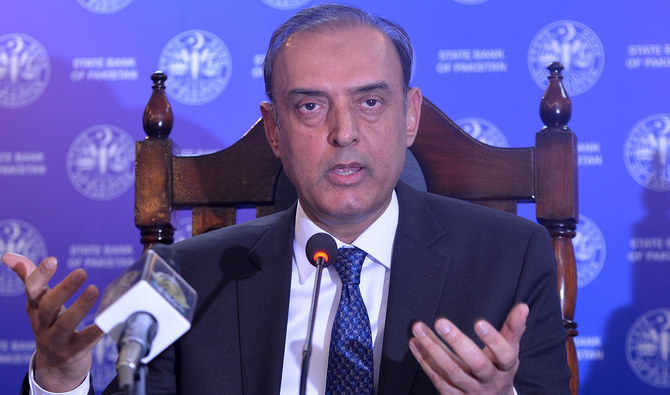
Governor of the State Bank of Pakistan, Jameel Ahmad addresses a press conference at the bank's headquarters in Karachi on January 23, 2023. (AFP/File)
Short Url
Updated 18 November 2023
Follow

Pakistan’s central bank unveils five-year strategic plan to pursue financial stability

  • The SBP Vision 2028 contains six key objectives including managing inflation and creating digital financial ecosystem
  • The strategic plan was developed through consultation with stakeholders and wants Shariah compliant banking system

ISLAMABAD: Pakistan’s central bank chief launched a strategic plan for the next five years in a ceremony held in Karachi on Friday, saying the document contained the key objectives that the bank planned to pursue to ensure financial stability in the country.

Last year, the government approved the State Bank of Pakistan (SBP) Amendment Bill, 2021, to meet a condition laid down by the International Monetary Fund (IMF) under a $6.5 billion bailout facility to ensure complete autonomy to the central bank.

The SBP Vision 2028 is the first plan since the passage of the amendment bill and has been developed through a consultative and inclusive process with key stakeholders.

Addressing the ceremony in Karachi, SBP Governor Jameel Ahmad maintained the plan would foster price and financial stability and contribute to the country’s sustainable economic development.

“Mr. Ahmad added that evolving risks and challenges to the economy and financial stability, including climate change, rapid digital innovations and disruptions, and growing cyber security threats, have been kept in perspective while developing the plan,” announced a statement issued by the central bank after the event.

“Governor SBP elaborated that the SBP Vision 2028, revolves around six strategic goals that include maintaining inflation within the medium-term target range, enhancing efficiency, effectiveness, fairness and stability of the financial system, promoting inclusive and sustainable access to financial services, transforming to a Shariah compliant banking system, building an innovative and inclusive digital financial services ecosystem, and transforming SBP into a high-tech, people-centric organization.”

He noted these strategic goals were built to cover five cross-cutting themes, including strategic communication, climate change, technological innovation, diversity and inclusion, and productivity and competitiveness.

Pakistan has witnessed major economic challenges in recent years that has forced it to seek external financial assistance from the IMF and friendly nations like China, Saudi Arabia and the United Arab Emirates.

Faced with a precarious financial situation amid rapid depreciation of national currency and dwindling foreign currency reserves, Pakistan managed to secure a short-term $3 billion loan program in July from the IMF to stave off sovereign debt default.


Imran Khan’s party shutdown draws mixed response; government calls it ‘ineffective’

Updated 14 min 48 sec ago
Follow

Imran Khan’s party shutdown draws mixed response; government calls it ‘ineffective’

  • Ex-PM Khan’s PTI party had called for a ‘shutter-down strike’ to protest Feb. 8, 2024 general election results
  • While businesses reportedly remained closed in Khyber Pakhtunkhwa, they continued as normal elsewhere

ISLAMABAD: A nationwide “shutter-down strike” called by former prime minister Imran Khan’s party drew a mixed response in Pakistan on Sunday, underscoring political polarization in the country two years after a controversial general election.

Khan’s Pakistan Tehreek-e-Insaf (PIT) opposition party had urged the masses to shut businesses across the country to protest alleged rigging on the second anniversary of the Feb. 8, 2024 general election.

Local media reported a majority of businesses remained closed in the Khyber Pakhtunkhwa (KP) province, governed by the PTI, while business continued as normal in other provinces as several trade associations distanced themselves from the strike call.

Arab News visited major markets in Islamabad’s G-6, G-9, I-8 and F-6 sectors, as well as commercial hubs in Rawalpindi, which largely remained operational on Sunday, a public holiday when shops, restaurants and malls typically remain open in Pakistan.

“Pakistan’s constitution says people will elect their representatives. But on 8th February 2024, people were barred from exercising their voting right freely,” Allama Raja Nasir Abbas Jafri, the PTI opposition leader in the Senate, said at a protest march near Islamabad’s iconic Faisal Mosque.

Millions of Pakistanis voted for national and provincial candidates during the Feb. 8, 2024 election, which was marred by a nationwide shutdown of cellphone networks and delayed results, leading to widespread allegations of election manipulation by the PTI and other opposition parties. The caretaker government at the time and the Election Commission of Pakistan (ECP) both rejected the allegations.

Khan’s PTI candidates contested the Feb. 8 elections as independents after the party was barred from the polls. They won the most seats but fell short of the majority needed to form a government, which was made by a smattering of rival political parties led by Prime Minister Shehbaz Sharif. The government insists the polling was conducted transparently and that Khan’s party was not denied a fair chance.

Authorities in the Pakistani capital deployed a heavy police contingent on the main road leading to the Faisal Mosque on Sunday. Despite police presence and the reported arrest of some PTI workers, Jafri led local PTI members and dozens of supporters who chanted slogans against the government at the march.

“We promise we will never forget 8th February,” Jafri said.

The PTI said its strike call was “successful” and shared videos on official social media accounts showing closed shops and markets in various parts of the country.

The government, however, dismissed the protest as “ineffective.”

“The public is fed up with protest politics and has strongly rejected PTI’s call,” Pakistan’s Information Minister Attaullah Tarar said on X.

“It’s Sunday, yet there is still hustle and bustle.”

Ajmal Baloch, All Pakistan Traders Association president, said they neither support such protest calls, nor prevent individuals from closing shops based on personal political affiliation.

“It’s a call from a political party and we do not close businesses on calls of any political party,” Baloch told Arab News.

“We only give calls of strike on issues related to traders.”

Khan was ousted from power in April 2022 after what is widely believed to be a falling out with the country’s powerful generals. The army denies it interferes in politics. Khan has been in prison since August 2023 and faces a slew of legal challenges that ruled him out of the Feb. 8 general elections and which he says are politically motivated to keep him and his party away from power.

In Jan. 2025, an accountability court convicted Khan and his wife in the £190 million Al-Qadir Trust land corruption case, sentencing him to 14 years and her to seven years after finding that the trust was used to acquire land and funds in exchange for alleged favors. The couple denies any wrongdoing.