

Saudi students win 1st place in world robot challenge

1 / 3
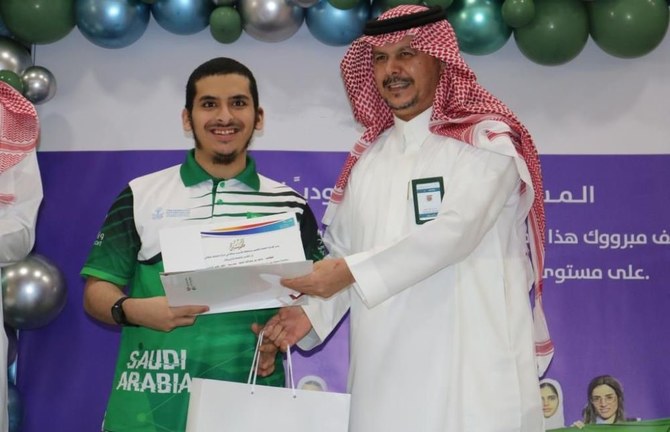
Mujtaba Hussein Salem and Majed Abdullah Al-Majed, both from Al-Ahsa, triumphed in the Virtual Robot Challenges category. (Supplied)
2 / 3
Mujtaba Hussein Salem and Majed Abdullah Al-Majed, both from Al-Ahsa, triumphed in the Virtual Robot Challenges category. (Supplied)
3 / 3
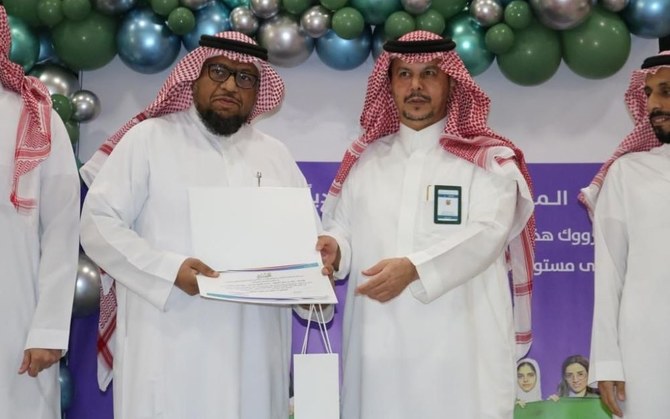
Hamad bin Muhammed Al-Issa, general director of Al-Ahsa Education, described the Saudi students’ performance as a “significant accomplishment.” (Supplied)
Short Url
Updated 16 November 2023
Follow

Saudi students win 1st place in world robot challenge

  • Mujtaba Hussein Salem and Majed Abdullah Al-Majed claimed first place in a World Robot Olympiad final
  • General director of Al-Ahsa Education Hamad bin Muhammed Al-Issa: This is certainly a win for the Kingdom and its people

MAKKAH: Two Saudi secondary school students have claimed first place in a World Robot Olympiad final in Panama. 

Mujtaba Hussein Salem and Majed Abdullah Al-Majed, both from Al-Ahsa, triumphed against student competitors from around the world in the Virtual Robot Challenges category.

Elementary students Fatima Ali Al-Rashid and Fatima Akil Salem finished fifth in the Future Innovators category. 

Scores of students in different age groups competed in a variety of categories at the international olympiad, held from Nov. 7-9.

Hamad bin Muhammed Al-Issa, general director of Al-Ahsa Education, described the Saudi students’ performance as a “significant accomplishment.”

Many teams of Al-Ahsa students have performed well while representing the Kingdom in global competitions, he added.

“Not only are our students drawn to the world of artificial intelligence, but they also lead in this field worldwide. This is certainly a win for the Kingdom and its people,” he said.

“To every loyal teacher who has provided support, and to every school principal who has worked hard to unleash the students’ potential in all fields, I hope your efforts will be blessed and I wish you all the best, as such achievements do not happen out of nowhere or by chance, but are the results of dedicated work and innovative students who don’t know the meaning of impossible and can face any challenge.”

Student instructor Khaled Al-Massoud told Arab News that the students’ performance is an “accomplishment for the country.” 

The two winners told Arab News that support provided by the Kingdom played a key role in their victory.

Intensive training under the supervision of Al-Massoud “helped us reach the highest levels in the Olympiad,” they added.


Saudi Arabia’s KAUST named FIFA’s first research institute in MENA

The canal in the King Abdullah University of Science and Technology campus. (Shutterstock)
Updated 10 February 2026
Follow

Saudi Arabia’s KAUST named FIFA’s first research institute in MENA

  • KAUST President Prof. Sir Edward Byrne said that the university’s selection as the fifth FIFA Research Institute in the world — and the first in the region — marks a significant achievement, reflecting Kingdom’s growing presence in international football

RIYADH: FIFA has designated the King Abdullah University of Science and Technology as its first research institute in the Middle East and Asia to support the development of innovative football research, the Saudi Press Agency reported on Tuesday.

The recognition highlights KAUST’s commitment to integrating sports, academic research and industry through advanced, high-level initiatives grounded in rigorous scientific methodologies, contributing to the advancement of football studies.

KAUST President Prof. Sir Edward Byrne said that the university’s selection as the fifth FIFA Research Institute in the world — and the first in the region — marks a significant achievement, reflecting Saudi Arabia’s growing presence in international football.

The accreditation aligns with national efforts to invest in research and development and promote the knowledge economy, supporting Saudi Vision 2030’s goals of building an advanced sports system based on innovation and sustainability.

The collaboration’s first project focuses on developing advanced AI algorithms to analyze historical FIFA World Cup broadcast footage, transforming decades of match videos into structured, searchable data, according to the KAUST website.

This work opens new opportunities to apply state-of-the-art computer vision techniques and deepen understanding of how football has evolved over time.

The second project uses player and ball tracking data from the FIFA World Cup 2022 in Qatar and the FIFA Women’s World Cup 2023 in Australia and New Zealand to compile comprehensive datasets capturing in-game dynamics.

These datasets provide deeper insights into human movement, playing techniques and performance dynamics through AI-driven analysis.