NEW ORLEANS: As a Jewish student, Eden Roth always has felt safe and welcome at Tulane University, where more than 40 percent of the students are Jewish. That has been tested by the aftermath of last month’s Hamas incursion into Israel.
Graffiti appeared on the New Orleans campus with the message ” from the river to the sea,” a rallying cry for pro-Palestinian activists. Then came a clash between dueling demonstrations, where a melee led to three arrests and left a Jewish student with a broken nose.
“I think that the shift of experience with Jews on campus was extremely shocking,” said Roth, who was in Israel last summer for a study-abroad program. “A lot of students come to Tulane because of the Jewish population — feeling like they’re supported, like a majority rather than a minority. And I think that’s definitely shifted.”
Tulane isn’t alone. On other campuses, long-simmering tensions are erupting in violence and shattering the sense of safety that makes colleges hubs of free discourse. Students on both sides are witnessing acts of hate, leaving many fearing for their safety even as they walk to classrooms.
Threats and clashes have sometimes come from within, including at Cornell, where a student is accused of posting online threats against Jewish students. A University of Massachusetts student was arrested after allegedly punching a Jewish student and spitting on an Israeli flag at a demonstration. At Stanford, an Arab Muslim student was hit by a car in a case being investigated as a hate crime.
The unease is felt acutely at Tulane, where 43 percent of students are Jewish, the highest percentage among colleges that are not explicitly Jewish.
“To see it on Tulane’s campus is definitely scary,” said Jacob Starr, a Jewish student from Massachusetts.
Within the student Jewish community, there is a range of perspectives on the conflict. The latest war began with an attack on Oct. 7 by Hamas militants who targeted towns, farming communities and a music festival near the Gaza border. At least 1,200 people have been killed in Israel, mainly in the initial Hamas attack, Israeli officials say. Israel has responded with weeks of attacks in Gaza, which have killed more than 11,000 people, according to the Hamas-run Health Ministry in Gaza — most of them Palestinian civilians.
Emma Sackheim, a Jewish student from Los Angeles who attends Tulane’s law school, said she grew up as a supporter of the Jewish state but now considers herself an opponent of Zionism. Sackheim says she knows students who oppose Israel’s policies “but don’t feel comfortable to publicly say anything.”
“I was standing on the Palestinian side,” she said when asked about the Oct. 26 demonstration, which took place along a public New Orleans street that runs through campus.
Still, she said Tulane is where she feels most comfortable as a Jew. “I know that I have so many options of community,” she said.
On campuses around the US, students on both sides say they have been subjected to taunts and rhetoric that oppose their very existence since the invasion and the subsequent Israeli assault on Hamas in northern Gaza.
They see it in campus rallies, on anonymous message boards frequented by college students, and on graffiti scrawled on dorms and buildings. In one case under police investigation as a possible hate crime, “Free Palestine” was found written this week on a window of Boston University’s Hillel center.
Colleges have been scrambling to restore a sense of security for Jewish and Arab students — and stressing messages of inclusion for diverse student bodies. But untangling what’s protected as political speech and what crosses into threatening language can be a daunting task.
Tulane’s president, Michael Fitts, has described an increased police presence and other security measures on campus. In messages to the campus community, he has lamented the loss of innocent Israeli and Palestinian lives and said the university was reaching out to Jewish and Muslim student groups and religious organizations.
He has faced criticism from people on both sides seeking more forceful statements.
Islam Elrabieey, for example, seeks condemnation of Israel’s actions.
“To condemn Hamas is a good thing,” said Elrabieey, a native of Egypt and a visiting scholar in Tulane’s Middle East and North African Studies program. “But at the same time, if you didn’t condemn Israel for committing war crimes, this is a double standard.”
As places that encourage intellectual debate, it isn’t surprising that colleges have seen heated conflict, said Jonathan Fansmith, a senior vice president for the American Council on Education, an association of university presidents. But when different factions disagree about what crosses the line between free speech and abuse, it puts colleges in a difficult place, he said.
“Everyone should be incredibly sympathetic to Jewish students who feel under threat, and the alarming rise in antisemitic actions is something college universities take very seriously,” Fansmith said. “But they have a requirement, a responsibility under the law as well, to balance the free speech rights of people who may disagree, who may have critiques that they find disagreeable or dislike. And finding that line is very, very difficult.”
After facing criticism for trying to remain too neutral on the war, Harvard University’s president on Thursday condemned the phrase “from the river to the sea,” saying it has historical meanings that, to many, imply the eradication of Jews from Israel. Pro-Palestinian activists around the world chanted the phrase in the aftermath of the Hamas raid.
At Tulane, Roth said some Jewish students have been rattled enough to make them think twice about visiting the Mintz Center, the headquarters for the Tulane Hillel organization.
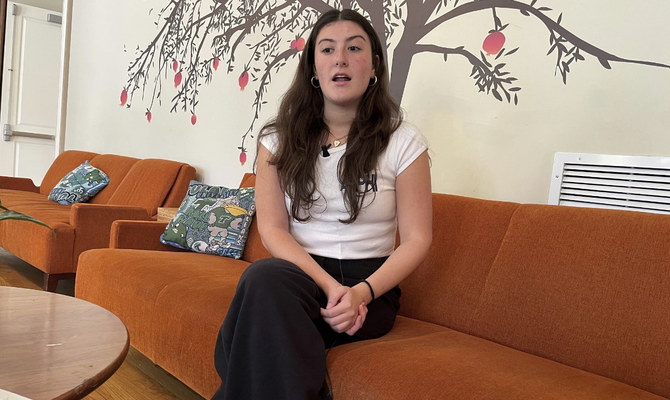
“I don’t feel completely safe, but I feel like we have no other choice but to embrace who we are in these times,” Roth said in an interview at the building. “I know a lot of my friends are nervous to wear their Star of David necklaces, to wear a kippah or even come into this building. But I think it’s critical that we do not let fear consume us.”
Lea Jackson, a freshman from New Jersey who describes herself as a modern Orthodox Jew, said she is concerned supporters of a Palestinian state are nervous expressing their views because of the large numbers of Jewish students on campus.
The Hamas raid may have made some people more reluctant to speak even as others become more outspoken, said Jackson, who said she recently spent a “gap year” in Israel and has friends and family there.
“But it’s a lot harder to have a civil conversation,” Jackson said, “when emotions and tension are so high and so many people are so personally connected to this.”


![]()

Clashes over Israel-Hamas war shatter students’ sense of safety on US college campuses
Short Url
https://arab.news/9mt7p
Clashes over Israel-Hamas war shatter students’ sense of safety on US college campuses
- Threats and clashes have sometimes come from within, including at Cornell, where a student is accused of posting online threats against Jewish students


Latest updates





Recommended


© 2026 SAUDI RESEARCH & PUBLISHING COMPANY, All Rights Reserved And subject to Terms of Use Agreement.