
DUBAI: Queuing for hours for even a modest amount of bread is now a common experience in Gaza, where rapidly diminishing food supplies and a shortage of safe drinking water have added to the challenges already faced by the Palestinian population living under Israeli siege.
Since the Oct. 7 attack by Hamas on southern Israel and the resulting Israeli retaliation, the humanitarian crisis in Gaza has reached an unprecedented scale as hospitals are overwhelmed, residential buildings bombed, and supplies of basic necessities run out.
“The situation on the ground is alarming,” Alia Zaki, spokesperson for the UN World Food Program’s Palestine office in Jerusalem, told Arab News.
“Existing food systems are collapsing. The last bakery that WFP has been working with has shut down because it has no fuel or gas.”
Bread, a staple of the Palestinian diet, has become increasingly scarce since the conflict began due to a lack of key ingredients, including clean water and wheat flour.
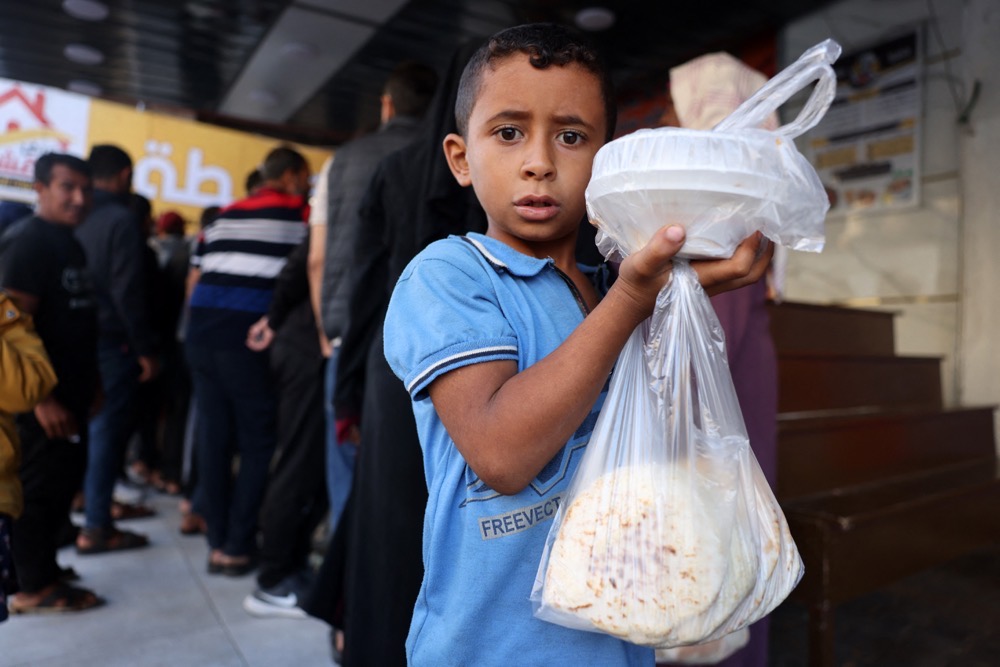
A boy returns home with bags of food in Rafah in the southern Gaza Strip on October 20, 2023. (AFP)
“Some bakeries have also been hit by air strikes,” said Zaki. “People are risking their lives and queuing for hours to get bread for their families, and many times are coming back empty-handed.”
The WFP has been closely monitoring the availability of food in shops since the outset of the war. The majority of businesses it had been collaborating with report shortages of essential items. Non-essential food products that do not fulfill nutritional needs, and those that cannot be consumed without cooking, are also rapidly dwindling.
“Shelves are nearly empty. Hunger is spreading in Gaza and cases of dehydration and malnutrition are increasing rapidly,” said Zaki.
Officials at Gaza’s largest flour and wheat manufacturing facility, Al-Salam Mills, told CNN on Tuesday they were operating at just 25 percent of capacity because of electricity and fuel shortages. It is the only one of five mills still operating in southern Gaza. Before the war, it could produce 480 tons of wheat a day or 300 tons of flour. Now it is limited to 75 tons daily.
Early in the conflict, the WFP and other aid agencies began to provide emergency assistance in the form of ready-to-eat rations and electronic vouchers that can be used to purchase food at designated shops using a standard Point of Sale machine.
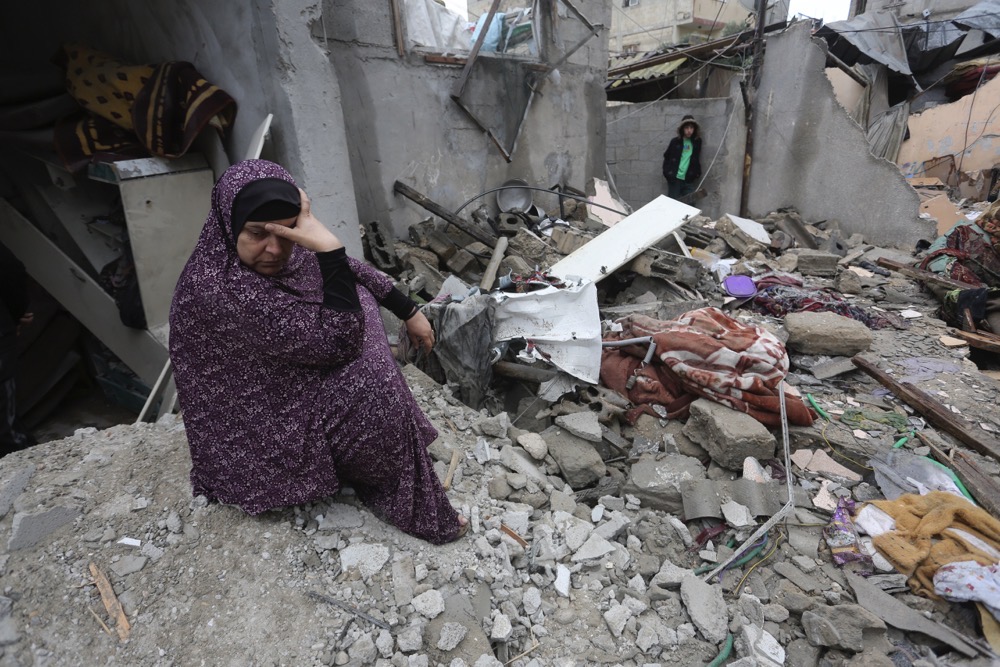
Israel’s military campaign to destroy Hamas has resulted in the death of thousands of civilians. (AFP)
“We were working with local bakeries to deliver fresh bread to those who have been displaced to UN designated shelters, and distributing nutritionally condensed date bars and canned food that have come in from across the Rafah border,” said Zaki.
The WFP said it has helped more than 700,000 people in Gaza since Oct. 7 through this type of food assistance.
In an attempt to stave off the worsening hunger crisis, aid agencies have called for significant levels of funding so that they can deliver emergency supplies to communities inside Gaza, many of which were, after 17 years of an Israeli embargo on the territory, already food insecure prior to the start of the current conflict.
Approximately $112 million of funding is needed for aid to help 1.1 million people — just the half the population that is “at risk of malnutrition” — in the next 90 days, said Kyung-nan Park, director of emergencies for the WFP.
“Before Oct. 7, some 33 percent of the population were food insecure,” she told Arab News. “We can safely say that 100 percent are food insecure at this moment.”
INNUMBERS
• 2.2m People in Gaza — nearly the entire population — now in need of food assistance.
• 100 Trucks of food supplies need to enter Gaza every day to keep pace with greatest needs.
• $112m Funds required by the World Food Program to meet needs for the next 3 months.
Source: UN WFP
Despite many countries in the Arab world and beyond providing millions of dollars in humanitarian aid, including supplies of food and medicines, the Israeli blockade and restrictions on entry to Gaza and the movement of aid have drastically impeded people’s access to essential food items.
Prior to a partial lifting of the total blockade of Gaza on Oct. 21, Israel was accused by international aid agency Oxfam and other organizations of employing starvation against the civilian population as a tactic of war, a claim that Israel denies.
On Nov. 9, Col. Moshe Tetro, head of coordination and liaison at the Coordinator of Government Activities in the Territories, the Israeli Defense Ministry body that handles civil affairs in Gaza, denied there was a humanitarian crisis in the besieged territory.
“We know the civil situation in the Gaza Strip is not an easy one,” he said during a media briefing at the Nitzana border post between Israel and Egypt. “But I can say that there is no humanitarian crisis in the Gaza Strip.”
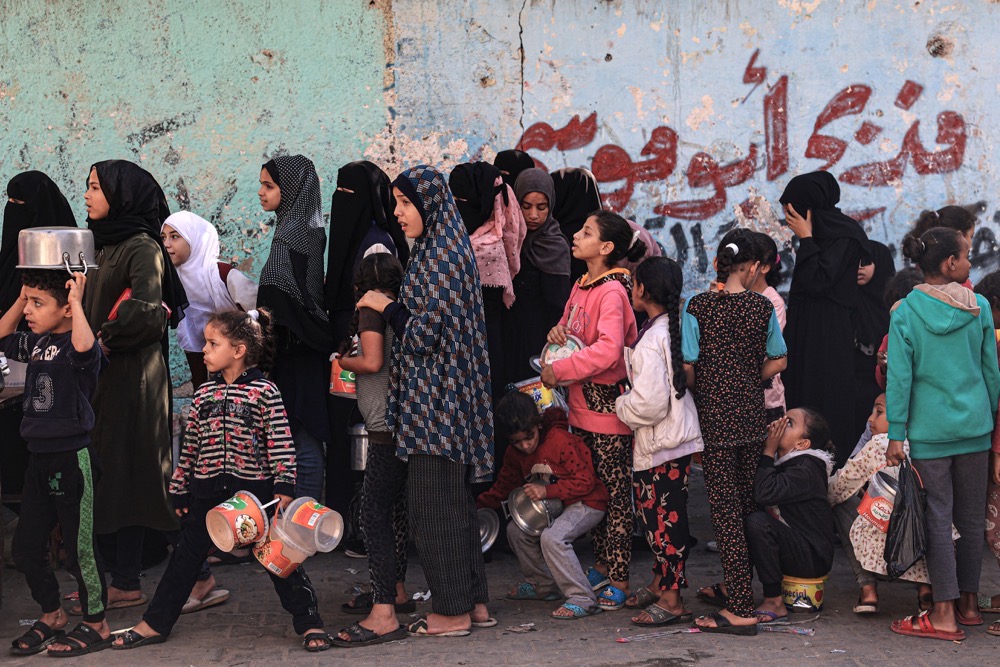
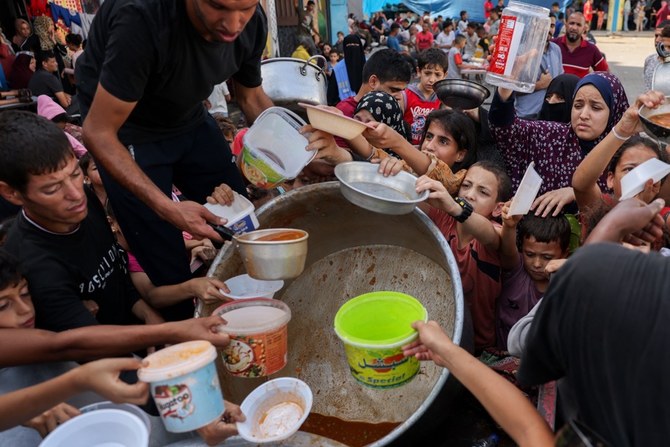
Palestinians queue to receive a portion of food at a make-shift charity kitchen in Rafah. (Getty Images/AFP)
Tetro added that the Israeli military had helped facilitate the delivery of “water, food, medical supplies and humanitarian aid for shelters,” but warned that “if we see that Hamas is using the humanitarian aid (that arrives in Gaza), we will stop it.”
Although shipments of aid have been permitted to enter Gaza through the Rafah crossing on the border with Egypt, the average number of trucks entering the besieged enclave each day has fallen to less than 19 percent of pre-conflict levels, according to the UN.
“At the Rafah border we have mobilized efforts, experts, storage units and trucks to provide the necessary support to maximize the number of trucks crossing into Gaza,” said Zaki. However, only a fraction of that support has been permitted to enter the territory.
Currently, about 40 to 50 aid trucks enter Gaza each day, a number Zaki said needs to increase to 100 in order to meet the most significant humanitarian demands of the Gazan people. Besides the shortages of food, access to clean drinking water has also become a critical concern.
“Cases of dehydration and malnutrition are increasing rapidly,” Riham Jafari, coordinator of advocacy and communication for ActionAid Palestine, said recently.
“Hospitals, which have remained overcapacity for weeks on end, can offer no solace to those on the brink of starvation as medical supplies run low, fuel is scarce, and bombs are indiscriminately dropped across Gaza, including on the doorsteps of hospitals.”
According to Dr. Hafeez ur Rahman of nongovernmental organization Alkhidmat Foundation Pakistan, the average person requires between three and four liters of drinking water each day to remain healthy.
“In Gaza, UNICEF has informed us that 96 percent of the underground water is not fit for human consumption,” he told Arab News.
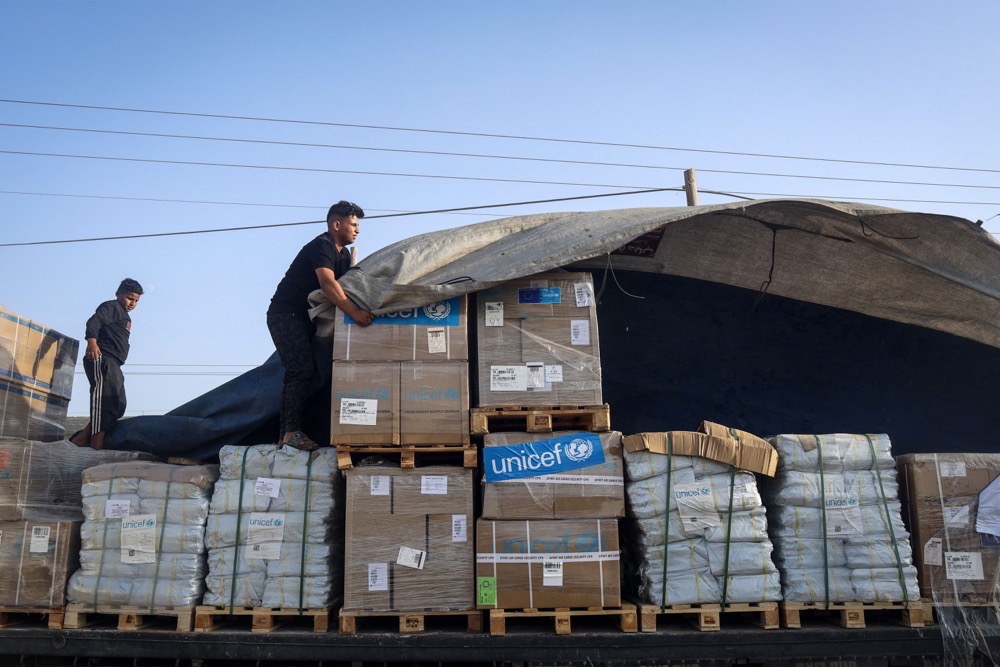
A man unloads humanitarian aid on a convoy of lorries entering the Gaza Strip from Egypt via the Rafah border crossing. (Getty Images/AFP)
Gaza has about 300 wells in which desalination equipment is installed, and three pipelines supply water from Israel.
“Since the start of the war, two pipelines from Israel were cut off and many of the desalination plants were bombarded and destroyed,” said Rahman. “Others stopped working due to the lack of electricity and fuel.”
According to the World Health Organization, the average amount of water available per person in Gaza currently stands at about three liters a day for all essential needs, including drinking and hygiene — and is likely to dwindle further.
Even before the current conflict began, Gazans had limited access to safe drinking water. In 2021, the Global Institute for Water, Environment and Health, along with the Euro-Mediterranean Human Rights Monitor, labeled Gaza’s water “undrinkable,” saying 97 percent was unfit for consumption.
Now, electricity shortages are exacerbating the situation by rendering surviving desalination and wastewater-treatment plants inoperable.
According to Hamas-affiliated Al-Aqsa TV, Israeli airstrikes damaged a public water tank that supplies several neighborhoods east of Rafah in the south of Gaza, and another critical water tank in Tal Al-Zaatar in the north of the territory. As a result, many residents have reportedly been forced to consume polluted or salt water, or endure long queues in the hope of obtaining some water that is safe to drink.
With each passing day, the lack of adequate nutrition and sanitary facilities that can help prevent gastric infections are compounding the problems of malnutrition and dehydration, which in turn can impede the regular growth and cognitive development of children, aid organizations warn.
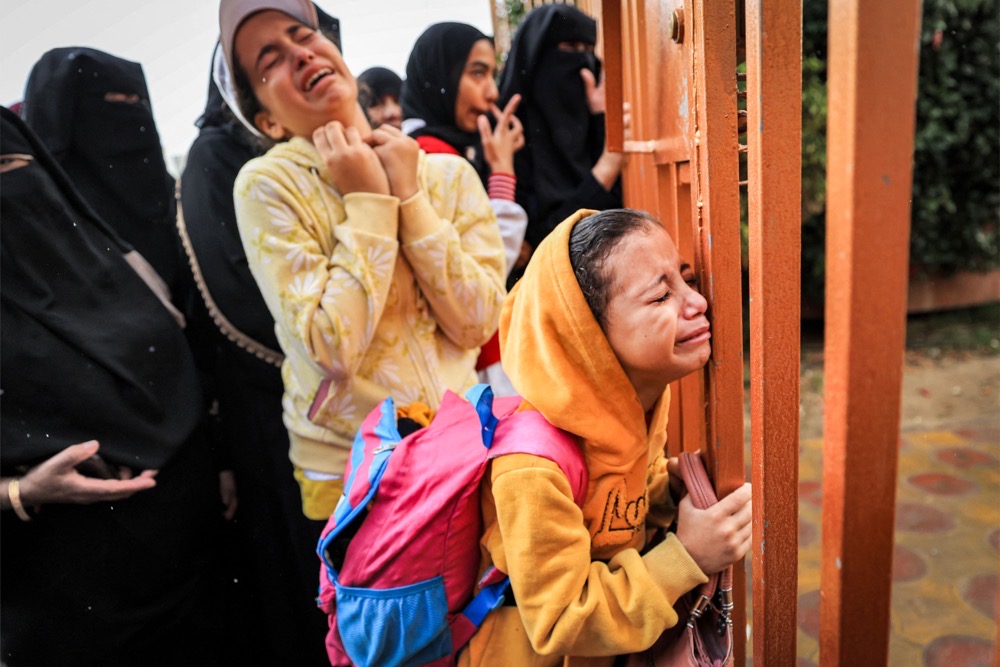
People in Khan Yunis mourn after the death of their loved ones in Israeli bombardments. (Getty Images/AFP)
“These conditions are fueling infections, diarrhea and parasitic diseases, which negatively impact the body’s ability to absorb nutrients and profoundly impair health and development,” leading to an increased risk of death, said Zaki.
Pregnant women and new mothers are especially vulnerable to the effects on health of restricted food supplies and insufficient safe drinking water. According to the WHO, there are about 50,000 pregnant women in Gaza, more than 180 of whom give birth every day. Of those, 15 percent will experience complications that require additional medical care — which is no longer available.
“Given the current conditions in Gaza it is likely that the nutrition status of the whole population, in particular infants and women who are pregnant and breastfeeding, is in a state of rapid decline,” said Zaki.
“Around 2.2 million people, nearly the entire population, in Gaza now need food assistance. Inadequate diets and inadequate safe water are core drivers of acute malnutrition.”