BEIRUT: Missile warning sirens sounded in the Israeli settlements of Kiryat Shmona and Margaliot on Wednesday afternoon, ending an 18-hour period of cautious calm on the border with Lebanon.
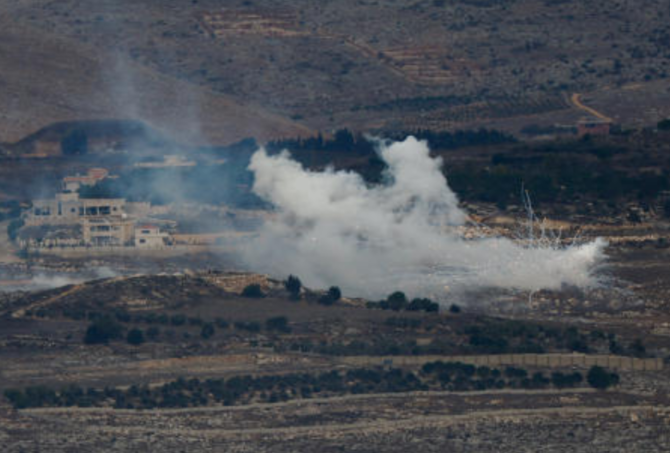
Israeli media reported that about 20 missiles fired from Lebanon toward the Galilee region fell near Kiryat Shmona.
Hezbollah said that it struck the Israeli Defense Forces’ Ramim barracks with missiles, achieving “direct hits,” and also targeted Israeli military sites in Ruwaizat Al-Alam in the Kafr Shuba hills.
Israel’s Channel 14 television channel reported that drones crossed into the Zar’it area on the border with Lebanon.
Israeli forces directed artillery fire at areas between Khiam, Ebl Al-Saqi, and the outskirts of the towns of Hula, Rab El Thalathine, Markaba, Burj Al-Muluk, and Labouneh, south of Naqoura.
An explosion from an Israeli Iron Dome interceptor missile echoed in the skies above the Khiam Plain.
Confrontations were confined to the area south of the Litani River.
Suggestions that the lull in clashes between Hezbollah and the Israeli army was linked to meetings between UNIFIL’s mission head Maj. Gen. Aroldo Lazaro Saenz and Lebanese political leaders on Tuesday were rejected by one source, who told Arab News: “This matter has nothing to do with what is happening on the ground. The southern front moves in line with field developments in the Gaza Strip.”
Hezbollah’s Deputy Secretary-General Naim Qassem said in a statement that “if Israel decides to go to war, we will confront it with all the power we have to defeat it.”
He added: “We are confident that we will win every war we could enter against the Israeli entity. When Israel wages a war against us, we have no choice but to defend.”
Qassem linked the possibility of war in Lebanon “to the developments taking place in Gaza and Israel’s decision to initiate the war.”
Referring to Hamas’s Oct. 7 attack on Israel, Qassem said: “The goal is resistance action in order to address many issues of concern to the Palestinians and release the prisoners. It is not right to focus on details that occurred to justify massacres. Our perspective is that matters should return to the origin. The Israeli occupying entity is the cause of Oct. 7.”
Regarding Israel’s right to safety, Qassem said: “They must end the occupation to restore stability to Palestine and the region. We must address the problem of the occupation, not the problem of resistance against the occupation.”
He added that if Israel “stands on its feet today,” it is only because of US support, including the opening of air routes for ammunition and weapons.
“Without this, Israel might have fallen within days,” he said.
“Israel continues to breathe through artificial respiration, and we don’t know when it will stop.”


![]()

Missile strikes end lull on Lebanon border
Short Url
https://arab.news/vg4yp
Missile strikes end lull on Lebanon border
- Israeli media reported that about 20 missiles fired from Lebanon toward the Galilee region fell near Kiryat Shmona
- Hezbollah said that it struck the Israeli Defense Forces’ Ramim barracks with missiles, achieving “direct hits”


Latest updates


© 2026 SAUDI RESEARCH & PUBLISHING COMPANY, All Rights Reserved And subject to Terms of Use Agreement.