Forced to leave Pakistan, Afghan refugees start over with nothing

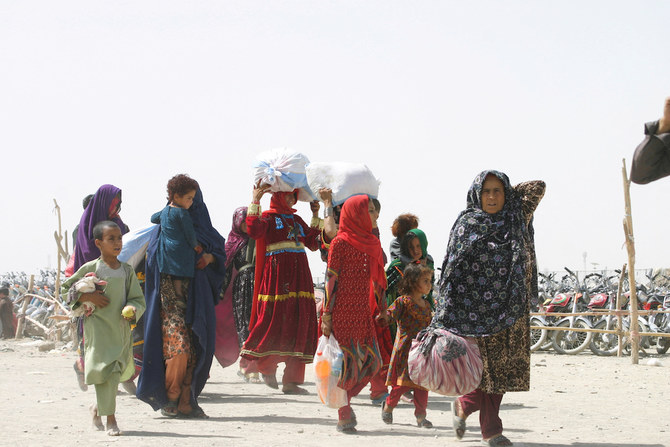
An Afghan family waits to cross the main Afghanistan-Pakistan land border in Torkham, Pakistan on Sept. 15, 2023. (Reuters)
Short Url
Updated 16 November 2023
Follow

Forced to leave Pakistan, Afghan refugees start over with nothing

  • 400,000 people returned from Pakistan to Afghanistan since last month
  • Pakistan launched a crackdown on unregistered foreigners

KABUL: After eight years of building his life in Islamabad, Abdul Shakor hurriedly packed all the possessions his family could take on a one-way trip as a Pakistan-wide crackdown on undocumented foreign nationals forced him to return to Afghanistan last week.

Shakor’s mother, wife and four children were among hundreds of thousands of Afghans who since last month have been flocking to the border to cross to their country of origin, ordered by Pakistani authorities to leave voluntarily or face deportation.

While the decision covered all the foreigners deemed as living in the country illegally, it hit Afghans the most as some 1.7 million of them — out of the total of 4 million — were living in Pakistan unregistered.

Millions of Afghans fled to Pakistan during decades of conflict, after their homeland was invaded by the Soviet Union in 1979. Over the years, some would return, and some more would flee Afghanistan — most recently when the Taliban took over the war-torn country following the withdrawal of US-led forces in 2021.

But since last month, Afghan authorities estimate that around 400,000 of them have made their way back.

Shakor chose to go to Kabul, where his sister lives and would share her room with his family.

“We arrived in Kabul and we have nothing,” he told Arab News.

“It was quite hard to leave Pakistan so suddenly … the Pakistani government should have given us at least five to six months to leave, but it did not. We are asking the current government of Afghanistan to provide us shelter and opportunity to work, nothing else.”

The Afghan administration has pledged support for the returnees, but it is itself already struggling with a collapsing economy. Since the Taliban takeover, the country has been hit by international sanctions and its unemployment has more than doubled.

While the Ministry of Refugees and Repatriation is handing out cash to each returning family, it is a drop in the ocean of needs.

“When we arrived at the Torkham crossing point, we received 10,000 afghanis ($140) in cash from Afghanistan’s Islamic Emirate officials who told us they would give us some land and assistance,” said Gul Agha, who for the past 15 years had been living in Haripur, in Pakistan’s northwest.

“We have to find a home, which is a big problem for me … It was really hard not only for me but for my entire family to leave Pakistan after we spent 15 years there. We had a very peaceful environment there and work opportunities.”

The deadline Pakistan set for unregistered foreigners to leave lapsed on Nov. 1. Since then, round-up operations have been taking place across the country.

Ahmadullah, another returnee who left Afghanistan’s Kapisa province for Pakistan seven years ago, made it a point of honor to not be expelled in such a way.

“I did not forcibly leave Pakistan because I took into consideration my family’s dignity. We decided to leave Pakistan before Pakistani security forces could come to our home,” he told Arab News.

Ahmadullah was working as a laborer in Peshawar, earning enough to send his children to school.

“All my children were studying in Peshawar, so it was really heartbreaking,” he said. “It was really hard to bring an end to our life in Pakistan.”


UN’s top court opens Myanmar Rohingya genocide case

Updated 12 January 2026
Follow

UN’s top court opens Myanmar Rohingya genocide case

  • The Gambia filed a case against Myanmar at the UN’s top court in 2019
  • Verdict expected to impact Israel’s genocide case over war on Gaza

DHAKA: The International Court of Justice on Monday opened a landmark case accusing Myanmar of genocide against its mostly Muslim Rohingya minority.

The Gambia filed a case against Myanmar at the UN’s top court in 2019, two years after a military offensive forced hundreds of thousands of Rohingya from their homes into neighboring Bangladesh.

The hearings will last three weeks and conclude on Jan. 29.

“The ICJ must secure justice for the persecuted Rohingya. This process should not take much longer, as we all know that justice delayed is justice denied,” said Asma Begum, who has been living in the Kutupalong refugee camp in Bangladesh’s Cox’s Bazar district since 2017.

A mostly Muslim ethnic minority, the Rohingya have lived for centuries in Myanmar’s western Rakhine state but were stripped of their citizenship in the 1980s and have faced systemic persecution ever since.

In 2017 alone, some 750,000 of them fled military atrocities and crossed to Bangladesh, in what the UN has called a textbook case of ethnic cleansing by Myanmar.

Today, about 1.3 million Rohingya shelter in 33 camps in Cox’s Bazar, turning the coastal district into the world’s largest refugee settlement.

“We experienced horrific acts such as arson, killings and rape in 2017, and fled to Bangladesh,” Begum told Arab News.

“I believe the ICJ verdict will pave the way for our repatriation to our homeland. The world should not forget us.”

A UN fact-finding mission has concluded that the Myanmar 2017 offensive included “genocidal acts” — an accusation rejected by Myanmar, which said it was a “clearance operation” against militants.

Now, there is hope for justice and a new future for those who have been displaced for years.

“We also have the right to live with dignity. I want to return to my homeland and live the rest of my life in my ancestral land. My children will reconnect with their roots and be able to build their own future,” said Syed Ahmed, who fled Myanmar in 2017 and has since been raising his four children in the Kutupalong camp.

“Despite the delay, I am optimistic that the perpetrators will be held accountable through the ICJ verdict. It will set a strong precedent for the world.”

The Myanmar trial is the first genocide case in more than a decade to be taken up by the ICJ. The outcome will also impact the genocide case that Israel is facing over its war on Gaza.

“The momentum of this case at the ICJ will send a strong message to all those (places) around the world where crimes against humanity have been committed,” Nur Khan, a Bangladeshi lawyer and human rights activist, told Arab News.

“The ICJ will play a significant role in ensuring justice regarding accusations of genocide in other parts of the world, such as the genocide and crimes against humanity committed by Israel against the people of Gaza.”