

‘Treasure in the sea’: Pakistani fisherman catches rare blackspotted croaker to become millionaire overnight

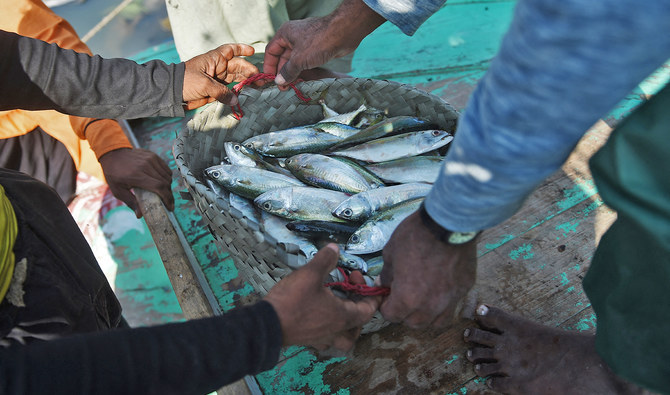
In this picture taken on December 28, 2022, fishermen unload their catch upon returning from fishing on the Arabian sea, at a port in Karachi. (AFP/File)
Short Url
Updated 15 November 2023
Follow

‘Treasure in the sea’: Pakistani fisherman catches rare blackspotted croaker to become millionaire overnight

  • Muhammad Juman’s catch was worth $599,782 of which he got $12,864, some believe high price of fish is due to medicinal value
  • Known as Sua in Sindhi language, the fish is a highly prized delicacy in countries like Singapore, Malaysia, Indonesia, Hong Kong, China

KARACHI: When Muhammad Juman docked his boat at a fish harbor in southern Pakistan last week, never could he have imagined the precious cargo he had brought in from the deep sea.

The father of 14 from the small fishing village of Mirpur Sakro in Pakistan’s coastal Thatta district had caught a blackspotted croaker, known as Sua in the Sindhi language, a rare and highly prized delicacy in countries like Singapore, Malaysia, Indonesia, Hong Kong, China and Japan and one of the most expensive types of fish in these regions.

“We found a treasure in the sea but we didn’t know it until we beached the boat and trading began,” said Juman, the 58-year-old captain of the fishing boat that chanced upon what turned out to be a catch worth Rs170 million ($599,782.95).

Asked about his own share in the catch, he said that he had made about Rs3.7 million ($12,864) since half the money went to the owner of the boat and the rest was equally divided among the fishermen he employed.

“This is a huge amount for me,” Juman told Arab News in a phone interview. “I had never thought of earning so much in a single instance.”

The blackspotted croaker is known for its distinct flavor and texture and is a sought-after ingredient in high-end culinary preparations.
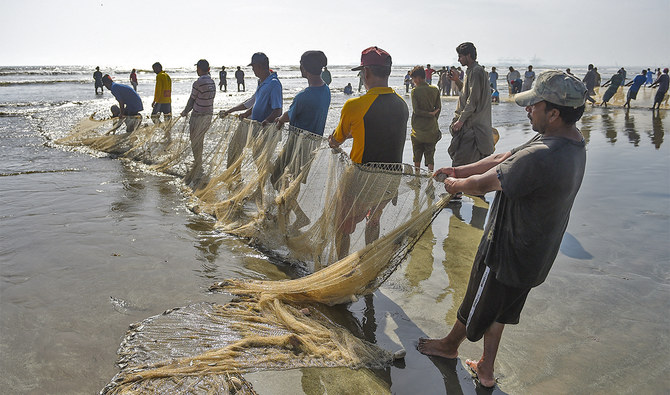


Pakistani fishermen pull a fishing net ashore at the Clifton beach in Karachi, Pakistan on April 1, 2019. (AFP/File)

Some believe its high price is due to its medicinal value, though Muhammad Moazam Khan, a former director general of the marine fisheries department who currently works as a technical adviser with the World Wide Fund for Nature (WWF), told Arab News the fish was expensive because its dried swim bladder was used as a speculative investment like gold and other commodities.

“Its dried swim bladder is sold at $20,000 to $80,000 per kilogram, which is why it is used as speculative investment,” he said. “In 2015, when its market went down, many in China who had invested in it committed suicide.”

Khan said the population of the fish in Pakistani waters had reduced by 95 percent, which made Juman’s catch quite rare.

“It’s a migratory fish and can be found near the coast in groups,” he said, adding that the fish had changed the destiny of many Pakistani fishermen when it could still be found more easily.

“In 2001, Muhammad Shafi, a marine fishery department guard, caught two big ones and sold them to buy a hut at the beach,” Khan said.

Juman still can’t believe his luck.

“I cannot thank Allah enough for what He gave us,” Juman said, adding that he planned to use the money to build a mosque in his village to express gratitude and take his wife for the Umrah pilgrimage.

It was a huge catch for Juman whose earnings have reduced as climate change has impacted the overall ecological system.

“Sometimes we return empty handed from the sea,” he said. “But sometimes, our efforts are fruitful and we earn two meals a day for our children.”

But despite becoming a millionaire, Juman said he would not abandon his profession:

“I will continue to go to the sea. Maybe I will find another treasure.”


Islamabad offers skilled manpower to help Iraq in reconstruction, development efforts

Updated 10 sec ago
Follow

Islamabad offers skilled manpower to help Iraq in reconstruction, development efforts

  • The development comes during Pakistan President Asif Ali Zardari’s four-day visit to Iraq to strengthen bilateral cooperation
  • Zardari says current levels of bilateral trade do not reflect true potential of Pakistan-Iraq ties, highlights opportunities

ISLAMABAD: Pakistan has offered to provide skilled manpower to support Iraq’s reconstruction and development efforts, the Pakistani government said on Sunday, signaling Islamabad’s willingness to deepen cooperation with Baghdad in sectors including infrastructure, technical services and human resource development.

The development comes during Pakistan President Asif Ali Zardari’s four-day visit to Iraq to strengthen cooperation in trade, investment, religious tourism, energy and other sectors.

Zardari held a one-on-one meeting with his Iraqi counterpart, Dr. Abdul Latif Jamal Rashid, at Baghdad Palace, which was followed by delegation-level talks to review the state of bilateral relations.

“President Zardari reiterated Pakistan’s willingness to support Iraq’s reconstruction and development efforts through the provision of skilled and semi-skilled manpower under the existing Memorandum of Understanding on manpower transmission,” Pakistan’s Press Information Department (PID) said in a statement.

“He also highlighted Pakistan’s capacity in medical services, financial expertise and digital governance, and expressed readiness to share technical experience, including in secure data management, to support institutional capacity-building in Iraq.”

Iraq has been working to rebuild its economy and infrastructure after decades of conflict, including the 2003 US-led invasion and years of instability caused by sectarian violence and the fight against Daesh group. Although security conditions have improved in recent years, large parts of the country still face damaged roads, power plants, hospitals and housing, requiring large-scale reconstruction and public service delivery.

During Sunday’s meeting, Zardari noted that the current levels of bilateral trade do not reflect the true potential of Pakistan-Iraq economic, cultural and security relations, highlighting opportunities in agriculture, defense production, information technology, construction, pharmaceuticals and other sectors. He underscored the importance of business-to-business engagement and the establishment of direct banking channels to facilitate trade and commercial activity, according to the PID.

Zardari also requested improved facilitation for Pakistani pilgrims visiting Iraq and expressed hope for early finalization and implementation of a proposed Memorandum of Understanding on Zaireen (pilgrims) Management, aimed at ensuring orderly travel. He expressed his firm resolve to work with the Iraqi government to stop illegal entry and overstay of those Pakistanis who violate Iraqi law.

“Both Presidents expressed their resolve to fight extremism, terrorism and narco trade and enhance bilateral cooperation,” the PID said. “The two leaders reaffirmed their commitment to further deepening bilateral cooperation across political, economic and social domains.”

Pakistan and Iraq established diplomatic relations in 1947 and have traditionally maintained cordial ties, though commercial links remain modest. The volume of trade between both countries stood at $268 million in 2023.

Pakistan’s major exports to Iraq include machinery and mechanical appliances, pharmaceutical products, fish, cereals, essential oils and resinoids. Islamabad’s imports from Iraq include mineral fuels, mineral, organic chemicals, edible fruit and nuts.