

Brazilian football player Dani Alves to face trial on sexual assault charge in Spain

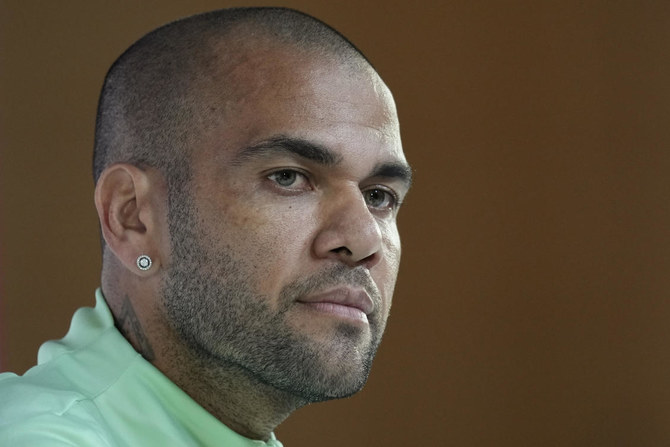
Brazil’s Dani Alves will face trial for allegedly having sexually assaulted a woman in a night club last year, a Spanish judge ordered on Nov. 14, 2023. (AP/File)
Short Url
Updated 15 November 2023
Follow

Brazilian football player Dani Alves to face trial on sexual assault charge in Spain

  • The Barcelona-based court said “there was enough evidence to open the trial”
  • The former Barcelona defender has denied any wrongdoing

BARCELONA, Spain: Brazilian football player Dani Alves will face trial for allegedly sexually assaulting a woman in a night club last year, a Spanish court said Tuesday.

The Barcelona-based court said “there was enough evidence to open the trial” considering the statements given to court and the evidence presented in the investigation phase.

A date for the hearings was yet to be set.

The 40-year-old Alves has been in pre-trial jail since January when he was arrested for allegedly assaulting the woman at a nightclub in Barcelona on Dec. 30. He was indicted by an investigative judge in August.

The former Barcelona defender has denied any wrongdoing, claiming he had consensual sex with the accuser.

Under Spain’s sexual consent law passed last year, the charge of sexual assault takes in a wide array of crimes from online abuse and groping to rape, each with different possible punishments. A case of rape can carry a maximum sentence of 15 years.

Alves won 42 football titles, including three Champions Leagues with Barcelona and two Copa Americas with Brazil. He played at his third World Cup last year in Qatar.

A judge ordered him to be jailed in January after analyzing the initial investigation by authorities and hearing testimony from the alleged victim, witnesses and the player himself.

All of Alves’ bail requests were denied because the court considered him a flight risk. The player had offered to turn in his passports and wear a tracking device while awaiting the court’s decision.

Alves’ lawyers did not immediately respond a request for comment on Tuesday.


Morocco banish any doubts about ability to host World Cup 2030

Updated 19 January 2026
Follow

Morocco banish any doubts about ability to host World Cup 2030

  • Impressive stadiums, easy transportation links and a well-established tourism infrastructure ensured the 24-team tournament went off without any major hitch and will assuage any doubters about the World Cup in four years’ time

RABAT: Morocco’s successful staging of the Africa Cup of Nations means there should be no skepticism about its ability to co-host the World Cup with Portugal and Spain in 2030, even if Sunday’s final was clouded by a walk-off and defeat for the home team.

Impressive stadiums, easy transportation links and a well-established tourism infrastructure ensured the

24-team tournament went off without any major hitch and will assuage any doubters about the World Cup in four years’ time.

Morocco plans to use six venues in 2030 and five of them were used for the Cup of Nations, providing world-class playing surfaces and a spectacular backdrop.

The Grande Stade in Tangier with a 75,000 capacity is an impressive facility in the northern coastal city, less than an hour’s ferry ride from Spain.

Meanwhile, FIFA President Gianni Infantino condemned "some Senegal players" for the "unacceptable scenes" which overshadowed their victory in the final when they left the pitch in protest at a penalty awarded to Morocco.

African football's showpiece event was marred by most of the Senegal team walking off when, deep into injury time of normal play and with the match locked at 0-0, Morocco were awarded a spot-kick following a VAR check by referee Jean-Jacques Ndala for a challenge on Brahim Diaz.

security personnel at the other end of the stadium, Senegal's players eventually returned to the pitch to see Diaz shoot a soft penalty into the arms of their goalkeeper Edouard Mendy.

The match was played at the Stade Moulay Abdellah in the capital Rabat, which has a capacity of 69,500. The attendance for the final was 66,526.

Stadiums in Agadir, Fes and Marrakech were also more than adequate and will now be renovated over the next few years.

But the crowning glory is the proposed 115,000-capacity Stade Hassan II on ⁠the outskirts of Casablanca which Morocco hope will be chosen to host the final over Madrid’s Santiago Bernabeu Stadium.

In all, Morocco will spend $1.4 billion on the six stadiums. Also planned is extensive investment in airports, with some 10 Moroccan cities already running direct air links to Europe and many budget airlines offering flights to the country.

An extension of Africa’s only high-speed rail service, which already provides a comfortable three-hour ride from Tangier to Casablanca, further south to Agadir and Marrakech is also planned. Morocco hopes all of this will modernize its cities and boost the economy.

On the field, Morocco will hope to launch a credible challenge for a first African World Cup success, although on Sunday they continued their poor return in the Cup of Nations, where their only triumph came 50 years ago.

They surprised with a thrilling run to the last four at the Qatar 2022 World Cup as the first African nation to get that far and will hope for a similar impact at this year’s finals in North America. They are in Group C with Brazil, Scotland and Haiti.