

More Gaza hospitals suspend operations as Israel hunts Hamas

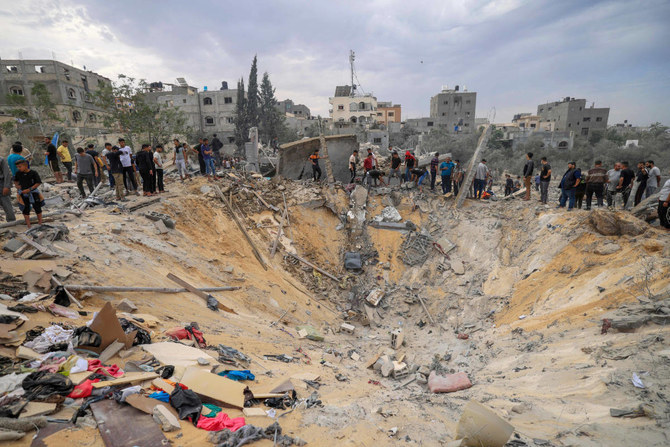
People stand over a crater following an Israeli bombardment in Khan Yunis in the southern Gaza Strip on November 12, 2023, amid the ongoing battles between Israel and the Palestinian militant group Hamas. (AFP)
Short Url
Updated 13 November 2023
Follow

More Gaza hospitals suspend operations as Israel hunts Hamas

  • Hospitals in the north of the Palestinian enclave are blockaded by Israeli forces and barely able to care for those inside
  • Battles around Gaza’s largest Al-Shifa hospital leave many trapped

GAZA/JERUSALEM: Two more major hospitals in Gaza closed to new patients on Sunday, with staff saying that Israeli bombardment plus lack of fuel and medicine meant more babies and others could die.
Hospitals in the north of the Palestinian enclave are blockaded by Israeli forces and barely able to care for those inside, medical staff said. Israel says it is homing in on Hamas militants in the area and the hospitals should be evacuated.
Gaza’s largest and second largest hospitals, Al-Shifa and Al-Quds, said they were suspending operations. With more people killed and wounded daily but half of the territory’s hospitals now out of action, there are ever fewer places for the injured.


Newborns are placed in bed after being taken off incubators in Gaza's Al Shifa hospital after power outage, amid the ongoing conflict between Israel and the Palestinian group Hamas, in Gaza City, Gaza November 12, 2023. (REUTERS)

“My son was injured and there was not a single hospital I could take him to so he could get stitches,” said Ahmed Al-Kahlout, who was fleeing south in accordance with Israeli advice while fearing that nowhere in Gaza was safe.
A plastic surgeon in Shifa said bombing of the building housing incubators had forced them to line up premature babies on ordinary beds, using the little power available to turn the air conditioning to warm.
“We are expecting to lose more of them day by day,” said Dr. Ahmed El Mokhallalati.
Israel says Hamas has placed command centers under and near the hospitals and it needs to get at them to free around 200 hostages the militants took in Israel in an attack just over a month ago. Hamas has denied using hospitals in this way.
On Sunday, a Palestinian official briefed on talks over the release of hostages said Hamas had suspended the negotiations because of the way Israel had handled Shifa hospital.
There was no immediate comment from either Hamas or Israel.

’NO ONE IS ALLOWED IN, NOBODY IS ALLOWED OUT’
Israel’s military said it had offered to evacuate newborn babies and had placed 300 liters of fuel at Shifa’s entrance on Saturday night, but that both gestures had been blocked by Hamas.
Muhammad Abu Salmiya, director of Shifa, said reports of refusing to leave the diesel were “lies and slander.” Ashraf Al-Qidra, spokesperson for the Health Ministry in Hamas-controlled Gaza, said that of 45 babies in incubators at Shifa, three had already died.


Israeli army soldiers attend an armed first response group training session in the Druze village of Hurfeish, which has garnered the name "Tsahal village" (a Hebrew-language acronym for the "Israel Defence Forces"), near the border with Lebanon in northern Israel on November 10, 2023. (AFP)

Shifa was out of reach for the newly wounded, said Mohammad Qandil, a doctor at Nasser Hospital in Khan Younis in south Gaza, who is in touch with colleagues there.
“Shifa hospital now isn’t working, no one is allowed in, nobody is allowed out,” he said.
The Palestinian Red Crescent said Al-Quds hospital was also out of service, with staff struggling to care for those already there with little medicine, food and water.
“Al Quds hospital has been cut off from the world in the last 6-7 days. No way in, no way out,” said Tommaso Della Longa, spokesperson for the International Federation of Red Cross and Red Crescent Societies.


Men check the bodies of people killed in bombardment that hit a school housing displaced Palestinians, as they lie on the ground in the yard of Al-Shifa hospital in Gaza City on November 10, 2023, amid ongoing battles between Israel and the Palestinian Hamas movement. (AFP)

Three UN agencies expressed horror at the situation in the hospitals, saying it had in 36 days registered at least 137 attacks on health care facilities, resulting in 521 deaths and 686 injuries — including 16 dead and 38 wounded medics.
“The world cannot stand silent while hospitals, which should be safe havens, are transformed into scenes of death, devastation, and despair,” it said, saying half of Gaza’s hospitals were now closed.
With the humanitarian situation across Gaza worsening, 80 foreigners and several injured Palestinians crossed into Egypt in the first evacuations since Friday, four Egyptian security sources said.
Poland said 18 of them were its citizens, and US National Security Adviser Jake Sullivan told CBS News American citizens would be moved out of Gaza during Sunday.

AID DELIVERIES BY TRUCK AND PARACHUTE
At least 80 aid trucks had also moved from Egypt into Gaza by Sunday afternoon, two of the sources said. Jordan said earlier it had air-dropped a second batch into a field hospital.
Very little aid has entered Gaza since Israel declared war on Hamas more than a month ago after militants rampaged through southern Israel, killing about 1,200 people and taking more than 200 hostages, according to Israeli officials.


White phosphorus fired by Israeli army to create a smoke screen, is seen on the Israel-Lebanon border in northern Israel, November 12, 2023. (REUTERS)

Palestinian officials said on Friday that 11,078 Gaza residents had been killed in air and artillery strikes since then, around 40 percent of them children.
Disease is spreading among evacuees packed into schools and other shelters and surviving on tiny amounts of food and water, international aid agencies say.
Speaking from inside Gaza City, Jamila, 54, said she and her family could hear the roar of tanks nearby.
“During the day, people try to look for essential items such as bread and water, and at night people try to stay alive,” she said. “We hear explosions throughout the night, sometimes we can tell that some of these explosions are exchanges of fire between the resistance fighters and the Israeli forces.”
Palestinian health officials said 13 people had been killed in an Israeli air strike on a house in Khan Younis in southern Gaza on Sunday.
Residents reported increased fighting around Al-Shati refugee camp, by the coast in northern Gaza. The Israeli military said it had killed a number of militants there and called on civilians to use a four-hour pause to evacuate south.
The Gaza fighting has reignited conflict on Israel’s northern border with Lebanon, which has seen the worst cross-border clashes since 2006.
Lebanon’s Hezbollah group, which like Hamas is backed by Iran, said it attacked Israeli army troops near the Dovev Barracks on Sunday, inflicting casualties.
The Israeli military said earlier that anti-tank missiles fired by militants had hit a number of civilians, adding that it was retaliating with artillery fire.
The UN peacekeeping force in Lebanon said one of its members near the town of Al-Qawzah in southern Lebanon had been wounded by a bullet overnight.


What to know about the Strait of Hormuz, a key passageway essential for global energy supply

Updated 7 sec ago
Follow

What to know about the Strait of Hormuz, a key passageway essential for global energy supply

  • The Strait of Hormuz is a bending waterway, about 33 kilometers (21 miles) wide at its narrowest point. It connects the Arabian Gulf to the Gulf of Oman

DUBAI, United Arab Emirates: The widening war in Iran has ground tanker traffic through the Strait of Hormuz to a halt and oil prices have been swinging sharply, highlighting the important role the narrow passageway plays in global energy supply.
The Strait of Hormuz is the narrow mouth of the Arabian Gulf through which about a fifth of the world’s oil passes. Tankers traveling through the strait, which is bordered in the north by Iran, carry oil and gas from Saudi Arabia, Kuwait, Iraq, Qatar, Bahrain, the UAE and Iran. Most of that oil goes to Asia.
Any disruption to traffic through the Strait of Hormuz is highly disruptive to the oil trade. Disruptions caused oil to spike Monday, only for it to swiftly fall back after President Donald Trump suggested the war could be near an end.
“The scale of what is at stake cannot be overstated,” said Hakan Kaya, senior portfolio manager at investment management firm Neuberger Berman. He said a partial slowdown lasting a week or two could be absorbed by oil companies. But a full or near full closure lasting a month or more would push crude oil prices “well into triple digits” and European natural gas prices “toward or above the crisis levels seen in 2022.”
Here’s what to know about the strait and the widening Iran war.
A key waterway for global shipping
The Strait of Hormuz is a bending waterway, about 33 kilometers (21 miles) wide at its narrowest point. It connects the Arabian Gulf to the Gulf of Oman. From there, ships can then travel to the rest of the world. While Iran and Oman have their territorial waters in the strait, it’s viewed as an international waterway all ships can ply. The United Arab Emirates, home to the skyscraper-studded city of Dubai, also sits near the waterway.
The strait long has been important for trade
The Strait of Hormuz through history has been important for trade, with ceramics, ivory, silk and textiles moving from China through the region. In the modern era, it is the route for supertankers carrying oil and gas from Saudi Arabia, Kuwait, Iraq, Qatar, Bahrain, the UAE and Iran. The vast majority of it goes to markets in Asia, including Iran’s only remaining oil customer, China.
While there are pipelines in Saudi Arabia and the UAE that can avoid the passage, the US Energy Information Administration says “most volumes that transit the strait have no alternative means of exiting the region.”
Threats to the route have spiked global energy prices in the past, including during the Israel-Iran war in June.
Is the strait closed?
Iran has attacked several ships in the Strait of Hormuz and threatened any ships that try to pass through, effectively but not officially closing it.
President Donald Trump said on social media that the US would dramatically increase attacks if Iran tried to close the Strait of Hormuz. Iran has been targeting energy infrastructure and traffic through the strait, which is a vital waterway for traded oil.
Previously, Iran temporarily shut down parts of the strait in mid-February for what it said was a military drill. In past times of tension and conflict, Iran has at times harassed shipping though the narrows, and during the 1980s’ Iran-Iraq war, both sides attacked tankers and other vessels, using naval mines to completely shut down traffic at points. But Iran had not carried out repeated threats to close the waterway altogether since the 1980s, even during last year’s 12-day war when Israel and the US bombarded Iran’s key nuclear and military sites.
The US is rolling out ship reinsurance in the region through the US International Development Finance Corp., a government agency that partners with the private sector to back global investment projects, in an effort to get ships moving through the Strait again.
Political risk insurance is a type of coverage intended to protect firms against financial losses caused by unstable political conditions, government actions, or violence. Marine insurers had been canceling or raising rates for insurance in the region.
The US reinsurance facility will insure losses up to approximately $20 billion on a rolling basis, according to the International Development Finance Corp., focusing on insuring cargo and physical damage to a ship’s structure and operating machinery to start.
Trump said that, if necessary, the US Navy would escort oil tankers through the Strait of Hormuz. The Navy has at least eight destroyers and three, smaller, littoral combat ships in the region. These ships have previously been used to escort merchant shipping in the region and in the Red Sea.
Meanwhile, French President Emmanuel Macron has pledged to dispatch additional warships to the Eastern Mediterranean. There is a French-led initiative in the works that will involve European and non-European nations helping to escort oil and gas tankers with the aim of gradually reopening the Strait of Hormuz off Iran “as soon as possible after the most intense phase of the conflict is over.”
Mine fears
On Tuesday, President Donald Trump said the US military “completely destroyed” 10 inactive Iranian mine-laying ships after reports of Iranian action in the Strait of Hormuz.
Trump in his social media post added that there would be “more to follow,” suggesting the US would target additional mine-laying vessels.
The announcement of the targeting of the ships came soon after two other social media posts by the US president in which he said he has no reports of Iran putting explosive mines in the strategic waterway, but also warned Tehran if mines were laid he wanted them immediately removed.
Global shippers suspend operations
Global shippers have issued service alerts saying they have suspended operations in the area. Danish shipping company Maersk, the world’s biggest shipping company, said Sunday it is suspending all vessel crossings in the Strait of Hormuz until further notice. Other ocean carriers including Hapag-Lloyd, CMA-CGM and MSC made similar announcements.
“Those ships that got stuck in the Gulf are not going anywhere,” said Tom Goldsby, logistics chairman in the Supply Chain Management Department at the University of Tennessee. “There’s also a whole host of ships that were heading into the Gulf to replace them, and of course they’re anchored or going elsewhere now.”
There are currently about 400 oil and product tankers idle in the Gulf, and one oil tanker passed through the Strait of Hormuz without incident on Monday, according to data from MarineTraffic, a project that tracks the movement of vessels around the globe using publicly available data.