

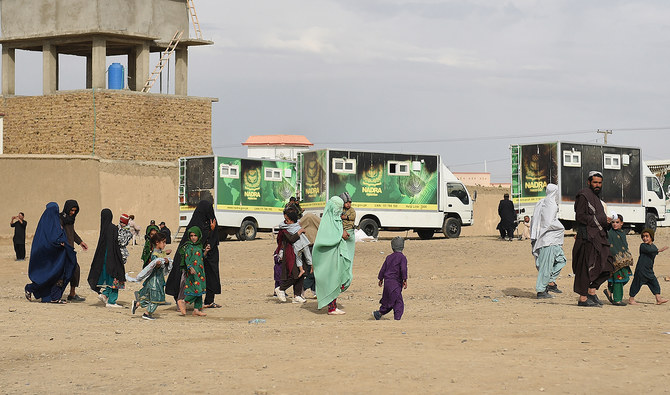
Pakistani police cracking down on migrants arresting Afghan women and children, activists claim

Afghan refugees walk near the Pakistan-Afghanistan border in Chaman on November 7, 2023, following Pakistan's government decision to expel people illegally staying in the country. (AFP)
Short Url
Updated 12 November 2023
Follow

Pakistani police cracking down on migrants arresting Afghan women and children, activists claim

  • More than 250,000 Afghans have left Pakistan in recent weeks amid Pakistan's crackdown on illegal immigrants
  • Pakistan has long hosted millions of Afghans, most of whom fled their country during 1979-1989 Soviet occupation


KARACHI: Pakistani police are arresting Afghan women and children in southern Sindh province as part of a government crackdown on migrants, activists said Saturday.

More than 250,000 Afghans have left Pakistan in recent weeks as the government rounded up, arrested and kicked out foreign nationals without papers. It set an Oct. 31 deadline for migrants without legal status to leave the country voluntarily.

The expulsions mostly affect Afghans, who make up the majority of foreigners living in Pakistan. Authorities maintain they are targeting all who are in the country illegally.

Human rights lawyer Moniza Kakar said police in Sindh launch midnight raids on people’s homes and detain Afghan families, including women and children.

Since Nov. 1, she and other activists have stationed themselves outside detention centers in Karachi to help Afghans. But they say they face challenges accessing the centers. They don’t have information about raid timings or deportation buses leaving the port city for Afghanistan.

“They’ve been arresting hundreds of Afghan nationals daily since the Oct. 31 deadline, sparing neither children nor women,” Kakar said.

Last December, Afghan women and children were among 1,200 people jailed in Karachi for entering the city without valid travel documents. The arrests brought criticism from around Afghanistan after images of locked-up children were circulated online.

In the latest crackdown, even Afghans with documentation face the constant threat of detention, leading many to confine themselves to their homes for fear of deportation, Kakar said. “Some families I know are struggling without food, forced to stay indoors as police officials continue arresting them, regardless of their immigration status.”

She highlighted the plight of refugee children born in Pakistan without proof of identity, even when their parents have papers. Minors are being separated from their families, she told The Associated Press.

A Pakistani child who speaks Pashto, one of Afghanistan's official languages, was detained and deported because his parents were unable to register him in the national database, according to Kakar.

The head of the Human Rights Commission of Pakistan, Hina Jilani, said Pakistan lacks a comprehensive mechanism to handle refugees, asylum-seekers and migrants without papers, despite hosting Afghans for 40 years.

She criticized the government’s “one-size-fits-all approach” and called for a needs-based assessment, especially for those who crossed the border after the Taliban seized control of Afghanistan in 2021.

Violence against Pakistani security forces and civilians has surged since the Taliban takeover. Most attacks have been claimed by the Pakistani Taliban, the Tehreek-e-Taliban Pakistan or TTP, a separate militant group but a close ally of the Afghan Taliban.

On Saturday, the TTP claimed responsibility for an attack that killed three police officers and injured another three in northwest Khyber Pakhtunkhwa province bordering Afghanistan.

Pakistan accuses the Taliban of harboring militants from groups like the TTP — allegations that the Taliban deny — and said Afghans without permanent legal status are responsible for some of the attacks.

Jilani highlighted the humanitarian aspect of dealing with Pakistan’s Afghan communities, saying they shouldn’t be solely viewed through a security lens.

The Sindh official responsible for detention and deportation centers in the province, Junaid Iqbal Khan, admitted there were “initial incidents” of mistaken identity, with documented refugees and even Pakistani nationals being taken to transit points or detention centers. But now only foreigners without proper registration or documentation are sent for deportation, Khan said.

Around 2,000 detainees have been taken to a central transit point in the past 10 days, with several buses heading to the Afghan border daily through southwest Baluchistan province.

Khan said he wasn’t involved in raids or detentions so couldn’t comment on allegations of mishandling.

Pakistan has long hosted millions of Afghans, most of whom fled during the 1979-1989 Soviet occupation. More than half a million fled Afghanistan after the Taliban takeover.


Women’s growing visibility in Baloch insurgency raises debate over militancy and politics

Updated 5 sec ago
Follow

Women’s growing visibility in Baloch insurgency raises debate over militancy and politics

  • Senior government official confirms women suicide bombers took part in Jan. 30 attacks
  • Analysts say participation reflects tactical shift but is rooted in deeper political grievances

ISLAMABAD: Video footage released by the separatist Balochistan Liberation Army (BLA) following coordinated gun and bomb attacks across multiple districts of southwestern Pakistan last month showed women fighting alongside men, underscoring what officials describe as an increasing role of female militants amid a fresh surge in violence in the province.

The Jan. 30 assaults targeted security installations and government facilities across Balochistan province, killing at least 50 people, including 36 civilians and 22 members of law enforcement agencies. Pakistan’s military said security forces killed 216 militants in subsequent counteroffensives.

The visible participation of women, both in propaganda footage and in confirmed suicide attacks, has intensified debate in Pakistan over whether their involvement signals a tactical evolution of the insurgency or reflects deeper political and social grievances in the province.

Speaking to Arab News on condition of anonymity, a senior government official in Balochistan confirmed that at least three women suicide bombers were involved in the coordinated assaults, identifying them as Asifa Mengal, Hatm Naaz Sumalani and Hawa Baloch.

Authorities say they are conscious of the cultural and political sensitivities surrounding the involvement of women in militancy, particularly in Balochistan where women have traditionally been viewed as outside the sphere of armed conflict.

The government official said security forces had been instructed not to treat Baloch women broadly as suspects amid heightened tensions following the attacks.

“The government has directed in clear terms that no Baloch woman is to be touched,” he said. “It is against the culture and they will be treated with respect.”

However, he added that those actively participating in militant violence would face prosecution.

“A terrorist is neither male nor female or Shia or Sunni or Baloch or Pakhtun,” he said. “A terrorist is a terrorist and is being treated as per the anti-terrorism act.”

The involvement of women in militant movements is not unprecedented globally. 

Insurgent groups from Sri Lanka’s Tamil Tigers to Kurdish armed movements and Latin American guerrilla organizations have incorporated women into combat and suicide missions, often for strategic and symbolic reasons. Analysts say women’s participation can offer propaganda value, exploit security blind spots, and signal ideological commitment, while also reflecting deeper political grievances and social disruption.

The official in Balochistan said the use of women in militancy in the province was also not new but had intensified in recent years.

Prior to last week’s attacks, at least five women suicide bombers linked to the BLA had carried out major incidents, he said.

These included Shari Baloch, who attacked the Confucius Institute at the University of Karachi in April 2022, and Sumaiya Qalandrani, who carried out a suicide attack on a military convoy in Turbat in June 2023.

Three others, Mahal Baloch, Mahikan Baloch and Zareena Rafiq, were also identified by officials as having conducted suicide attacks between 2024 and 2025.

The official said that in Baloch traditions, women had historically been regarded with dignity and often played roles in resolving tribal disputes.

“Unfortunately, today these very women are being turned into fuel for war,” he said.

PROTEST AND MILITANCY

While the participation of a small number of women in militant attacks has drawn attention, women in Balochistan have also become increasingly visible in nonviolent political activism over the past decade, particularly around the issue of enforced disappearances. They have led prolonged protests over “missing family members,” relatives they accuse Pakistani security agencies of forcefully disappearing. The military and government deny the accusations. 

Women have led long marches from Balochistan to the capital and staged sit-ins outside the Islamabad Press Club demanding the recovery of missing persons, drawing national attention.

The Baloch Yakjehti Committee (BYC), a civil rights movement founded by Dr. Mahrang Baloch, has been prominent in these efforts.

“We see that our men, our brothers and sons, were systematically taken from their homes, from educational institutions, dragged away while they slept at night,” BYC leader Sammi Deen Baloch told Arab News in an interview last year.

“In such circumstances, the only option left for Baloch women was to take this fight into their own hands, to step forward and lead the battle for justice themselves.”

Analysts also caution against conflating civil activism with armed militancy.

Sahar Baloch, a journalist who has reported extensively on Balochistan’s issues, said women’s participation in militant groups reflected prolonged political trauma and structural exclusion rather than a simple rejection of conservative norms.

“Unlike Islamist militancy, Baloch insurgent narratives frame participation in militancy as a national duty, not gendered transgression,” she said.

“Women are positioned as political subjects first, not moral symbols to be hidden or protected.”

Baloch stressed that grassroots protest movements and insurgent recruitment operated in different spheres.

“Baloch women protesters are political actors exercising civil resistance often with social legitimacy within their communities,” she said. “Women joining armed groups are ideologically mobilized in a completely different sphere, often facing lethal risk.”

She also cautioned against interpreting participation in violence as empowerment.

“It is often a symptom of political suffocation, not liberation,” she said. “What we should be asking is what conditions make violence feel like the only remaining political language?”

PROPAGANDA AND STRATEGY

Abdul Basit, a Singapore-based expert on violent extremism, said the use of women in militant operations reflected both strategic calculation and symbolic value.

“In an area where people are killed in the name of honor for love marriages, the participation of women in militancy is strange,” he said, adding that militant groups used women operatives for visibility and recruitment impact.

However, he cautioned against overstating the scale of the phenomenon, noting that the number of women involved in militancy remained small relative to the broader insurgency.

Raja Umar Khattab, a former senior officer of the Sindh Police’s Counter Terrorism Department, said women involved in militancy in Balochistan generally fell into three categories.

The first comprises women radicalized at a young age by militant groups such as the BLA.

“Militant women of this category are highly educated,” he said.

The second category includes women allegedly coerced or blackmailed, “often through objectionable videos,” particularly those linked to Baloch student groups. He cited the case of Gul Nisa, arrested in connection with the October 2024 suicide attack on Chinese nationals near Karachi’s Jinnah International Airport.

The claims that Baloch women had been forced or blackmailed into carrying out attacks could not be independently verified.

The third category, he said, involved women whose close relatives were among the missing.

“They have been radicalized by their family members.”

Khattab said militant groups were deliberately incorporating women into their operational strategy.

“They are using women for all purposes, including protests, logistic supplies, and terrorism,” he added.