

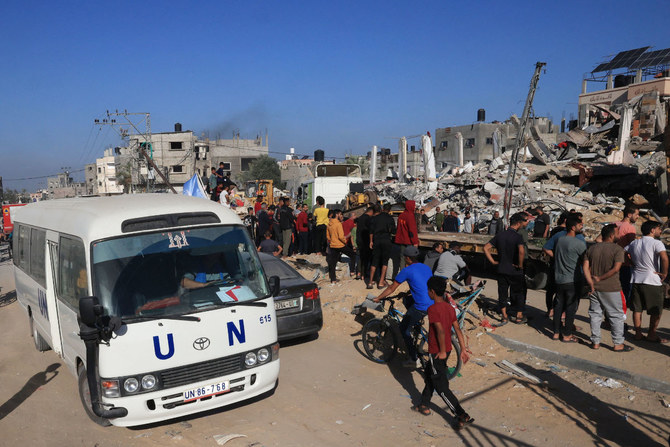

DEIR AL-BALAH, Gaza Strip: Prime Minister Benjamin Netanyahu pushed back Saturday against growing international calls for a ceasefire, saying Israel’s battle to crush Gaza’s ruling Hamas militants will continue with “full force.”
A ceasefire would be possible only if all 239 hostages held by militants in Gaza are released, Netanyahu said in a televised address.
The Israeli leader also insisted that after the war, now entering its sixth week, Gaza would be demilitarized and Israel would retain security control there. Asked what he meant by security control, Netanyahu said Israeli forces must be able to enter Gaza freely to hunt down militants.
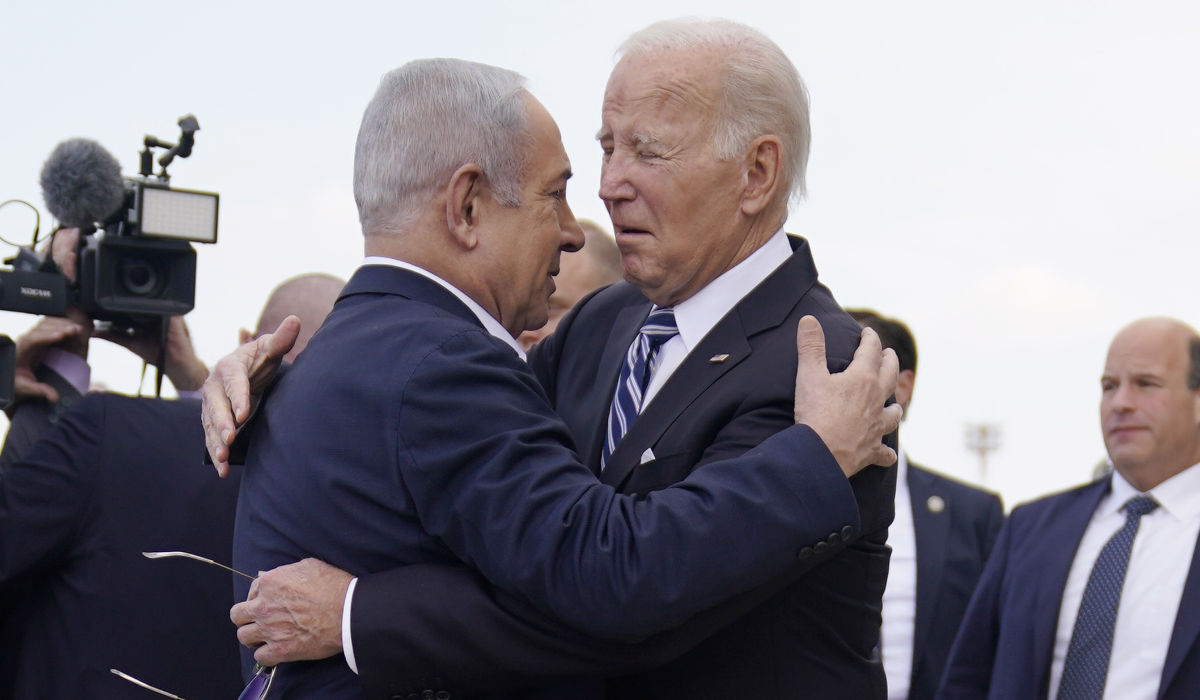
President Joe Biden is greeted by Israeli Prime Minister Benjamin Netanyahu after arriving at Ben Gurion International Airport, Oct. 18, 2023, in Tel Aviv. (AFP)
He also rejected the idea that the Palestinian Authority, which currently administers autonomous areas in the Israeli-occupied West Bank, would at some stage control Gaza. Both positions run counter to post-war scenarios floated by Israel’s closest ally, the United States. Secretary of State Antony Blinken has said the US opposes an Israeli reoccupation of Gaza and envisions a unified Palestinian government in both Gaza and the West Bank at some stage as a step toward Palestinian statehood.
For now, Netanyahu said, “the war against (Hamas) is advancing with full force, and it has one goal, to win. There is no alternative to victory.”
Pressure was growing on Israel after frantic doctors at Gaza’s largest hospital said the last generator had run out of fuel, causing the death of a premature baby, another child in an incubator and four other patients. Thousands of war-wounded, medical staff and displaced civilians were caught in the fighting.
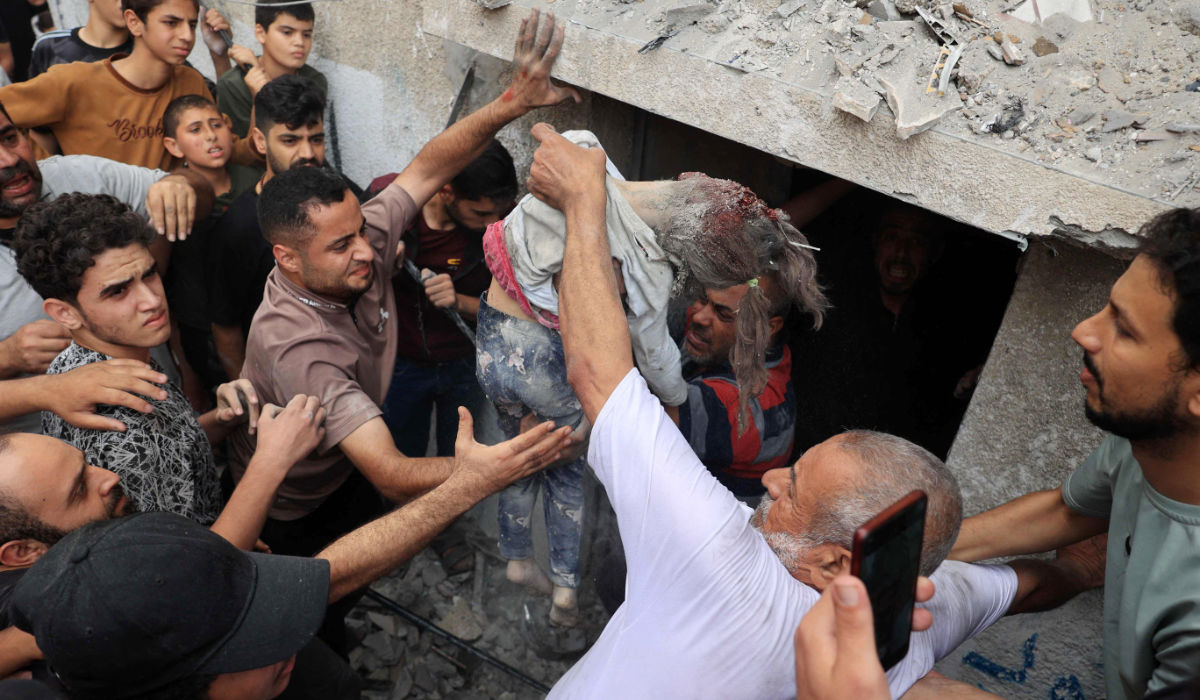
People remove the body of a child killed in Israeli bombing on Rafah in the southern Gaza Strip, on November 11, 2023. (AFP)
In recent days, fighting near Shifa and other hospitals in northern Gaza has intensified and supplies have run out. The Israeli military has alleged, without providing evidence, that Hamas has established command posts in and underneath hospitals, using civilians as human shields. Medical staff at Shifa have denied such claims and accused Israel of harming civilians with indiscriminate attacks.
Shifa hospital director Mohammed Abu Selmia said the facility lost power Saturday.
“Medical devices stopped. Patients, especially those in intensive care, started to die,” he said by phone, with gunfire and explosions in the background. He said Israeli troops were “shooting at anyone outside or inside the hospital” and prevented movement between buildings.
Israel’s military confirmed clashes outside the hospital, but Rear Adm. Daniel Hagari denied Shifa was under siege. He said troops will assist Sunday in moving babies treated there and said “we are speaking directly and regularly” with hospital staff.
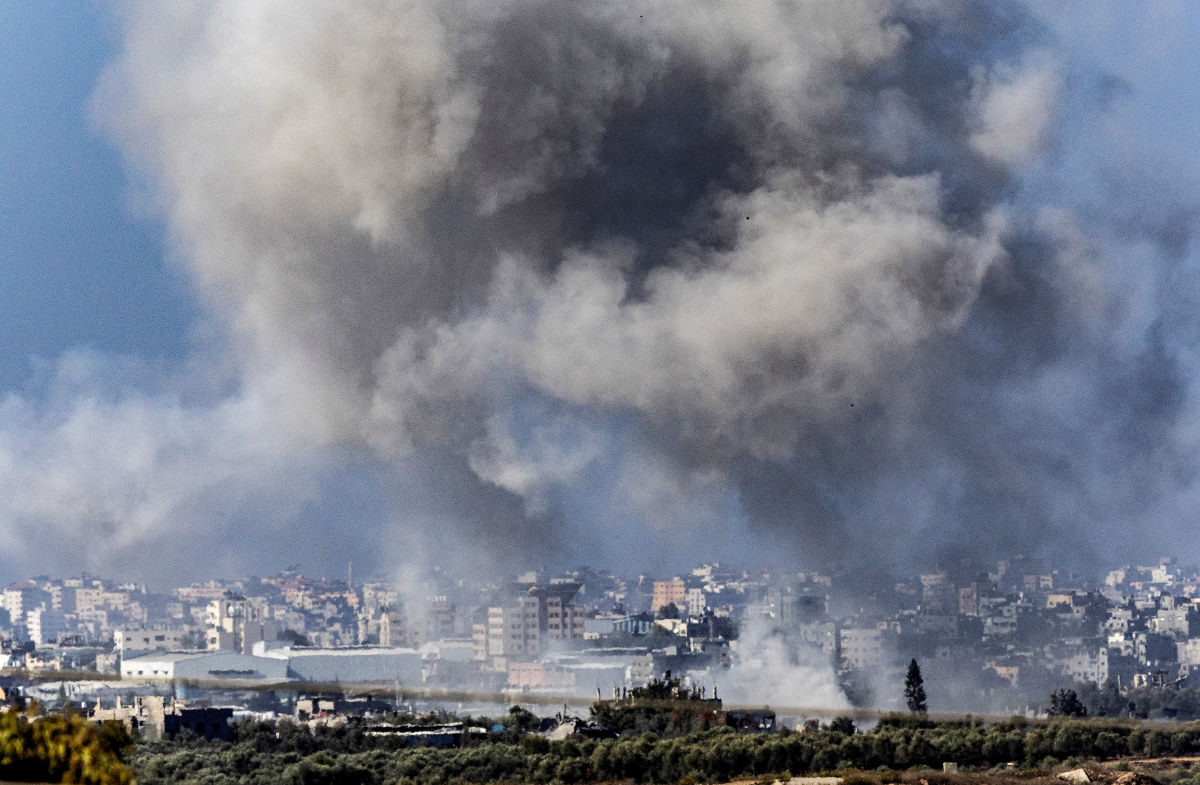
Smoke rises over Gaza as seen from Southern Israel, amid the ongoing conflict between Israel and Palestinian group Hamas, November 10, 2023. (REUTERS)
Amos Yadlin, a former head of Israeli military intelligence, told broadcaster Channel 12 that as Israel aims to crush Hamas, taking control of the hospitals would be key but require “a lot of tactical creativity,” without hurting patients, other civilians and Israeli hostages.
Six patients died at Shifa after the generator shut down, including the two children, spokesmen with the Hamas-run Health Ministry said.
The “unbearably desperate situation” at Shifa must stop now, the International Committee of the Red Cross director general, Robert Mardini, said on social media. UN humanitarian chief Martin Griffiths posted that “there can be no justification for acts of war in health care facilities.”
Elsewhere, the Palestinian Red Crescent said Israeli tanks were 20 meters (65 feet) from Al-Quds hospital in Gaza City, causing “a state of extreme panic and fear” among the 14,000 displaced people sheltering there.
Israel’s military released footage which it said showed tanks operating in Gaza. The images showed shattered buildings, some on fire, and destroyed streets empty of anyone but troops.
A 57-nation gathering of Muslim and Arab leaders in Saudi Arabia called in their communique for an end to the war in Gaza and the immediate delivery of humanitarian aid. They also called on the International Court of Justice, a UN organ, to open an investigation into Israel’s attacks, saying the war “cannot be called self-defense and cannot be justified under any means.”
Netanyahu has said the responsibility for any harm to civilians lies with Hamas, which denied it was preventing people in Gaza City from fleeing.
The spokesman of the Hamas military wing said militants were ambushing Israeli troops and vowed that Israel will face a long battle. The Qassam Brigades spokesman, who goes by Abu Obaida, acknowledged in audio aired on Al-Jazeera that the fight is disproportionate “but it is terrifying the strongest force in the region.”
Israel’s military has said soldiers have encountered hundreds of Hamas fighters in underground facilities, schools, mosques and clinics during the fighting. Israel has said a key goal of the war is to crush Hamas, which has ruled Gaza for 16 years.
Following Hamas’ deadly Oct. 7 attack on Israel, in which at least 1,200 people were killed, Israel’s allies have defended the country’s right to protect itself. But now into the second month of war, there are growing differences over how Israel should conduct its fight.
The US has pushed for temporary pauses that would allow for wider distribution of badly needed aid to civilians in the besieged territory where conditions are increasingly dire. However, Israel has only agreed to brief daily periods during which civilians can flee the area of ground combat in northern Gaza and head south on foot along the territory’s main north-south artery.
Since these evacuation windows were first announced a week ago, more than 150,000 civilians have fled the north, according to UN monitors. On Saturday, the military announced a new evacuation window, saying civilians could use the central road and a coastal road.
A stream of people fled southward on the main road, some on donkey-drawn carts. One man pushed two children in a wheelbarrow.
“Where to go, and what do they want from us?” said Yehia Al-Kafarnah, one fleeing resident.
Palestinian civilians and rights advocates have pushed back against Israel’s portrayal of the southern evacuation zones as “relatively safe.” They note that Israeli bombardment has continued across Gaza, including airstrikes in the south that Israel says target Hamas leaders but that have also killed women and children.
Demonstrations and outrage continued. Police said 300,000 Palestinian supporters marched peacefully in London, the largest such event there since the war started. Right-wing counterprotesters clashed with police.
FEAR GROWS INSIDE SHIFA
“Shelling and explosions never stopped,” said Islam Mattar, one of thousands sheltering at Shifa. “Children here are terrified from the constant sound of explosions.”
The Health Ministry told Al Jazeera there were still 1,500 patients at Shifa, along with 1,500 medical personnel and between 15,000 and 20,000 people seeking shelter.
Thousands have fled Shifa and other hospitals that have come under attack, but physicians said it’s impossible for everyone to get out.
“We cannot evacuate ourselves and (leave) these people inside,” a Doctors Without Borders surgeon at Shifa, Mohammed Obeid, was quoted as saying by the organization.
CASUALTIES RISE
More than 11,070 Palestinians, two-thirds of them women and minors, have been killed since the war began, according to the Health Ministry in Gaza, which does not differentiate between civilian and militant deaths. About 2,700 people have been reported missing and are thought to be possibly trapped or dead under the rubble.
At least 1,200 people have been killed in Israel, mainly in the initial Hamas attack, Israeli officials say. The military on Saturday confirmed the deaths of five reserve soldiers; 46 Israeli soldiers have been killed in Gaza since the ground offensive began.
Nearly 240 people abducted by Hamas from Israel remain captive.
About 250,000 Israelis have been forced to evacuate from communities near Gaza and along the northern border with Lebanon, where Israeli forces and Hezbollah militants have traded fire repeatedly.
“Hezbollah is dragging Lebanon into a possible war,” Israeli Defense Minister Yoav Gallant said after meeting with soldiers stationed along the border.


