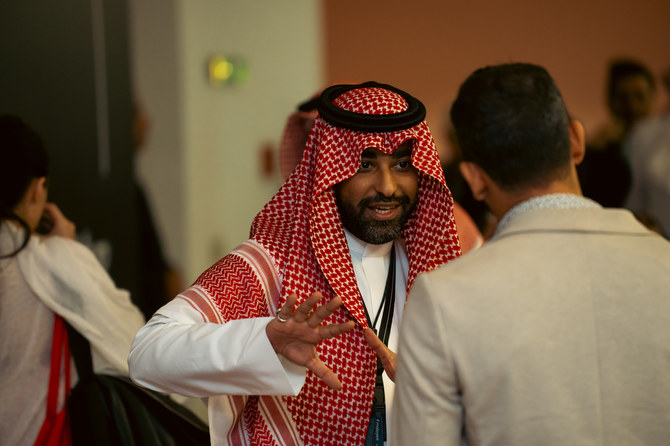
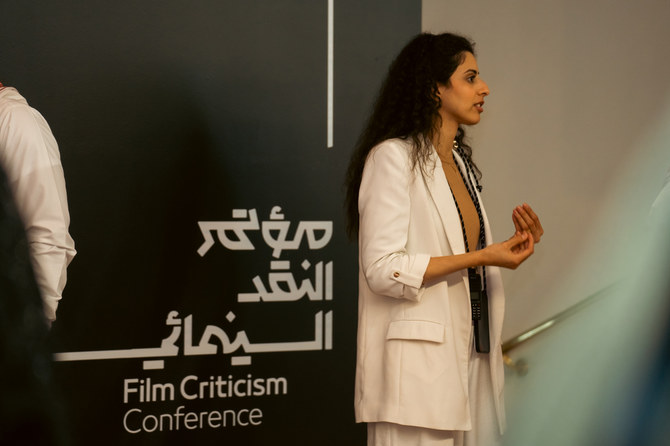
RIYADH: Filmmakers and cinema enthusiasts gathered at the Cultural Palace on Thursday night for the official opening of the Film Criticism Conference, organized by the Saudi Film Commission.
The event began with a talk by Egyptian filmmaker Yousry Nasrallah, followed by a screening of his 1996 documentary “On Boys, Girls and the Veil” and a Q&A session.
Opening the event, Film Commission CEO Abdullah Al-Ayyaf said: “We need, today more than ever, a criticism movement that parallels the development of cinema, one that raises the audience’s awareness from one end and supports filmmakers and enables them to envision their works from a different perspective on the other.
“In a time when film criticism is declining in the Arab region and abroad, the need arose to initiate this conference and its forums to create balance and find a place that embraces the film scene, its ideologies and art forms, through deconstruction, analysis and comparison.”
While the official opening took place on Thursday, the conference got underway on Tuesday with the screening of several regional and international films at the Muvi Cinema on the U Walk strip.
On Thursday night, visitors were treated to an open-air screening of the Norwegian-Belgian animated film “Titina” in Kindi Square.
As well as the screenings, the conference will feature masterclasses and talks by filmmakers and industry experts from around the world. Among the topics up for discussion are the ethical dilemmas involved in documentary-making and the importance of criticism in the age of social media.
The event is accompanied by art film installations, including French artist Jean-Luc Godard’s “The Image Book,” Laia Cabrera and Isabelle Duverger’s “Dream-e-scape” and Kuwaiti Haya Alghanim’s “Two Captains Sink the Ship.”
Other activities, including workshops, are designed to appeal to younger audiences.
Saudi director and producer Majeed Saud told Arab News: “I think criticism is one of the pillars of cinema and without it the industry would be at a standstill.
“This conference is such a positive step that’s beneficial to any filmmaker and also in developing the Saudi cinema through criticism.”
Saudi director Khalid Fahad, whose film “Valley Road” is among those being screened, told Arab News that the conference was vital in developing an environment for film criticism.
“The most we have in Saudi are viewers and reviewers. We don’t have true critics,” he said.
“So, this is a mark of new beginnings for filmmakers to broaden their horizons and begin to understand. I think many people are interested in criticism or have that capability but haven’t explored it yet, so these conferences will hold a spotlight on them and help them find themselves.”
The conference runs until Tuesday.


![]()
![]()
![]()
![]()

The art of analysis: Film Criticism Conference opens in Riyadh


Short Url
https://arab.news/ycjw2
The art of analysis: Film Criticism Conference opens in Riyadh
- Event aims to ‘embrace film … through deconstruction, analysis and comparison,’ organizer says
- Weeklong conference features screenings, workshops, discussions


Latest updates


© 2026 SAUDI RESEARCH & PUBLISHING COMPANY, All Rights Reserved And subject to Terms of Use Agreement.