Health Ministry in Hamas-run Gaza says Palestinian death toll has passed 11,000

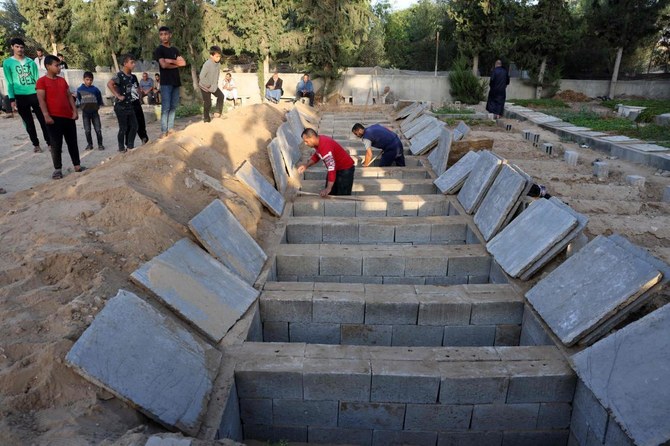
People build a cemetary in Rafah in the southern Gaza Strip on November 10, 2023. (AFP)
Short Url
Updated 10 November 2023
Follow

Health Ministry in Hamas-run Gaza says Palestinian death toll has passed 11,000

  • The ministry said Friday that 11,078 people had been killed since hostilities began
  • 21 hospitals had gone out of service and 47 health centers were out of services

KHAN YOUNIS, Gaza Strip: The Health Ministry in Hamas-run Gaza says the Palestinian death toll in the war has surpassed 11,000 people.
The ministry said Friday that 11,078 people had been killed since hostilities began Oct. 7 when Hamas launched a surprise attack on Israel.
The deaths include 4,506 children, the ministry’s statement said, adding that 21 hospitals had gone out of service and 47 health centers were out of services.
More than 1,400 people have been killed in Israel, primarily in the initial Hamas attack, and 41 Israeli soldiers have been killed in Gaza since the ground offensive began.
Meanwhile, thousands of Palestinians streamed onto Gaza’s only highway Friday, fleeing the combat zone in the north after Israel announced a window for safe passage and following strikes near hospitals that medical officials blamed on Israel.
Amid an intensifying campaign of airstrikes and ground battles in Gaza City, the search for safety in the besieged enclave has grown increasingly desperate. Tens of thousands have walked south, where they face the prospect of ongoing bombardment and dire conditions. Others have crowded into and around hospitals, sleeping in operating rooms and wards.
Gaza’s largest city is the focus of Israel’s campaign to crush Hamas following its deadly Oct. 7 surprise incursion.
* With AP and Reuters


How talks in Riyadh led to the end of harsh US sanctions on Syria

Updated 42 min 44 sec ago
Follow

How talks in Riyadh led to the end of harsh US sanctions on Syria

  • Congress’ repeal of the Caesar Act caps a Saudi-led diplomatic push to reintegrate a war-weary nation into the global economy
  • The end of tough US sanctions opens the door to foreign investment as Damascus reenters the world stage, analysts say

RIYADH: What began as a Saudi-led push to reengage Syria after the fall of Bashar Assad reached a pivotal moment on Dec. 17 when the US Congress voted to permanently repeal the Caesar Syria Civilian Protection Act of 2019.

The long-awaited step has removed a major obstacle to foreign investment and economic recovery in Syria, analysts say, further easing the nation’s global reintegration after years of international isolation.

“Saudi Arabia believed that bringing Syria back into the Arab fold was the right path forward,” Ghassan Ibrahim, a Syria expert and head of the London-based Global Arab Network, told Arab News.

“To achieve this, it required a strong and clear decision to support Syria. One of the main challenges was lifting sanctions and reconnecting Syria with the US, and Saudi Arabia played a major role in accomplishing that.”

A May 14 meeting in Riyadh between Saudi Crown Prince Mohammed bin Salman, US President Trump and Syrian President Al- Sharaa paved the way for the Caesar Act repeal. (Saudi Royal Palace handout photo/File)

Hani Nasira, a regional political analyst, said the decision stemmed from a meeting in Riyadh in May between Saudi Crown Prince Mohammed bin Salman, US President Donald Trump, and Syria’s interim President Ahmad Al-Sharaa.

“Following this decision, Syria will regain its vitality, and the train of development will return to the country,” Nasira told Arab News.

He said Saudi Arabia has emerged as “the foremost driving force and the most important incubator” of Syria’s return to the international community — a role underscored by Washington’s decision to end its strictest sanction.

Trump signaled that intent at the start of his three-day visit to Saudi Arabia on May 13. “After discussing the situation in Syria with the (Saudi) crown prince, I will be ordering the cessation of sanctions against Syria in order to give them a chance at greatness,” he said.

People gather to mark the first anniversary of Bashar al-Assad's fall, in Aleppo, Syria, on December 8, 2025. (REUTERS)

The following day in Riyadh, Trump met Al-Sharaa — who had led the rebel offensive that toppled Assad on Dec. 8, 2024 — marking the first high-level US-Syria meeting in a quarter of a century.

The meeting represented a dramatic turn for a country still adjusting to life after more than five decades of Assad family rule, and for an interim president who until recently had a $10 million bounty on his head.

“The meeting in Riyadh between the three leaders was carefully arranged and reflected a shared desire and need for cooperation between Syria and Saudi Arabia,” Ibrahim said.

“This cooperation laid the groundwork for a new type of coalition — one aimed at bringing greater stability and prosperity to the region.

“The Saudi, American and Syrian leaderships came together around a common vision; that stability is the pathway to prosperity. This vision aligns with Saudi Arabia’s Vision 2030, and all sides shared similar perspectives and objectives.”

Diplomatic momentum quickly followed. On May 23, US Secretary of State Marco Rubio signed a 180-day waiver of the Caesar Act’s secondary sanctions to facilitate humanitarian aid and early recovery efforts.

Syrian Foreign Minister Asaad Hassan al-Shibani (L) shakes hands with US Secretary of State Marco Rubio at the NEST International Convention Center, in Antalya, Turkiye, on May 15, 2025. (AFP/File)

Nearly a month later, on June 30, Trump issued an executive order terminating the broader US sanctions program on Syria, effective July 1, and instructed the State Department to review whether additional Caesar-mandated sanctions should be suspended.

In November, following Al-Sharaa’s historic visit to the White House — the first Syrian leader to do so — the Caesar Act suspension was temporarily extended for another 180 days before Congress ultimately moved to repeal it.

“When Assad was in power, Syria’s only allies were Iran and Russia,” Ibrahim said. “After his removal, Syria was left with just one uncertain partner: Russia. That made reconnecting with the world essential.

“President Al-Sharaa chose Saudi Arabia as the first gateway to reestablish Syria’s ties with the international community. Saudi Arabia did not hesitate; it supported the new Syria and its new leadership.

“The relationship between the two countries had always existed, but it needed this push to be fully restored.”

First imposed in 2019 during Trump’s first term, the Caesar Act was a cornerstone of US pressure on the former Syrian regime.

Designed to deter foreign entities from doing business with Damascus, the law reportedly exacted a heavy toll on ordinary Syrians already suffering through a civil war that began in 2011.

Although the act formally expired in December last year under its five-year sunset clause, Congress renewed it through the 2025 National Defense Authorization Act, extending its reach into 2029 before reversing course months later.

Assad fled to Russia on Dec. 8, 2024, after Al-Sharaa’s Hayat Tahrir Al-Sham seized Damascus. In the months that followed, and amid appeals from Saudi Arabia and other regional powers, the Trump administration reassessed its Syria policy.

Beyond the symbolic importance of repealing the Caesar Act, Nasira said it will facilitate the release of Syrian assets held abroad, estimated at about $400 million, providing critical funding for economic reforms.

The World Bank estimates that reconstruction will cost between $140 billion and $345 billion, with a “best estimate” of $216 billion — nearly 10 times Syria’s 2024 gross domestic product of $21.4 billion.

In July, Damascus hosted its first Syrian-Saudi Investment Forum, producing more than 40 preliminary agreements worth about $6 billion across sectors including infrastructure, telecoms, tourism and health care.

That same month, Syria signed an $800 million agreement with Dubai Ports World to upgrade port infrastructure.

In August, it reached additional energy deals with Saudi Arabia, while a separate $7 billion energy project involving Turkish, Qatari and US firms promises to boost electricity supply.

Even so, sanctions relief alone, while “necessary,” is “far from sufficient,” said Vittorio Maresca di Serracapriola, lead sanctions expert at Karam Shaar Advisory

“For international capital to enter Syria at scale, deeper conditions must be met; meaningful banking sector reform, upgraded anti-money laundering and combating the financing of terrorism standards, and above all, political and security stability,” he said. 

Nevertheless, Ibrahim believes the repeal of the Caesar Act will allow Syria to “move to the next phase; reconstructing the country and ensuring there is no vacuum of authority or power.”

“It gives Syria a real opportunity,” he said. “The next step is strengthening the new leadership, deepening cooperation, attracting investment and restoring Syria as a normal member of the international community.”

Al-Sharaa echoed that message in his first post on X following the repeal, congratulating Syrians and thanking those who helped lift the sanctions.

“Through the will of the Syrians and the support of brothers and friends, a page of suffering has been turned, and a new phase of reconstruction has begun,” he said.

“Hand in hand, we move forward toward a future worthy of our people and our homeland.”